
![[Shri Krishna]](https://krishnasmercy.files.wordpress.com/2020/05/img_0081.jpg?w=119&h=124) “Peacefulness, self-control, austerity, purity, tolerance, honesty, wisdom, knowledge, and religiousness—these are the qualities by which the brahmanas work.” (Lord Krishna, Bhagavad-gita, 18.42)
“Peacefulness, self-control, austerity, purity, tolerance, honesty, wisdom, knowledge, and religiousness—these are the qualities by which the brahmanas work.” (Lord Krishna, Bhagavad-gita, 18.42)
Download this episode (right click and save)
शमो दमस् तपः शौचं
क्षान्तिर् आर्जवम् एव च
ज्ञानं विज्ञानम् आस्तिक्यं
ब्रह्म-कर्म स्वभाव-जम्
śamo damas tapaḥ śaucaṁ
kṣāntir ārjavam eva ca
jñānaṁ vijñānam āstikyaṁ
brahma-karma svabhāva-jam
1. When will the sun shine again?
“It’s been days. Cloudy. Gloomy. Rain, on and off. No one really wants to go outside during this time. In some parts of the house we leave the lights on from morning until night. Do you realize how ridiculous that sounds?
“I don’t mind the rain. We need it. It is a vital part of life. But what kind of area of the world has rain consecutively for an entire week? That is ridiculous. If I don’t see the sun soon I am going to lose it.”
2. When will they open the restaurants?
“The lockdown has been going on for too long. People are this afraid of catching a virus? That expensive tuition paid to the university obviously did nothing for them. Your average village person realizes that this world is dangerous, that there is always some kind of disease lurking around the corner.
![[restaurant]](https://krishnasmercy.files.wordpress.com/2020/05/image-31.png?w=204&h=162) “But, no, we are forced to stay at home until the authorities tell us it is safe to go out. I don’t think I can last much longer this way. I want to know when the restaurants will be open again for people to sit down in. Just so I can have a change of setting and read a book. I am not asking for much.”
“But, no, we are forced to stay at home until the authorities tell us it is safe to go out. I don’t think I can last much longer this way. I want to know when the restaurants will be open again for people to sit down in. Just so I can have a change of setting and read a book. I am not asking for much.”
3. When will I be able to sleep peacefully?
“In childhood there was no issue. I never remember hearing the term ‘insomnia.’ Probably because it didn’t apply to us. We were more than happy to wake up in the morning and start playing. Go to school? That was a different story, but it had nothing to do with wanting to sleep more.
“Now it seems like every night is a struggle. I know diet and exercise can play a factor, but it is mostly concern on my part. I fear the pressures of the upcoming day. I am worried that I will not have enough rest to function optimally. That concern then becomes a self-fulfilling prophecy. I long for the day when sleep will come easily.”
4. When will I have enough money?
“I realize this concern is not exclusive to me, but I feel as if I am so close to the finish line. Just a little more and I will be able to retire. That would be terrific. Then I could concentrate on the real business of this human life, that activity which gives me more happiness than I could ever imagine.
“Seeing the way things are going in the world, it looks like that dream will never become a reality. Work well into old age. Never leave the responsibilities behind. I see other retired people and I wonder how they did it. It seems impossible to me.”
5. When will the people become wise to their government?
“This shouldn’t bother me, but it does. You could call it political correctness. You could label it as covering one’s rear. I think it is just Administration 101. It is the basics of being in charge of a committee.
“I am saying that these people don’t really have anyone’s best interests at heart. The primary concern of a bureaucracy is to make sure the bureaucracy continues to exist. Thus they keep making predictions that are wrong, but there are no consequences. They are not experts on health in the least, but they continue to act as if they are.
“I just wish other people could see through the farce like I do. It bothers me that people just accept what their government tells them, without questioning. How can they be so foolish? Do they not notice the deceit? Why are they so trusting?”
…
His Divine Grace A.C. Bhaktivedanta Swami Prabhupada recommends advancing to the brahmana stage of living. Not that every person will have the necessary qualifications, but at least a certain class of people should be trained to fulfill this role.
One of the qualities of a brahmana is shama. One English translation is “peacefulness.” The idea is to not be easily agitated. A steady mind. Focused on the bigger picture, the end-goal, instead of getting distracted by issues that are not so relevant in the long-term.
From the review conducted above, we see that there are many sources of distraction. If everything else is going well in life, I could be upset over the outcome of tossing a coin. In other words, I could invent distresses if they should be lacking. Take the trivial and elevate it to vital.
योगिनाम् अपि सर्वेषां
मद्-गतेनान्तर्-आत्मना
श्रद्धावान् भजते यो मां
स मे युक्ततमो मतःyoginām api sarveṣāṁ
mad-gatenāntar-ātmanā
śraddhāvān bhajate yo māṁ
sa me yuktatamo mataḥ“And of all yogis, he who always abides in Me with great faith, worshiping Me in transcendental loving service, is most intimately united with Me in yoga and is the highest of all.” (Lord Krishna, Bhagavad-gita, 6.47)
![[Shri Krishna]](https://krishnasmercy.files.wordpress.com/2020/05/img_0081-1.jpg?w=204&h=213) It is much more difficult to remain free from agitation. Fortunately, there is yoga, and in Bhagavad-gita we learn that the best yogi is the one who always thinks of Krishna, the Supreme Personality of Godhead. This yoga can be established and maintained through chanting the holy names: Hare Krishna Hare Krishna, Krishna Krishna, Hare Hare, Hare Rama Hare Rama, Rama Rama, Hare Hare.
It is much more difficult to remain free from agitation. Fortunately, there is yoga, and in Bhagavad-gita we learn that the best yogi is the one who always thinks of Krishna, the Supreme Personality of Godhead. This yoga can be established and maintained through chanting the holy names: Hare Krishna Hare Krishna, Krishna Krishna, Hare Hare, Hare Rama Hare Rama, Rama Rama, Hare Hare.
In Closing:
Through connection maintained,
Higher state attained.
Where on temporary not dwelling,
Or mind agitation’s quickly swelling.
Since towards Krishna to reach,
Finally finding peace.
This life for yoga is meant,
And in Divine’s company spent.


![[Sita-Rama]](https://krishnasmercy.files.wordpress.com/2020/05/b6n2stw2kkgrhquokjmeyqnrqy9bmwr03jn_3.jpg?w=119&h=137) “Just as a tree starts to blossom during the proper season, so the doer of sinful deeds inevitably reaps the horrible fruit of their actions at the appropriate time.” (Lord Rama speaking to Khara, Valmiki Ramayana, Aranya Kand, 29.8)
“Just as a tree starts to blossom during the proper season, so the doer of sinful deeds inevitably reaps the horrible fruit of their actions at the appropriate time.” (Lord Rama speaking to Khara, Valmiki Ramayana, Aranya Kand, 29.8)![[sofa chair]](https://krishnasmercy.files.wordpress.com/2020/05/image-30.png?w=200&h=201) If you follow the instructions, which would be symbolic of dharma, then the proper outcome is there. A nice chair to sit in, with few issues. If you fall into adharma, karma still applies. The correlation is that if you incorrectly assemble the furniture, you will face the consequence.
If you follow the instructions, which would be symbolic of dharma, then the proper outcome is there. A nice chair to sit in, with few issues. If you fall into adharma, karma still applies. The correlation is that if you incorrectly assemble the furniture, you will face the consequence. ![[Sita-Rama]](https://krishnasmercy.files.wordpress.com/2020/05/b6n2stw2kkgrhquokjmeyqnrqy9bmwr03jn_3-1.jpg?w=204&h=235) When we surrender to Bhagavan in full devotion, our past karma may still affect us, but it is mitigated. The pain of suffering is less, but this is not the primary impetus for accepting the shelter of the Divine, sharanagati. That connection is the true meaning of dharma, and for all the suffering we have endured in the past, we can finally taste eternal happiness.
When we surrender to Bhagavan in full devotion, our past karma may still affect us, but it is mitigated. The pain of suffering is less, but this is not the primary impetus for accepting the shelter of the Divine, sharanagati. That connection is the true meaning of dharma, and for all the suffering we have endured in the past, we can finally taste eternal happiness. ![[Lord Chaitanya]](https://krishnasmercy.files.wordpress.com/2020/05/nimai_nitai_3.jpg?w=119&h=131) “Indeed, Lord Chaitanya Mahaprabhu eagerly tore this page from the Kurma Purana, although the book was very old, and He later showed it to Ramadasa Vipra, whose unhappiness was mitigated.” (Chaitanya Charitamrita, Madhya 1.119)
“Indeed, Lord Chaitanya Mahaprabhu eagerly tore this page from the Kurma Purana, although the book was very old, and He later showed it to Ramadasa Vipra, whose unhappiness was mitigated.” (Chaitanya Charitamrita, Madhya 1.119) ![[Sita-Rama]](https://krishnasmercy.files.wordpress.com/2020/05/devoted-to-rama-cover-300dpi.jpg?w=204&h=177) In one of the more disturbing incidents described in the Ramayana, Sita gets forcibly taken away from Rama by a Rakshasa demon named Ravana. This occurs in secret; despite Ravana’s amazing fighting prowess, he would be no match for Rama in battle.
In one of the more disturbing incidents described in the Ramayana, Sita gets forcibly taken away from Rama by a Rakshasa demon named Ravana. This occurs in secret; despite Ravana’s amazing fighting prowess, he would be no match for Rama in battle. 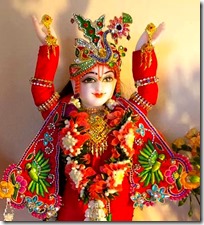 Mahaprabhu’s word was enough. His explanation would calm any doubter, but a saintly person goes to extraordinary lengths to bring the truth to others. It is no surprise, then, that we have the wonderful maha-mantra handed down to us, which brings safety and protection from the dreaded condition of material life:
 ![[Vishnu and Bhrigu]](https://krishnasmercy.files.wordpress.com/2020/05/vishnu_pastimes_bhrigu.jpg?w=119&h=128) “My dear father, O great sage, I know that your feet are very soft, like a lotus flower, and that My chest is as hard as a thunderbolt. I am therefore afraid that you may have felt some pain by touching My chest with your feet. Let Me therefore touch your feet to relieve the pain you have suffered.” (Lord Vishnu,
“My dear father, O great sage, I know that your feet are very soft, like a lotus flower, and that My chest is as hard as a thunderbolt. I am therefore afraid that you may have felt some pain by touching My chest with your feet. Let Me therefore touch your feet to relieve the pain you have suffered.” (Lord Vishnu, ![[argument]](https://krishnasmercy.files.wordpress.com/2020/05/image-29.png?w=200&h=197) “An advanced state of living should carry less disagreement. People living in harmony. Supporting one another. Empathy for the various struggles. Volunteerism to offer assistance. Instead, it seems everyone in your community is out for themselves. Earn as much as they can right now, not concerned with the afterlife.”
“An advanced state of living should carry less disagreement. People living in harmony. Supporting one another. Empathy for the various struggles. Volunteerism to offer assistance. Instead, it seems everyone in your community is out for themselves. Earn as much as they can right now, not concerned with the afterlife.” ![[Vishnu and Bhrigu]](https://krishnasmercy.files.wordpress.com/2020/05/vishnu_pastimes_bhrigu-1.jpg?w=204&h=219) That is the underlying cause for the widespread poverty, but there is the additional reason rooted in behavior and attitude. Devotees of Vishnu do not require much. They tend to live simply, and they tolerate the different life conditions. Asceticism rooted in their devotion is their wealth. This is more valuable than any floating balance based in an easily manipulated currency printed by modern governments already under a large mountain of debt.
That is the underlying cause for the widespread poverty, but there is the additional reason rooted in behavior and attitude. Devotees of Vishnu do not require much. They tend to live simply, and they tolerate the different life conditions. Asceticism rooted in their devotion is their wealth. This is more valuable than any floating balance based in an easily manipulated currency printed by modern governments already under a large mountain of debt. ![[Shri Hanuman]](https://krishnasmercy.files.wordpress.com/2020/05/b4onmpgb2kkgrhquokm4e67l3dgbbmpdmecpqw_3.jpg?w=119&h=151) “Whom are you lamenting for when you yourself are pitiable? Why do you pity the poor when you yourself have now been made poor? While in this body that is like a bubble, how can anyone look at anyone else as being worthy of lamentation?” (Hanuman speaking to Tara, Valmiki Ramayana, Kishkindha Kand, 21.3)
“Whom are you lamenting for when you yourself are pitiable? Why do you pity the poor when you yourself have now been made poor? While in this body that is like a bubble, how can anyone look at anyone else as being worthy of lamentation?” (Hanuman speaking to Tara, Valmiki Ramayana, Kishkindha Kand, 21.3)![[Sugriva and Vali fighting]](https://krishnasmercy.files.wordpress.com/2020/05/0191.jpg?w=204&h=203) Hanuman showed his intelligence by rhetorically asking why Tara was lamenting. The idea is that every person is actually equal. We consider this person to be poor and that one to be wealthy, but these are just temporary situations.
Hanuman showed his intelligence by rhetorically asking why Tara was lamenting. The idea is that every person is actually equal. We consider this person to be poor and that one to be wealthy, but these are just temporary situations. ![[Shri Hanuman]](https://krishnasmercy.files.wordpress.com/2020/05/b4onmpgb2kkgrhquokm4e67l3dgbbmpdmecpqw_3-1.jpg?w=204&h=260) Hanuman can fly like the wind via the aerial route across the vast ocean to reach Lanka. He swiftly finds the mountain area to search for a healing herb to bring back to Lakshmana. He wastes no time in bringing back the entire mountain so as to avoid any mistakes.
Hanuman can fly like the wind via the aerial route across the vast ocean to reach Lanka. He swiftly finds the mountain area to search for a healing herb to bring back to Lakshmana. He wastes no time in bringing back the entire mountain so as to avoid any mistakes. ![[Radha-Krishna]](https://krishnasmercy.files.wordpress.com/2020/05/radhakrishna2.jpg?w=119&h=117) “But ignorant and faithless persons who doubt the revealed scriptures do not attain God consciousness. For the doubting soul there is happiness neither in this world nor in the next.” (Lord Krishna, Bhagavad-gita, 4.40)
“But ignorant and faithless persons who doubt the revealed scriptures do not attain God consciousness. For the doubting soul there is happiness neither in this world nor in the next.” (Lord Krishna, Bhagavad-gita, 4.40)![[database caching]](https://krishnasmercy.files.wordpress.com/2020/05/image-28.png?w=300&h=192) With the empirical evidence route, we would have to be able to recall anything at a moment’s notice. Take the data, both large and small, and make sense of it. Then we could begin to put the pieces together, to show that the person claiming to be God, to be Divine, is actually so.
With the empirical evidence route, we would have to be able to recall anything at a moment’s notice. Take the data, both large and small, and make sense of it. Then we could begin to put the pieces together, to show that the person claiming to be God, to be Divine, is actually so. ![[Radha-Krishna]](https://krishnasmercy.files.wordpress.com/2020/05/radhakrishna2-1.jpg?w=304&h=298) Fortunately, both jnana and vijnana are accounted for in the bhakti process. Simply hear from the right source and you will know. Stay connected to the holy names and achieve a level of certainty that surpasses what physical perception could ever bring:
Fortunately, both jnana and vijnana are accounted for in the bhakti process. Simply hear from the right source and you will know. Stay connected to the holy names and achieve a level of certainty that surpasses what physical perception could ever bring: ![[Shri Hanuman]](https://krishnasmercy.files.wordpress.com/2020/05/rama_darbar1-2.jpg?w=119&h=165) “Whom are you lamenting for when you yourself are pitiable? Why do you pity the poor when you yourself have now been made poor? While in this body that is like a bubble, how can anyone look at anyone else as being worthy of lamentation?” (Hanuman speaking to Tara, Valmiki Ramayana, Kishkindha Kand, 21.3)
“Whom are you lamenting for when you yourself are pitiable? Why do you pity the poor when you yourself have now been made poor? While in this body that is like a bubble, how can anyone look at anyone else as being worthy of lamentation?” (Hanuman speaking to Tara, Valmiki Ramayana, Kishkindha Kand, 21.3)![[Arjuna]](https://krishnasmercy.files.wordpress.com/2020/05/bg_cartoon1.jpg?w=204&h=291) Friend2: How can you say that? If I’m trying to lose weight, sugar is bad for me. If I’m training for an upcoming marathon, proper rest the night before is good for me. I doubt anyone would challenge these assertions.
Friend2: How can you say that? If I’m trying to lose weight, sugar is bad for me. If I’m training for an upcoming marathon, proper rest the night before is good for me. I doubt anyone would challenge these assertions. ![[Shri Hanuman]](https://krishnasmercy.files.wordpress.com/2020/05/rama_darbar1-3.jpg?w=204&h=284) Friend2: Which means that rich and poor are also relative circumstances. We should always feel distress upon seeing others in difficulty. This is the impetus for the saints of the Vedic tradition to travel from place to place and describe the glories of the Supreme Personality of Godhead. They know dharma is the way to happiness for every person. Dharma is sanatana, and so it is eternally the way for every person to live.
Friend2: Which means that rich and poor are also relative circumstances. We should always feel distress upon seeing others in difficulty. This is the impetus for the saints of the Vedic tradition to travel from place to place and describe the glories of the Supreme Personality of Godhead. They know dharma is the way to happiness for every person. Dharma is sanatana, and so it is eternally the way for every person to live.