
![[Narasimha]](https://krishnasmercy.files.wordpress.com/2019/04/cimg0112.jpg?w=119&h=148) “Indignant and angry, his reddish eyes like molten copper, Hiranyakashipu said to his servants: O demons, take this boy away from me! He deserves to be killed. Kill him as soon as possible!” (Shrimad Bhagavatam, 7.5.34)
“Indignant and angry, his reddish eyes like molten copper, Hiranyakashipu said to his servants: O demons, take this boy away from me! He deserves to be killed. Kill him as soon as possible!” (Shrimad Bhagavatam, 7.5.34)
Download this episode (right click and save)
आहामर्ष-रुषाविष्टः
कषायी-भूत-लोचनः
वध्यताम् आश्व् अयं वध्यो
निःसारयत नैरृताः
āhāmarṣa-ruṣāviṣṭaḥ
kaṣāyī-bhūta-locanaḥ
vadhyatām āśv ayaṁ vadhyo
niḥsārayata nairṛtāḥ
It seems like a rather innocent decision. Not that you are aiming at perfection at the outset. The finish line is way in the distance, perhaps not even attainable. This is your analysis at present, anyway. Nevertheless, you accept the promise from Shri Krishna that a little effort along the path goes a long way.
नेहाभिक्रम-नाशो ऽस्ति
प्रत्यवायो न विद्यते
स्व्-अल्पम् अप्य् अस्य धर्मस्य
त्रायते महतो भयात्nehābhikrama-nāśo 'sti
pratyavāyo na vidyate
sv-alpam apy asya dharmasya
trāyate mahato bhayāt“In this endeavor there is no loss or diminution, and a little advancement on this path can protect one from the most dangerous type of fear.” (Lord Krishna, Bhagavad-gita, 2.40)
Prior to making this turn, for a while little questions here and there were starting to prop up. You were no longer accepting everything blindly, following along just because everyone else was in the same mindset. You knew that life had to have something more. There must be a purpose for being put on this earth. It can’t be to simply enjoy the senses, as the animals already fall into that category.
They have no choice, but the human beings are rational. They can use that enhanced thinking ability to make excuses for procrastinating from the real objective, but you would rather not wait any longer. As Goswami Tulsidas says, correct the many mistakes from the past, including prior births, today, right now.
बिगरी जनम अनेक की सुधरै अबहीं आजु |
होहि राम को नाम जपु तुलसी तजि कुसमाजु ||bigarī janama aneka kī sudharai abahīṃ āju |
hohi rāma ko nāma japu tulasī taji kusamāju ||“The many past births you spoiled can be rectified right now, today, if you start chanting Shri Rama’s holy name and renounce bad association, says Tulsi.” (Dohavali, 22)
The issue is that most people don’t live in isolation. If they implement drastic changes to lifestyle, such as giving up meat and alcohol consumption, always chanting a specific mantra and so forth, others are sure to notice. The close family members can react in different ways.
1. “That’s cool”
In this case they are accepting. They may not understand what you are doing. The many previous generations in the family ate meat. They never considered a vegetarian diet. They were not concerned with killing innocent animals. Every new generation simply followed tradition. There was no challenge.
The family accepts your decision, but they think it is more or less a phase. You will eventually grow out of it. After all, it is not affecting them. Maybe one or two friends will take an interest down the road, but for now you are left alone.
2. Worried
In this case the family members have grave concerns. At a young age, you should be interested in advancing materially. Getting a better job. Perhaps further education to earn more prestige which translates to a higher salary. Marriage. Children.
The last thing that should be on your mind is life and death. Why give up so quickly? Renunciation is for the end of life. Right now is the time to enjoy. They try to talk you out of it.
“Try religion at a later point in life. I am religious, too, you know, but you don’t see me doing anything crazy. There has to be a balance to things. You go to the extreme today and tomorrow you will regret the time missed experiencing what is out there.”
3. Order violence
![[Sita-Rama]](https://krishnasmercy.files.wordpress.com/2019/04/sitarama.jpg?w=200&h=194) You can handle either of the two previous cases. It’s understandable for friends and family members to be worried. Shri Rama describes that a person only offers such instruction when there is love and affection in the relationship.
You can handle either of the two previous cases. It’s understandable for friends and family members to be worried. Shri Rama describes that a person only offers such instruction when there is love and affection in the relationship.
मम स्नेहाच्च सौहार्दादिदमुक्तंत्वयाऽनघे
परितुष्टोऽस्म्यहं सीते न ह्यनिष्टोऽनुशिष्यतेmama snehācca sauhārdādidamuktaṃtvayā'naghe
parituṣṭo'smyahaṃ sīte na hyaniṣṭo'nuśiṣyate“Certainly all these words were spoken by you due to your kind-heartedness and affection for Me. I am very pleased with you, O Sita, for indeed one does not offer instructions and advice to another without caring for them.” (Lord Rama speaking to Sita Devi, Valmiki Ramayana, Aranya Kand, 10.20)
What if the opposition went to the extreme? Forget trying to change your mind, they wanted your life ended, and immediately at that. Prahlada Maharaja faced that very danger. Hiranyakashipu tried to show affection in the beginning. Tears streamed from his eyes when he one time saw the five-year old son offering obeisance. This was after the relationship had turned rocky.
Prahlada insisted on the science of self-realization. He did not keep the preference to himself. When asked about the most important subjects taught in school, Prahlada replied with devotion to Vishnu. He explained that the real self-interest of the individual is to go towards the personal side of God. Material life, otherwise, is an embarrassing situation.
The father was the greatest materialist, so he did not like being insulted. More offensive was the praise of Vishnu, who was considered an enemy to the kingdom. Hiranyakashipu could no longer tolerate. The supposedly innocent choice of devotion to a higher being was considered a crime.
![[Narasimha]](https://krishnasmercy.files.wordpress.com/2019/04/cimg0112-1.jpg?w=204&h=254) There is always this danger. The material world is not very conducive to spiritual life, but fortunately in this age the connection in yoga can be created and maintained through the maha-mantra: Hare Krishna Hare Krishna, Krishna Krishna, Hare Hare, Hare Rama Hare Rama, Rama Rama, Hare Hare. Prahlada stayed with that name, and the unbroken meditation saved him. The devotion thrived, whereas Hiranyakashipu and his attacks did not survive for long.
There is always this danger. The material world is not very conducive to spiritual life, but fortunately in this age the connection in yoga can be created and maintained through the maha-mantra: Hare Krishna Hare Krishna, Krishna Krishna, Hare Hare, Hare Rama Hare Rama, Rama Rama, Hare Hare. Prahlada stayed with that name, and the unbroken meditation saved him. The devotion thrived, whereas Hiranyakashipu and his attacks did not survive for long.
In Closing:
In fixed meditation strong,
So attacks not lasting long.
Since eventually time to heal,
And wrath of Narasimha to feel.
This way when choice making,
That impetus for devotion taking.
Others not always to accept,
But Lord’s shelter can expect.


![[Shri Krishna]](https://krishnasmercy.files.wordpress.com/2019/04/15-julyd.jpg?w=119&h=120) “Abandon all varieties of religion and just surrender unto Me. I shall deliver you from all sinful reaction. Do not fear.” (Lord Krishna, Bhagavad-gita, 18.66)
“Abandon all varieties of religion and just surrender unto Me. I shall deliver you from all sinful reaction. Do not fear.” (Lord Krishna, Bhagavad-gita, 18.66)![[faith]](https://krishnasmercy.files.wordpress.com/2019/04/image.png?w=200&h=208) Friend1: I don’t know. I’ve heard different explanations. One is that the higher authorities involved in a specific faith give every person a chance at some point.
Friend1: I don’t know. I’ve heard different explanations. One is that the higher authorities involved in a specific faith give every person a chance at some point.  Friend2: There can only be one God. There is only one real religion. Perhaps it is explained in different ways based on time and circumstance, but the individual is always separate from the temporary conditions of the material world. He is always spirit soul, part and parcel of God. Connecting with Krishna means understanding and enjoying God in His complete feature. It means experiencing the best kind of life in liberation. The promise is not for scaring anyone; it is for alleviating concerns related to abiding by this rule and that. It is for removing doubts.
 ![[Prahlada thrown off cliff]](https://krishnasmercy.files.wordpress.com/2019/04/jsng.jpg?w=119&h=141) “Hiranyakashipu could not kill his son by throwing him beneath the feet of big elephants, throwing him among huge, fearful snakes, employing destructive spells, hurling him from the top of a hill, conjuring up illusory tricks, administering poison, starving him, exposing him to severe cold, winds, fire and water, or throwing heavy stones to crush him. When Hiranyakashipu found that he could not in any way harm Prahlada, who was completely sinless, he was in great anxiety about what to do next.” (Shrimad Bhagavatam, 7.5.43-44)
“Hiranyakashipu could not kill his son by throwing him beneath the feet of big elephants, throwing him among huge, fearful snakes, employing destructive spells, hurling him from the top of a hill, conjuring up illusory tricks, administering poison, starving him, exposing him to severe cold, winds, fire and water, or throwing heavy stones to crush him. When Hiranyakashipu found that he could not in any way harm Prahlada, who was completely sinless, he was in great anxiety about what to do next.” (Shrimad Bhagavatam, 7.5.43-44)![[Prahlada thrown off cliff]](https://krishnasmercy.files.wordpress.com/2019/04/jsng-1.jpg?w=204&h=243) A struggling parent may have this urge every now and then when dealing with a child who won’t stop crying, but only a crazy person carries through. Hiranyakashipu had every intent from the beginning. It was a premeditated attack, and also one that failed.
A struggling parent may have this urge every now and then when dealing with a child who won’t stop crying, but only a crazy person carries through. Hiranyakashipu had every intent from the beginning. It was a premeditated attack, and also one that failed. ![[Narasimha]](https://krishnasmercy.files.wordpress.com/2019/04/nrsimha4.jpg?w=204&h=259) From the broad spectrum of weapons employed we see that Hiranyakashipu left no stone unturned (no pun intended). Amazingly, it would take just the nails on a lion-like figure to do away with the father. The same strength that was protecting Prahlada the entire time manifest in an amazing half-man/half-lion creature. This was the same Vishnu worshiped by the son and hated by the father.
From the broad spectrum of weapons employed we see that Hiranyakashipu left no stone unturned (no pun intended). Amazingly, it would take just the nails on a lion-like figure to do away with the father. The same strength that was protecting Prahlada the entire time manifest in an amazing half-man/half-lion creature. This was the same Vishnu worshiped by the son and hated by the father. ![[Draupadi_Sari]](https://krishnasmercy.files.wordpress.com/2019/03/draupadi_sari.jpg?w=119&h=161) “Once Bhima was administered poison in a cake, once they were put into the house made of shellac and set afire, and once Draupadi was dragged out, and attempts were made to insult her by stripping her naked in the vicious assembly of the Kurus. The Lord saved Draupadi by supplying an immeasurable length of cloth, and Duryodhana's party failed to see her naked.” (Shrila Prabhupada, Shrimad Bhagavatam, 1.8.24 Purport)
“Once Bhima was administered poison in a cake, once they were put into the house made of shellac and set afire, and once Draupadi was dragged out, and attempts were made to insult her by stripping her naked in the vicious assembly of the Kurus. The Lord saved Draupadi by supplying an immeasurable length of cloth, and Duryodhana's party failed to see her naked.” (Shrila Prabhupada, Shrimad Bhagavatam, 1.8.24 Purport)![[Krishna_swallowing_fire]](https://krishnasmercy.files.wordpress.com/2019/03/krishna_swallowing_fire.jpg?w=204&h=233) The residents of that farm community were not aware that their life and soul was actually Hari Himself. Shri Krishna chose to descend to earth and live in that specific land because of the good qualities in the people. Dangerous moments were only temporary in nature and lacked any real potential to harm. Something like a snake without fangs, the fire was no match for the mouth of Krishna, who saved His friends by devouring the blaze.
The residents of that farm community were not aware that their life and soul was actually Hari Himself. Shri Krishna chose to descend to earth and live in that specific land because of the good qualities in the people. Dangerous moments were only temporary in nature and lacked any real potential to harm. Something like a snake without fangs, the fire was no match for the mouth of Krishna, who saved His friends by devouring the blaze. ![[Draupadi_Sari]](https://krishnasmercy.files.wordpress.com/2019/03/draupadi_sari-1.jpg?w=204&h=277) Having no one else to intervene, Draupadi called out to Krishna. Just like with the forest fire in Vrindavana, He came to save the day. This time He took the form of an unending sari. No matter how much the Kauravas tried, they could not completely remove Draupadi’s sari.
Having no one else to intervene, Draupadi called out to Krishna. Just like with the forest fire in Vrindavana, He came to save the day. This time He took the form of an unending sari. No matter how much the Kauravas tried, they could not completely remove Draupadi’s sari.  “After Prahlada Maharaja had spoken in this way and become silent, Hiranyakashipu, blinded by anger, threw him off his lap and onto the ground.” (Shrimad Bhagavatam, 7.5.33)
 The son turns out to be what is referred to as a nerd. They are interested in science and technology. Video games are more to their liking. Science experiments are fun. Sports? Not so much. No matter how much the father tries, the son just has no interest. They are on the low end of ability, as well. They can’t throw a ball very well. They are slow and clumsy when running. At times the father wonders if this child is actually related to them.
  From that episode we see that though children may not turn out as planned or desired, if they are devotees of the Supreme Personality of Godhead the parents have received the greatest blessing. Even in the case of an antagonistic father like Hiranyakashipu, the end result is still auspicious. Vishnu Himself arrives on the scene to purify.
  “Heroism, power, determination, resourcefulness, courage in battle, generosity, and leadership are the qualities of work for the kshatriyas.” (Lord Krishna, Bhagavad-gita, 18.43)
 Friend1: The night before the due date. Anyway, I was considering the carryover to
 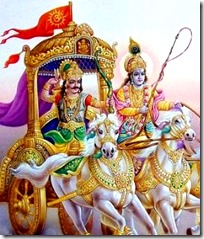 Friend2: If they run into issues, they know where to get help. The connection in yoga guides them along the proper direction. In Vrindavana, the elderly gopis are worried that Shri Krishna will be attacked by asuras sent by Kamsa. They see Krishna taken high into the air by Trinavarta. They see the poisonous snake Kaliya wrapping its hoods around Him. They see the hideous witch named Putana. The people get nervous, but they know towards which direction to turn.
 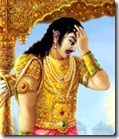 “Sanjaya said: Arjuna, having thus spoken on the battlefield, cast aside his bow and arrows and sat down on the chariot, his mind overwhelmed with grief.” (Bhagavad-gita, 1.46)
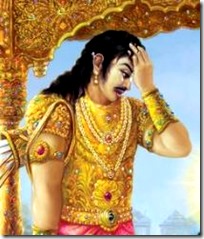 Friend1: Take Arjuna, for example. He didn’t want to fight in the Bharata War. He was a devotee; no denying that. He asked Krishna directly if he could drop his weapons and retreat to the forest or something similar.
 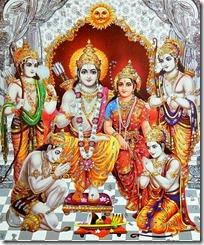 Friend2: Yes. Shri Rama ordered Shatrughna to go take care of a particular bad character named Lavana. From there the younger brother had to administer the kingdom. Not just search and destroy. Make sure there was peace in the aftermath.