
 “Prahlada Maharaja said, agunena ca kankshitena: if one is engaged in the transcendental loving service of the lotus feet of the Lord, he does not need anything in terms of dharma, artha, kama or moksha.” (Shrila Prabhupada, Shrimad Bhagavatam, 7.6.25 Purport)
Download this episode (right click and save)
Friend1: One of the repeating patterns in Vedic literature is the reference to the four rewards.
Friend2: Please explain what those are.
Friend1: Dharma, artha, kama and moksha.
Friend2: Those are the Sanskrit. What is the English equivalent?
Friend1: Dharma is religiosity. Adherence to some higher principles. Guardrails. The root is belief in a higher authority. Artha is interest or profit. Work that will yield a benefit. Behavior that aids in reaching a positive outcome.
Friend2: What about kama and moksha?
Friend1: Kama is material desire or sense gratification. It is nature’s way. Right from the start we are after kama. The animal community knows only kama. Moksha is release. The end to the cycle of birth and death.
Friend2: There is a cycle?
Friend1: Yes. The soul lives on.
Friend2: What is the soul?
Friend1: My identity.
Friend2: Just yours?
Friend1: Yes; for the individual soul, jivatma. The soul is also your identity, but your soul is not the same as mine. Therefore, we are distinct individuals.
Friend2: Are souls limited to the human population?
Friend1: No. From the highest to the lowest. As far up as Lord Brahma, the demigod-creator, and to the lowest depths of the organisms which survive nuclear war.
Friend2: There is soul inside?
Friend1: There has to be. Soul is what provides the animating spark. The four rewards are exclusive to the human birth. There is no such thing as dharma for the animals or plants.
Friend2: Are you sure about that?
Friend1: There is dharma in the sense that the essential characteristic will always remain, as soul can never be separated from its properties. Dharma in the sense of voluntary alignment with higher principles is only possible through a rational choice, and that rational thinking ability is exclusive to the humans.
Friend2: I see.
 Friend1: The reason I bring this up today is because in a verse of the Shrimad Bhagavatam, Prahlada Maharaja mentions how for devotees the four rewards are not that important. Since they are connected in a mood of devotional love to the Supreme Personality of Godhead, they do not require anything.
Friend2: Neither do they seek those rewards.
Friend1: Okay, but if the four are important enough to receive mention in many places in sacred texts, why does someone exalted like Prahlada downplay them?
Friend2: There is this concept of aguna.
Friend1: Is that a negation of the word guna?
Friend2: Yes. Lacking material qualities. Devotional service has this feature. The four rewards are part of guna life.
Friend1: I.e. material life.
Friend2: They are a kind of enjoyment, though reserved for civilized people. In other words, even striving for those four rewards represents significant advancement. Just consider how rampant atheism has become today.
Friend1: It is rare for people to want to become gentlemen, to treat others fairly and with compassion. The focus is entirely on advancing the personal economic condition and then enjoying the senses.
 Friend2: The four rewards are something like restricted enjoyment, for a higher purpose. But they still belong to the material category. Prahlada is saying that in devotional service everything is already available. There is no need to strive for anything material. The Supreme Lord has transcendental qualities, gunas. In staying with those gunas, in glorifying them, the outcome will always be auspicious. There is no need for an extra endeavor in a risky business that is limited by time, intelligence and proper association.
In Closing:
In that game limited by time,
Where proper association to find.
And intelligence needed,
Else failure proceeded.
As human of rewards aware,
But in devotion higher is there.
Since spiritual included already,
When in bhakti steady.


 “Prahlada Maharaja's class friends, who were born of Daitya families, thought that realizing the Absolute was extremely difficult. Indeed, we have experience that many, many people say this very thing. Actually, however, this is not so. The Absolute, the Supreme Personality of Godhead, is most intimately related to all living entities. Therefore if one understands the Vaishnava philosophy, which explains how He is present everywhere and how He acts everywhere, to worship the Supreme Lord or to realize Him is not at all difficult.” (Shrimad Bhagavatam, 7.6.20-23 Purport)
 Friend1: I think the context of Prahlada’s teaching is the situation of abandoning family life. There is fear, for sure. These are people to whom I have formed an attachment since long ago. If I suddenly leave behind my material way of life, how will I survive? I think that is the primary concern.
 If they keep you in illusion, then it is better to eventually get out. Find better association. That is the meaning. Don’t be too worried about how to maintain yourself, because on the other side you can never have enough money. The retirement investment plan never grows fast enough. The cost of living can never be low enough and you can never be sure about the future of the bank balance. Better to go from the uncertain to the certain, which is the promise of
 “A baby gives pleasure by speaking sweet words in broken language, and when the sons and daughters are grown up one becomes involved in their education and marriage. Then there are one's own father and mother to be taken care of, and one also becomes concerned with the social atmosphere and with pleasing his brothers and sisters. A man becomes increasingly entangled in household affairs, so much so that leaving them becomes almost impossible.” (Shrila Prabhupada, Shrimad Bhagavatam, 7.6.11-13 Purport)
 Friend1: Then there are the parents to maintain. Brothers and sisters. When the children get older and married, you can’t help but miss their association. I don’t disagree with anything Prahlada teaches, but I’m wondering if he was a victim of the same.
 Friend2: You can remain in family life and maintain a constant connection in yoga. There is the example of King Janaka, who held affection for his daughter Sita from the moment he met her. He never forgot her, even after arranging her marriage to Shri Rama, the Supreme Lord. Again, it’s a delicate balance, but the real message is to not get distracted in life, and through family you will find many areas over which to place concern.
 “We see materialistic persons busily engaged in economic development all day and all night, trying to increase their material opulence, but even if we suppose that they get some benefit from such endeavors, that does not solve the real problem of their lives. Nor do they know what the real problem of life is. This is due to a lack of spiritual education.” (Shrila Prabhupada, Shrimad Bhagavatam, 7.6.4 Purport)
 While there was success, the comfort didn’t last very long. Competitors saw an opportunity to enter that particular market. Now your software has to keep up. It needs to be rewritten to match the growing demands of the consumer. The initial effort, which was exhaustive, yielded little long-term benefit.
 I can continue to chant this sacred mantra for the rest of my life. I can engage in basic worship in the home. A humble process creates a large result that cannot be matched by any other area of life. Prahlada wanted his friends in school to have this great advantage. Despite being born as Daityas, who are prone towards atheism, they had the opportunity of the human birth for fulfilling life’s mission.
 “In the tender age of childhood, when everyone is bewildered, one passes ten years. Similarly, in boyhood, engaged in sporting and playing, one passes another ten years. In this way, twenty years are wasted. Similarly, in old age, when one is an invalid, unable to perform even material activities, one passes another twenty years wastefully.” (Prahlada Maharaja, Shrimad Bhagavatam, 7.6.7)
 An appropriate juxtaposition is to Prahlada Maharaja, the famous son of the Daitya king named Hiranyakashipu. Well-known for what he taught to others in a specific setting, equally as significant is what Prahlada did not teach.
 Sin is nothing more than turning further away from the Supreme Lord, and so Prahlada had the most difficult task in front of him. He did not mask his beliefs or present arguments rooted in duality that could be easily nullified through the opposing view. He shared what Narada Muni previously passed on to him, and that wisdom can save any person, at any stage of life.
 “Without Krishna consciousness, one wastes twenty years in childhood and boyhood and another twenty years in old age, when one cannot perform any material activities and is full of anxiety about what is to be done by his sons and grandsons and how one's estate should be protected. Half of these years are spent in sleep. Furthermore, one wastes another thirty years sleeping at night during the rest of his life. Thus seventy out of one hundred years are wasted by a person who does not know the aim of life and how to utilize this human form.” (Shrila Prabhupada, Shrimad Bhagavatam, 7.6.7 Purport)
 Ten years easily pass by in this phase of life. Rarely is there contemplation on the destined end to life, as so many changes take place. The mind focuses on the new environments and what should be accomplished moving forward.
 Whatever time remains should be spent in spiritual life. That is Prahlada’s message. He revealed this due to his compassionate nature. He was not afraid to speak the same to the hostile father, who was the greatest atheist in the world. The Divine consciousness, connected to the Supersoul, understanding the personal side and the all-attractiveness of the Almighty, is the way towards transcendence. That devotional life is the best use of time and it brings happiness to anyone engaged, whether young or old, fully able or of diminishing capacity.
 “Material happiness and distress come as soon as we accept a material body, regardless of what form. We cannot avoid such happiness and distress under any circumstances. The best use of human life, therefore, lies in reviving our relationship with the Supreme Lord, Vishnu.” (Shrila Prabhupada, Shrimad Bhagavatam, 7.6.3 Purport)
 On the unhappiness side, the added pressure is significant. Previously, you could quit your job if you wanted to, at any time. Enough money saved up to live like you are on vacation for a while. But now that option is gone. You have to work. You have to pay the bills. Otherwise, the dependents won’t eat.
 The happiness and distress from sense interaction can arrive in any situation and in any existence. A special endeavor is not required. Therefore, why make it the primary focus? Prahlada and Vaishnava saints like him recommend reaching for a higher taste. That is the boon of the human existence, as it brings the potential to ask sobering questions and receive both philosophical and practical evidence of the solutions.
 “Until the return of our spiritual master, Shukracharya, arrest this child with the ropes of Varuna so that he will not flee in fear. In any case, by the time he is somewhat grown up and has assimilated our instructions or served our spiritual master, he will change in his intelligence. Thus there need be no cause for anxiety.” (Shanda and Amarka speaking to Hiranyakashipu, Shrimad Bhagavatam, 7.5.50)
 Prahlada was respectful, but obstinate in some ways. In Hiranyakashipu’s kingdom, worship of Vishnu was forbidden. No exceptions, not even for one of the sons of the king. Prahlada could not be dissuaded, however.
 The same attempt will be made countless times in the future, yielding an identical result. The devotion of the devotees is never destroyed, and so it is not surprising that Prahlada succeeded, supported as he was by
 “O lord, we know that when you simply move your eyebrows, all the commanders of the various planets are most afraid. Without the help of any assistant, you have conquered all the three worlds. Therefore, we do not find any reason for you to be morose and full of anxiety. As for Prahlada, he is nothing but a child and cannot be a cause of anxiety. After all, his bad or good qualities have no value.” (Shanda and Amarka speaking to Hiranyakashipu, Shrimad Bhagavatam, 7.5.49)
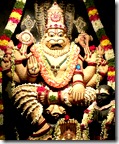
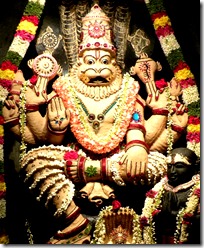 Amazing strength at the source, Narasimha was the visual evidence that the nonbelievers so often insist upon. Hiranyakashipu didn’t believe, but he was forced to acknowledge the truth when meeting the amazing half-man/half-lion.

 “When one is above the stages of dharma, artha, kama and moksha, one becomes a devotee. He is then on the platform from which he is guaranteed not to fall again to material existence (yad gatva na nivartante [Bg. 15.6]). As advised in Bhagavad-gita if one transcends these four processes and is actually liberated, one engages in devotional service. Then he is guaranteed not to fall to material existence again.” (Shrila Prabhupada, Shrimad Bhagavatam, 7.5.52 Purport)
 Friend1: The royal teachers said that Prahlada would one day turn around. There wasn’t much harm to expect, anyway.
 Friend2: On a different platform. When you are connected in yoga, you do not need to follow the standard path. Prahlada was not even an adult yet. He could not take the steps necessary to satisfy interest, artha. He had no means of satisfying the senses. Yet he was totally liberated. He bypassed the need for what the teachers were teaching him. He indeed could have taught them a lesson or two; that is the power of bhakti. Devotional service is the real meaning of dharma.
 “A devotee purified by devotional service is always in the transcendental position above the mundane qualities. Thus the difference between Prahlada Maharaja and Hiranyakashipu was that Hiranyakashipu wanted to keep Prahlada in mundane attachment whereas Prahlada was above the modes of material nature.” (Shrila Prabhupada, Shrimad Bhagavatam, 7.5.51 Purport)
 Hiranyakashipu did not understand that real dharma is connecting with God in a mood of service, and that connection can take place at any point in life. It has the same effectiveness in any occupation. Prahlada would one day become king, but he operated with a different mentality. Whereas the father was completely miserable despite indulging every sense demand, Prahlada was always in bliss. They both lived in the same environment, but the difference in mentality was everything. The grihastha is spiritually inclined, and the rajarshi protects the citizens without becoming further entangled in the cycle of birth and death.
 “Until the return of our spiritual master, Shukracharya, arrest this child with the ropes of Varuna so that he will not flee in fear. In any case, by the time he is somewhat grown up and has assimilated our instructions or served our spiritual master, he will change in his intelligence. Thus there need be no cause for anxiety.” (Shanda and Amarka speaking to Hiranyakashipu, Shrimad Bhagavatam, 7.5.50)
 Hiranyakashipu didn’t think that anyone was above him. He took over the post of the demigods, by force. He intimidated others into submission. They knew his strength, so they thought better of challenging him. The leader of the Daityas could simply ask for something and it would happen.
 We see that Hiranyakashipu was at the pinnacle of success in material life. Nothing was lacking, and at the same time he became morose. He felt anxiety, and the cause was lack of control over the senses. Juxtaposing with the son, Prahlada had no fear, despite the clear and present danger before him. There was a connection to Vishnu, technically known as yoga. With that achievement, a person’s material existence naturally becomes easier. They may or may not succeed in this venture and that, but through the holy names they are always joyful:
 “O lord, we know that when you simply move your eyebrows, all the commanders of the various planets are most afraid. Without the help of any assistant, you have conquered all the three worlds. Therefore, we do not find any reason for you to be morose and full of anxiety. As for Prahlada, he is nothing but a child and cannot be a cause of anxiety. After all, his bad or good qualities have no value.” (Shrimad Bhagavatam, 7.5.49)
 He did not act alone in taking over the three worlds on the power of Brahma’s boons, and he did not engage in teaching the children in his family, either. Hiranyakashipu’s son Prahlada was under the care of the family gurus. They were sons to Shukracharya, who is the preceptor of the demon clan, the Daityas. His name indicates that the qualifications are based on ancestry.
 The king received help in his successful ventures, like taking over the world, and also in the ones that failed. This is the way of the world, as no one is guaranteed to have every desire fulfilled. Better to be an akama devotee of the Supreme Lord, where the lone desire is considered spiritual since it relates to serving the one who is above this world of duality. He alone exists before the creation, at the start of time, in the middle, and also beyond the end.
 “O lord, we know that when you simply move your eyebrows, all the commanders of the various planets are most afraid. Without the help of any assistant, you have conquered all the three worlds. Therefore, we do not find any reason for you to be morose and full of anxiety. As for Prahlada, he is nothing but a child and cannot be a cause of anxiety. After all, his bad or good qualities have no value.” (Shanda and Amarka speaking to Hiranyakashipu, Shrimad Bhagavatam, 7.5.49)
 There is a spot in the front where you have to press down in order to get the hood to release. You can’t seem to find it. You have never done this before. Luckily, someone is there to help. They open the hood in no time.
 Vishnu can share some of His amazing potency with those who are devoted to Him. It was through Vishnu’s protection that Prahlada survived, and the same Vishnu would succeed in eliminating the consistent and persistent danger to the world that was Hiranyakashipu.
 “Thinking in this way, the King of the Daityas, morose and bereft of bodily luster, remained silent with his face downward. Then Shanda and Amarka, the two sons of Shukracharya, spoke to him in secret.” (Shrimad Bhagavatam, 7.5.48)
 Vishnu then empowers people to create. His hands do not get dirty, so to speak, because it is not necessary. Why not put exalted people in charge, who will feel uplifted through some dedicated service? The creator is Lord Brahma, who is also known as the first living entity. He is svayambhu, or one who is self-born. He does not have the typical set of mother and father. Brahma emerges from the lotus stem that grows from the lotus-like navel of Padmanabha, which is another name for Vishnu.
 Yet since he was connected in yoga, there was complete peace. He considered it the greatest blessing to be able to remember the Supreme Lord on a daily basis, which is actually possible for every person through the maha-mantra: