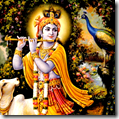
Showing posts with label dohavali 81-120. Show all posts

Thursday, April 29, 2021

Helping To Dress The Deity

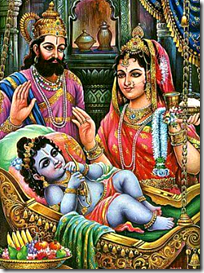
[Rama with mother]“In the childhood form, wearing nice jewelry and clothing, He plays in the dirt and His limbs become full of dust. With child-like speech, Rama plays with all the brothers and children.” (Dohavali, 117)

Download this episode (right click and save)

बाल बिभू।सन बसन बर धूरि धूसरित अंग |
बालकेलि रघुबर करत बाल बन्धु सब सन्ग ||

bāla bibhū।sana basana bara dhūri dhūsarita aṃga |
bālakeli raghubara karata bāla bandhu saba sanga ||

If we sit down and truly contemplate the subject, a rational person would have to conclude that God is beyond their thinking ability. In every category of classification, the Almighty is greater than the greatest.

That person who just won the track and field competition to be declared, “Fastest Man in the World”? God could easily outrun them. That group of astronauts that made it into outer space, after the lengthy time in training and the significant resources invested in the travelling vessel? The Almighty could take a single leap and reach the moon if He wanted to.

This explains why a single image depicting an incident from Bhagavad-gita is well-known to followers of the Vedic tradition. It is the virata-rupa, which roughly translates to “universal-form.” The story begins as a conversation between charioteer and warrior. The relationship then transitions to guru and disciple. Soon enough, the disciple learns the true identity of the teacher, that He is the Supreme Personality of Godhead.

Arjuna asks for the visual evidence, though He already has sufficient faith. He requests Krishna to show the virata-rupa so that future generations consulting the recorded transcript of the conversation will not have doubts.

मन्यसे यदि तच् छक्यं
मया द्रष्टुम् इति प्रभो
योगेश्वर ततो मे त्वं
दर्शयात्मानम् अव्ययम्

manyase yadi tac chakyaṁ
mayā draṣṭum iti prabho
yogeśvara tato me tvaṁ
darśayātmānam avyayam

“If You think that I am able to behold Your cosmic form, O my Lord, O master of all mystic power, then kindly show me that universal self.” (Arjuna, Bhagavad-gita, 11.4)

[virata-rupa]Arjuna sees everything within a single image. Both three-dimensional and with a time element, Krishna reveals something which is awe-inspiring to the less intelligent, but rather insignificant to those who know Him well.

This universal form does put a person in a bind. After searching for, finding, and understanding the origin of everything, to an extent, they wish to serve. They want to do something for Him, as they are thankful for everything He has done for them.

“Please let me serve you. You are the greatest. You have been my friend for so long, but I kept ignoring you. Now things have changed. I don’t want to help anyone else first. You are my top priority.”

One option is to purchase nice clothes for someone we care about. They may not need it. They may be content with what they have, but they still appreciate the gesture. They feel happy wearing the gifted items, as there is a connection in affection.

How will a person dress the Supreme Lord? He is the entire universe and more. The virata-rupa image is only displayed to the extent that a person can understand. Infinite time and space are beyond our comprehension. There is always a beginning to a beginning and an end to an end. Reach the limits of space and know that there is more to go.

Since He is compassion personified, God facilitates such desires in pure devotion. One example is the childhood period of Shri Rama in the city of Ayodhya. Goswami Tulsidas describes that even though Rama plays in the dirt with the other children in the community, the parents dress Him nicely. Rama wears the best ornaments and always beams an effulgence that is unique to Him.

When placed on His transcendental body, the ornaments benefit instead of the other way around. They increase in value, as well as the parents through their devotion. This fact alone proves the Divinity of Rama, who is beloved to this day.

[Rama with mother]I should not be depressed at the awesome nature of the Supreme Lord. Just because He is larger than the largest does not mean He will keep me out of my preferred outpouring of affection. If I want to cook for Him, I can do so on a daily basis. The deity is real, authorized through the instructions of the guru, who follows parampara. If the devotion is strong and the person most qualified, they can even receive God as a dependent, as was the case with Mother Kausalya.

In Closing:

With those ornaments resplendent,
To Kausalya a dependent.

Shri Rama under her care,
Of Divinity not aware.

Since devotion so strong,
Received that for which longed.

Because Supreme Lord kindest so,
Many ways His glories to know.

Friday, April 6, 2018

Lalita Guna

[Shri Rama]“The name, pastimes, form, clothing and ornaments of Shri Rama are all very charming and beautiful. Together with His brothers the children are playing.” (Dohavali, 120)

Download this episode (right click and save)

nāma lalita līlā lalita lalita rupa raghunātha |
lalita basana bhū।sana lalita lalita anuja sisu sātha ||

For conditioned souls gunas aren’t necessarily a good thing. One translation for the Sanskrit word is “rope,” and in one context the description is accurate. Gunas are commonly known as material qualities, but since they cover up the spotless spirit soul and lead to repeated birth and death, there is tightening or tying involved.

It is something like having a boat anchored at the dock. The boat has the potential to sail away. It can travel over the waters, both rough and calm, and with an expert navigator changes in weather and currents aren’t that big a deal.

The spirit soul is ready to travel over the ocean of birth and death. The boat is the human form of body. The favorable winds are the instructions of shastra, which emanate from the Supreme Personality of Godhead. The expert navigator is the spiritual master, who knows how to make the combination of instructions and human body fully auspicious, capable of crossing over successfully despite whatever impediments exist in the specific time and place.

“The human body is the boat, the instructions of Lord Krishna are the favorable winds, and the spiritual master is the navigator. The spiritual master knows well how to adjust the sails to catch the winds favorably and steer the boat to its destination.” (Shrila Prabhupada, Shrimad Bhagavatam, 4.23.28 Purport)

Gunas are like the anchor and even with the auspicious human body there is not a guarantee to escape birth and death. Material qualities, whether in goodness, passion or ignorance, help to continue the illusion of God’s non-existence. In His absence, I feel like I can do everything myself. I can make certain the outcomes desired. I can succeed where others have failed. I can make the most out of life through speculating on what is the real purpose.

As described in the Dohavali, gunas are also associated with the Supreme Lord. This is important to know since one of the faulty speculations of the material mind is that God must be the full negation of everything we see. Since everyone with whom we interact has a body of some sort, God must be without one. Since people have names and tendencies, likes and dislikes, perhaps the Almighty is devoid of such attributes.

Goswami Tulsidas says that there are many attributes for the Supreme Lord and that they are lalita. This means charming, beautiful or pleasant. It starts with the name. Tulsidas specifically worships Shri Rama, who is referred to above as Raghunatha. Rama is the Lord of the Raghu dynasty, a specific family of kings who once ruled over the area known as Ayodhya. Many great kings appeared in that dynasty, and Rama was the best.

[Valmiki]This is not surprising since Rama is God Himself. The incarnation is there to serve many purposes, with one to show that the Supreme is not devoid of attributes. Rama’s name is so beautiful that it can be repeated over and over without exhaustion. Valmiki became a celebrated sage after producing and hearing that sound for years and years. He started by having to receive the sound in a secondhand way, by saying the word backwards. Repeated in sequence, the sound of Rama was heard nonetheless.
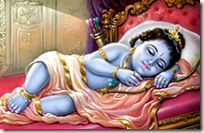
The lila, form, clothing and ornaments are also lalita. The lila manifest before the eyes of the population of the world begins in the childhood form. Rama plays in the courtyard of the royal palace. He is accompanied by His younger brothers, who are also in the childhood form.

Those children are adorable to behold, and they are dressed nicely. The clothing is beautiful and the mothers make sure to put nice ornaments on them. Normally, this increases the beauty of the person being dressed, but with God and His associates the reverse holds true. The ornaments become more beautiful as a result of association with the Divine.

[Shri Rama]The description of these gunas are not meant to be heard and learned just one time. Contemplate. Study. Understand. Most importantly, remember. Keep remembering, all the way until the time of death. Then not only will the journey of life become easier, future association with the binding ropes of material qualities will cease.

In Closing:

Like from binding ropes to release,

Cycle of birth and death to cease.


When Shri Rama remembered throughout,

Of glorious qualities, material without.


In Ayodhya charmingly dressed,

With vision the parents blessed.


Gunas too, but not ordinary so,

Meant for everyone to know.

Thursday, April 5, 2018

The Charitra Mala

[Shri Rama with family]“The loveable son of the king of Koshala, Dasharatha, in the beautiful royal courtyard is crawling on His hands in the childhood form, moving in such a way with His activities are like a garland of every good quality and auspiciousness.” (Dohavali, 119)
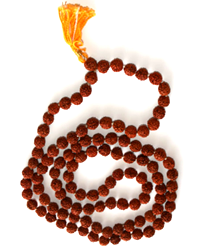
Download this episode (right click and save)

rāja ajira rājata rucira kosalapālaka bāla |
jānu pāni cara carita bara saguna sumagaṃla māla ||

People practicing bhakti-yoga in this age of Kali take one particular routine very seriously. The chanting of the holy names on a japa mala: Hare Krishna Hare Krishna, Krishna Krishna, Hare Hare, Hare Rama Hare Rama, Rama Rama, Hare Hare.

The mala is a string of beads, one hundred and eight in total. There is a head bead, on which the mantra is not chanted. Otherwise, the practice is to say the specific mantra one time per bead, moving around in a circle. This is considered one round of chanting japa. With further progression, more rounds are chanted.

[japa mala]The mantra is the important factor, as it is not an ordinary sound. The words contained within directly represent the Supreme Personality of Godhead. The indirect representation is everything material. That is to say the sky, the earth, the trees, the many living creatures - when viewed they externally give an idea of God’s existence, but not direct interaction.

Indirect association brings inferior results. Namely, there is continued residence in the material world, where the Almighty continues to be known only indirectly. The holy names are for a superior way of living. In fact, through such interaction there is a higher taste, one that is so superior that previous attachments are left behind without much difficulty.

“The embodied soul may be restricted from sense enjoyment, though the taste for sense objects remains. But, ceasing such engagements by experiencing a higher taste, he is fixed in consciousness.” (Lord Krishna, Bhagavad-gita, 2.59)

Each name in the mantra is important, especially to hear. Even if a person does not know much about God or is not so interested at the moment in escaping material life, the potency from the sound can do wonders. If chanted accidentally, with ill intent, or without much faith and attention, the holy names are still so powerful that they can deliver the mind; hence the word “mantra.”

In the Dohavali of Goswami Tulsidas there is reference to a garland of auspiciousness. Something physical, like a collection of plucked flowers, turning into something beyond the temporary nature of the world. Mangala, auspiciousness, is for the benefit of the individual, both in the short and long terms.

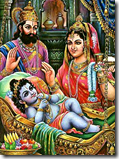
Here the mangala is with respect to Shri Rama, the Supreme Lord in an incarnation form. The garland of auspiciousness consists of the childhood play of Rama, while in the royal courtyard. He has appeared as the son of the king, Dasharatha, who rules over the area known as Koshala.

Though Divine, Rama crawls on all fours, with His limbs becoming dirty. As first-time parents can spend hours just staring at their newborn child, so the devotees can contemplate the movements of the child Rama. The difference is that they can remember these activities for an entire lifetime and into future ones, as well.

The character and activities, charitra, form a sort of mala. As one chants the holy names as part of their daily routine, they can remember such deeds on each bead. There is no offense, as the entire aim of bhakti-yoga is to increase consciousness of the Almighty. The more one is conscious of Him, the better off they will be going forward.

[Shri Rama with family]Bhakti is beyond this world, so there is no limit to the bliss that can be experienced. Watching Rama in the royal courtyard and remembering His play afterwards are activities for the liberated souls, as well; those who have already escaped the cycle of birth and death. From beginning to end Rama’s direct association is auspicious.
In Closing:

Material world only indirect,

Experience from holy names direct.


Daily routing chanting a round,

Mind delivered through sacred sound.


Charitra of Rama in similar way,

In royal courtyard His play.


Of childhood form, auspiciousness creating,

From young to old, to all relating.

Tuesday, April 3, 2018

Bala Vinoda

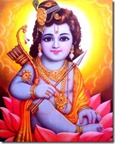
[Rama with parents]“Every day in Ayodhya there is a celebration happening, as renewing auspiciousness brings so much happiness. The mother, the father and the people are so happy seeing the childhood play of Shri Rama.” (Dohavali, 118)
Download this episode (right click and save)

anudita avadha badhāvane nita nava ma:ngala moda |
mudita mātu pitu loga lakhi raghubara bāla binoda ||

We know what misery is like. Pain and heartache. Anxiety from separation. Worry about the future, as there is uncertainty in the most basic things. It is not guaranteed for the sun to shine brightly tomorrow. In some places there is cloud cover for a week straight. How to deal with the depressing atmosphere?

We know that the troubles begin at birth. While everyone is happy to see the new baby, pretty soon the responses change. Instead of smiling and making cute noises, others walk past you without saying a word. People are afraid to speak, lest they anger someone else.

We know that everything ends at death. Despite our greatest hope to the contrary, there is no way to take our life’s work with us. The house, the car, the family relationships - they are not guaranteed to remain through to the next life.

We know from studying different spiritual traditions that there is an end to the suffering. Some call it salvation. Others refer to it as nirvana, or the ultimate end. In Sanskrit there is the term “moksha.” The common English translation is “liberation,” but what exactly does that mean? There is an end to the cycle of birth and death, of further swimming in the ocean of suffering, of spinning on the wheel of rebirth, samsara-chakra.

We don’t know what comes afterwards, though. Let’s say that you are fortunate enough to achieve the end. Moksha, after dharma, artha and kama, becomes a reality. What happens next? Time is known to be infinite in both directions. Therefore something must come after an end; otherwise time as we know it is not valid.

In the above referenced verse from the Dohavali, Goswami Tulsidas gives a glimpse into the life of liberation. Though the circumstances may not be exactly the same for every liberated soul, there is one important factor in common. There is interaction with the personal form of the Divine.

In this case God is playing the role of a small child, living in the house of King Dasharatha of Ayodhya. The events occurred on this earth, in the city of the same name, many thousands of years ago, but that is not to say the pastimes aren’t continuing. In some place in the unlimited universe Rama is playing right now. He has descended as the avatara, to protect the pious and annihilate the miscreants.

The bala vinoda, the pleasurable play in the childhood form, brings great delight to the mother, the father, and the people. An interesting thing occurs: a celebration takes place daily. Whatever Rama does is cause for celebration. There isn’t boredom, either. If we celebrate someone’s birthday today, tomorrow another party might not carry the same festive atmosphere. If every day were a celebration, then celebrations would start to lose their meaning.

[Shri Rama with parents]Not so with the Supreme Personality of Godhead. He is to be celebrated every single day, and not out of fear. There is great joy that results, and time does nothing to diminish the effect. Rama is the embodiment of mangala, or auspiciousness, and so the liberated souls take great delight in endlessly celebrating His transcendental glories.
In Closing:

No need of description to be suspicious,

Shri Rama embodiment of auspicious.


In Ayodhya celebrating every day,

For more bliss to find a way.


Especially when the childhood form displaying,

That son the one for whom the saints praying.


Glimpse into life of liberation giving,

That eternally in spiritual bliss living.

Friday, March 30, 2018

What Can This Child Do To Me

[Shri Rama - child]“In the childhood form, wearing nice jewelry and clothing, He plays in the dirt and His limbs become full of dust. With child-like speech, Rama plays with all the brothers and children.” (Dohavali, 117)

Download this episode (right click and save)

bāla bibhū।sana basana bara dhūri dhūsarita aṃga |
bālakeli raghubara karata bāla bandhu saba sanga ||

The swan-like person looks for the good in others. When they meet someone new, they overlook the bad qualities. After all, which one of us is perfect? Who among us hasn’t lied at some time? Who hasn’t made a costly mistake, one to regret later on?

[swan]The saintly person is like a swan in this way, which can separate milk from a mixture of water and milk. The saint understands that each person derives their strength from the same source. Prahlada Maharaja, the wise son of a king, once tried to explain this to his father, who was wicked in nature.

“Prahlada Maharaja said: My dear King, the source of my strength, of which you are asking, is also the source of yours. Indeed, the original source of all kinds of strength is one. He is not only your strength or mine, but the only strength for everyone. Without Him, no one can get any strength. Whether moving or not moving, superior or inferior, everyone, including Lord Brahma, is controlled by the strength of the Supreme Personality of Godhead.” (Shrimad Bhagavatam, 7.8.7)

The asura is crow-like. They tend to behave the opposite of the saint. They see someone and immediately look for faults. It’s not difficult. You can criticize any type of clothing. Each person has a unique way of walking, and so that is eligible for ridicule, as well.

The asura is constantly threatened, so they size up other people, whom they view as competition. Deep down the naradhama, the lowest among men, knows that death will finish everything. They try to prolong life as much as possible, enjoying the senses to the fullest. Lying, cheating and stealing are okay, because hey, you only live once.

The standard bearer for the asuras is Ravana, who was actually in a Rakshasa body. This is a kind of man-eating ogre. He was strongly against God, to the point that when he saw the Divine directly he was not moved in the proper direction. He looked for faults. He scanned the visual and known activities for any vulnerabilities.

Fortunately, the Supreme Lord is not a miser in this area. He gives to everyone what they want. As they surrender to Him, He rewards accordingly. If the asura wants to compete with Him, Bhagavan allows for that competition to take place.

“All of them - as they surrender unto Me - I reward accordingly. Everyone follows My path in all respects, O son of Pritha.” (Lord Krishna, Bhagavad-gita, 4.11)

In the avatara of Shri Rama, the Divine gave signs of vulnerability to Ravana by living in the forest of Dandaka. The king of Lanka could never understand this. Ravana lived in a city literally made of gold. He was extremely wealthy, had tremendous fighting prowess, and was intoxicated constantly. In summary, there was no shortage of material enjoyment, as many beautiful queens lived in the palaces.

Ravana thought Rama was weak for having left the kingdom of Ayodhya at the order of the mother and father. Rama should have fought back. Perhaps He was afraid. Maybe He was lacking confidence. This was Ravana’s line of thinking.

One can imagine the demon’s thought process were he to witness pastimes from several years prior. Goswami Tulsidas provides a glimpse in his Dohavali. The poet says that Rama plays in the courtyard of the king, Maharaja Dasharatha. Rama is beautifully dressed. He wears nice jewels and necklaces. At the same time, the limbs are dirty. This is because Rama plays in the dirt.

God is not alone. He is with the three younger brothers: Bharata, Lakshmana and Shatrughna. They are also in the childhood stage of life. The other children from the community are there, and together everyone is playing. Rama speaks like a child, also, which means that His sentences and words aren’t perfect.

The enemy would use this as fuel for their way of life. How can God speak like a child? How can He have limbs covered with dirt? How can He be dependent on others for feeding? These are signs of weakness.

The saints know the truth, that in any form Bhagavan retains His true potency. Before there were any visible signs of manhood on His face, Shri Rama defended against one of Ravana’s most skilled advisors, Maricha. The testimony was relayed directly to Ravana later on, as a warning to not misjudge Rama.

“At the time, there were not yet visible any signs of manhood on the boy’s beautiful face, which was dark-blue in complexion and had an all-auspicious gaze. Rama had a gold chain round His neck, a small tuft of hair on His head, wore only one piece of clothing, and held a bow in His hands.” (Maricha speaking to Ravana, Valmiki Ramayana, Aranya Kand, 38.14)

[Shri Rama - child]Indeed, the child Rama once swallowed a devotee crow and showed the universal form from within His belly. Whether large or small, no one can measure up to God. The saints take delight in His childhood pastimes, and they know that they are protected from Ravana and those like him, who try to make the material world even more miserable than it already is. Those who have Rama’s protection can cross over the ocean of suffering easily, as if it were like jumping over a small puddle.

In Closing:

From a single visual to take,

Gross misjudgment to make.


That Rama weak and small,

That playing on dirt to fall.


Maricha warning against one time,

That Ravana harsh lesson to find.


But asuras in this way encouraged,

By ample evidence not discouraged.

Tuesday, March 27, 2018

A Bridge To Cross The Ocean

[Shri Rama]“The one who is pure, having an eternal form of bliss and knowledge, who is the standard bearer of the solar dynasty - Shri Rama performed amazing activities in a human form, celebrating which creates a bridge to easily cross over the ocean of birth and death.” (Dohavali, 116)
Download this episode (right click and save)

suddha saccidānandamaya kanda bhānukula ketu |
carita karata nara anuharata saṃs।rti sāgara setu ||

Shri Rama is known for His bridge. Since He is the Supreme Personality of Godhead, Bhagavan, the physical object used for transportation could have appeared at will. Just as Bhagavan is sometimes prakata, or appearing before the eyes, and sometimes aprakata, or apparently invisible, any collection of material elements can appear and disappear according to His will. Those elements are part of His energy to begin with.

The Rama setu was built by dedicated and loyal servants. Some of them hadn’t known Rama for very long; they met Rama and His brother Lakshmana in the forest of Dandaka. At the same time, every living entity has been intimately connected to Bhagavan since the beginning of time. As God is both beginning-less and endless, so are the living entities.

That property is mentioned here, as well. Sach-chid-ananda means eternal, blissful and knowledgeable. For God there is no distinction between body and soul, matter and spirit, and by extension, birth and death. He is always sach-chid-ananda, and so for Him building a bridge is not difficult.

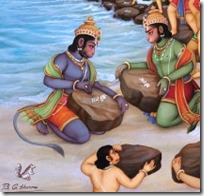
[Building Rama's bridge]The loyal devotees did something amazing, though. They built the bridge out of rocks. Not starting from the bed of the ocean and working their way north, the rocks floated from the beginning. This was a concession provided by the ocean, who is also devoted to Rama. Each aspect of the material creation has a presiding deity. That is the intelligence behind what we consider to be bereft of life.

Goswami Tulsidas speaks of another kind of Rama-setu. This bridge is for crossing the ocean of birth and death. That ocean is samsara, or full of suffering. From the beginning of life to the end, there is very little time for peace. Perhaps in the bliss of ignorance there is a respite, but that is not real. It is something like being elated at winning the lottery in a dream. Reality eventually returns.

Rama is the lone reality, who expands to generate the living entities, who are also eternal. The ocean of suffering is difficult to cross because so many attachments form along the way. From those attachments consciousness gets altered, and consciousness is what determines the next destination for the departing soul.

Celebrating, remembering, and hearing about Rama’s activities is like a bridge because consciousness gets fixed on something entirely pure, shuddha. With the modes of material nature there is always some kind of contamination. Even work in the mode of goodness is tainted with temporary happiness and a false sense of pride. The demigods in heaven have these impurities arise every now and then, even though they are on an elevated platform.

Though Rama is Bhagavan, He kindly appears in a human-like form, to perform activities that can be remembered and celebrated. In that role He carries the flag for the solar dynasty, enhancing its glory through His triumphs. The example He sets is the one for subsequent generations to follow.

[Shri Rama]Rama’s association increases the importance of the solar dynasty, and in the same way those connected to Him through devotional service rise above the suffering of the material ocean. They can cross over easily, without having to work hard at construction. The power of the name itself makes the rocks float, allowing for safe and easy passage: Hare Krishna Hare Krishna, Krishna Krishna, Hare Hare, Hare Rama Hare Rama, Rama Rama, Hare Hare.

In Closing:

Bridge for Shri Rama making,

Out of rocks to float taking.


Not order for Him tall,

Since already controller of all.


Tulsi of another bridge saying,

Made of remembrance and praying.


To Lord who in solar dynasty came,

By Him increased its fame.

Saturday, March 10, 2018

Miscreants To Annihilate

[Vishnu and Hiranyaksha]“Hiranyaksha and his brother, Madhu and the very strong Kaitabha - the one who slayed them, Bhagavan, the ocean of mercy, has descended as an avatara.” (Dohavali, 115)

Download this episode (right click and save)

hiranyācca bhrātā sahita madhu kai।tabha balavāna |
jehiṃ māre soi avatareu k।rpāsindhu bhagavāna ||

Whenever and wherever there is a decline in religious practice, dharma. Correspondingly, the rise of irreligion, adharma. These conditions trigger the periodic appearances, which to the limited vision look like a janma, or birth, but are not really. The form is described as an avatara, or one who descends. This means that the external is not material, despite what common assessment says.

The avatara descends from the spiritual world for these purposes, and then there are two primary functions carried out. Protecting the pious, the sadhus. These are saintly people, who typically don’t keep attention on defense. There shouldn’t be much concern in this area, as there aren’t many possessions. If need be, the sadhu can take residence inside of a remote cave, sit down in front of a tulasi plant, and all day chant the holy names: Hare Krishna Hare Krishna, Krishna Krishna, Hare Hare, Hare Rama Hare Rama, Rama Rama, Hare Hare.

The second function relates to the first. The avatara annihilates the miscreants. The Sanskrit word is dushkritam, those who are interested only in impious work. The miscreants love to harass the saints, and rather than take up weapons and get distracted from their primary business of God consciousness and worship of the Divine, the Supreme Lord Himself takes up the task of defense on their behalf.

He is already everywhere through the expansion known as Supersoul. The material nature works at His direction. While that energy is typically neutral, for the devotees an exception is made. The sadhu comes under the direct supervision of the most intelligent mind. This is because the devotees are considered to be His friends.

“I envy no one, nor am I partial to anyone. I am equal to all. But whoever renders service unto Me in devotion is a friend, is in Me, and I am also a friend to him.” (Lord Krishna, Bhagavad-gita, 9.29)

How exactly does Bhagavan annihilate the miscreants? Should not the material nature handle the responsibility? The avataras are paired with some of the most powerful miscreants in the world. Again, the purpose is twofold. One is to show just how high a person can climb in material advancement. In one sense, the sky is the limit. People like Hiranyakashipu were so powerful that even the demigods were helpless against him.

The other purpose is to show that no matter how advanced a person becomes materially, in any of the different areas of opulence, they are still no match for Bhagavan, the Supreme Personality of Godhead. Goswami Tulsidas mentions four different times Bhagavan took on such miscreants to describe how God again descended as the avatara named Rama.

[Shri Rama]The bad guys have been around just as long as the good guys have. The original good guy is Lord Brahma, who is also known as the creator. Both the suras and asuras trace their lineage back to him. In fact, Brahma is the original father of every species.

“In the beginning of creation, Lord Brahma was attacked by two demons—Madhu and Kaitabha—but Krishna saved him. Therefore Krishna is addressed as madhu-kaitabha-hantri.” (Shrila Prabhupada, Shrimad Bhagavatam, 7.3.13 Purport)

A long time ago Brahma was attacked by two people named Madhu and Kaitabha. Bhagavan was there to protect. The different avataras that offer this protection are of the same identity, that is to say they are the same person. Therefore Bhagavan is also known by such names as Vishnu, Rama, Krishna, Narasimha and Varaha.

[Vishnu and Hiranyaksha]The Varaha avatara was in the transcendental form of a boar. He defeated the very powerful demon named Hiranyaksha. The brother of the slain victim later vowed to get revenge on Vishnu. His name was Hiranyakashipu and he was defeated by the avatar named Narasimha, who was a half-man/half-lion.

Tulsidas worships the avatara named Rama, who is in a human-like body. The poet gives the background description so that no one will be confused. Rama is the same person who previously slayed Kaitabha, Madhu, and other powerful characters. After His appearance in Ayodhya, Rama would go on to rid the world of even more bad people.

Today the primary avatara is in the form of the holy name itself. This powerful sound cuts through the miscreant known as illusion. Therefore the saints take shelter of this protection, making sure it is always around by constantly producing the sound and allowing others to hear it as well.

In Closing:

Now avatara of Rama the name,

By whom previously demons slain.


Like Madhu and Kaitabha attacking,

Wicked characters of piety lacking.


Hiranyaksha against Varaha the boar,

Whose brother hoping revenge in store.


For the saintly Bhagavan ready to stand,

Now same with Ravana’s fate in hand.

Wednesday, March 7, 2018

Don’t Let The Visual Fool You

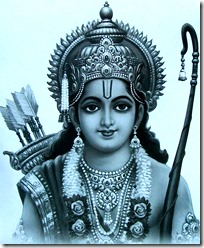
[Shri Rama]“Whose knowledge, speech, perception, qualities and mind are beyond illusion, the unborn one, that same Bhagavan, who is like a sach-chid-ananda cloud, out of His kindness performed activities in the form of a man.” (Dohavali, 114)
Download this episode (right click and save)

gyāna girā gotīta aja māyā mana guna pāra |
soi saccidānandaghana kara nara carita udāra ||

As Shri Krishna, He was shot in the foot by the hunter. This fulfilled the prophecy tied to the curse of Gandhari, the grieving mother of the Kauravas. It also made real the mistake of omission detected by Durvasa Muni, who had previously asked Krishna and Queen Rukmini to rub a frumenty paste all over their bodies. Krishna missed a spot on the sole of the foot, and Durvasa said that the paste had given them immunity from death wherever it was applied.

As Shri Rama, He is famously depicted chasing after the golden deer, which was actually an ogre in disguise. He used monkeys and bears to build a bridge, and He allowed Himself to be thrown out of His kingdom for fourteen years, without putting up a fight. He lamented greatly at the separation from His wife, and He also required instruction from teachers in youth.

In fact, these blemishes or vulnerabilities exist to help the non-devotees stay that way. Atheism is a choice, after all. Otherwise everyone would be forced to acknowledge and serve God, and by extension love would be lacking. Transcendental taste, rasa, cannot exist without some love, and true love is the result of a choice.

The atheists are fooled by the external vision, and intentionally so. They purposely ignore the other amazing activities. These are transcendental, or beyond illusion. Maya is the illusory energy and as soon as birth takes place there is vulnerability to this illusion. To break out is very difficult, but the Supreme Lord kindly arrives in an avatara form from time to time to give the greatest support in escaping for good.

Fools deride Him, but the devotees know the truth. As Goswami Tulsidas describes in his Dohavali, Shri Rama is actually like a sach-chid-ananda cloud. The cloud is dense, full of potential to distribute rainwater. The comparison is appropriate because the transcendental body of Shri Rama has a complexion that resembles the dark raincloud.

[Shri Rama]Rama possesses knowledge, eternality and bliss to the highest extent. His cloud-like body is thus sach-chid-ananda. Rama is also aja, or unborn. He appears at a certain time in the royal home of King Dasharatha of Ayodhya, but it is not like He didn’t exist before. He always has that transcendental form, from beginning to end. In fact, aja means that there is no beginning for Him. This also means that death does not apply to Him.

In the avatara form, Rama acts like an ordinary human being. To such a person qualities, knowledge, speech and perception apply. There is a mind, as well. None of these are ordinary. They are beyond the illusory energy of maya. Vedic literature is replete with evidence; in one place after another there is proof.

[Ramayana book]The works with the most detail about Rama’s life are the Ramayana, Ramacharitamanasa and various Puranas. Rama both knows the science of self-realization and lives by its principles. His speech is beautifully composed, meaningful, and pleasant to hear. His perception is unmatched; He can defeat fighters without seeing them. His presence extends to every single living thing, as He lives within the heart as the Supersoul, Paramatma.
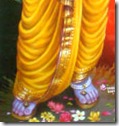
Every quality, guna, is transcendental. That very same Bhagavan agreed to appear as a human being. This was done out of supreme kindness. Such kindness should be met by love, service, attachment and allegiance on the other side. There is no risk, as Rama is the only one who can reciprocate fully and perfectly, from lifetime to lifetime.

In Closing:

Fooled not to be,

Despite human-like to see.


With activities, thoughts and speech,

Still the one who inside every and each.


Fighting Rakshasas using only sound,

Protecting sage’s sacrificial ground.


For pleasure of devotees only coming,

Serving Him loser never becoming.

Saturday, March 3, 2018

Sometimes Ordinary

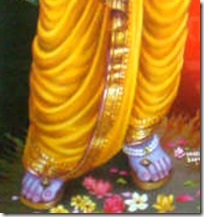
[Rama's lotus feet]“For the benefit of the devotees, the Supreme Lord, Shri Rama, took the body of a king. He performed the most amazing activities in a manifest form, like an ordinary man.” (Dohavali, 113)
Download this episode (right click and save)

bhagata hetu bhagavāna prabhu rāma dhareu tanu bhūpa |
kie carita pāvana parama prāk।rta nara anurupa ||

How to understand the glories of someone who is beyond comprehension? How to apply logic, reasoning, and deductive methods to knowing a person who is outside the scope of the powers gifted to the human mind? It is most certainly a benediction, since not everyone has the same level of intelligence. Basic observation of a variety of human beings gives evidence of this.

How to understand someone who exceeds the limits of time and space, both of which baffle the mind? How to know someone who is time itself, which operates as the all-devouring agent known as death? In fact, this is the face most commonly seen of the Almighty. After a lifetime of obstinate refusal, of denying that a higher power exists, the individual must succumb to time in the ugly form of death. That gruesome and merciless force is one representation of God.

Since we are known to measure greatness by using comparison, perhaps if the Almighty played the role of a human being we could have a reference point. He is never material. He cannot assume the elements of earth, water, fire, air, mind, intelligence and ego. That is because the distinction between material and spiritual applies to us, and only when under the influence of the illusory energy known as maya.

God is completely spiritual, at all times, in any form that manifests. The prakrita form is that seen with the eyes, and there is some illusion there, as well. The form looks like a nara, or man. There may be some ordinary activities, with some fallibility mixed in, too.

Goswami Tulsidas references the avatara of Rama. He is actually Bhagavan, or the Supreme Personality of Godhead. He wants to do good to the devotees, and so for that reason He appears. His tasks have two purposes. Annihilate the miscreants and protect the saints. Both have the same end result; there is auspiciousness to everything Bhagavan does. He gives pleasure to the devotees through something as basic as blinking His eyes, which look like petals of the lotus flower.

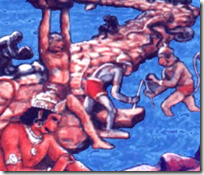
[Rama's bridge]Though looking like an ordinary man, nara, Rama’s activities are just amazing. They are supremely purifying, parama pavana. He builds a bridge on the spot, made of floating rocks. He defends Himself against 14,000 fighters of terrific prowess. He does this by Himself, using only a bow and arrow set. He defeats the most powerful atheist in the world. The other side has weapons of great potency mixed with black magic and no reservations in using questionable methods in war.
Rama has monkeys and bears hurling rocks and trees. Rama’s side wins. He liberates the wife of a celebrated Rishi from only the touch of His feet. He lifts the heaviest bow in the world, in front of kings of the highest strength. He shows everyone that He is the only worthy husband of the goddess of fortune, Sita Devi.

He also shows vulnerability and fallibility from time to time. He plays as a child in the courtyard of King Dasharatha, the father. He gets exiled from the kingdom for fourteen years. He supposedly gets tricked into chasing after a golden deer, which is actually one of Ravana’s henchmen in disguise. He laments greatly at the separation from Sita. He takes the foolish words of one of the citizens to heart, despite His wife being completely innocent of the allegations.

[Shri Rama]The good and the supposedly bad are all for the pleasure of the devotees. Through works like the Ramayana and Ramacharitamanasa they can discuss these pastimes for one lifetime after another and not get bored. The joy only increases. Whenever they chant the holy names these same auspicious activities come to mind: Hare Krishna Hare Krishna, Krishna Krishna, Hare Hare, Hare Rama Hare Rama, Rama Rama, Hare Hare.

In Closing:

The good and the bad to show,

For transcendental qualities to know.


Contest winner husband of Sita to call,

At separation into lamentation to fall.


Help from monkeys and bears taking,

And quick work of Rakshasas making.


Supreme not possible to understand,

So sometimes descending as man.

Monday, February 26, 2018

Baradayaka

[Hanuman]“The great devotee in the monkey form carried out his duty, giving everything of himself, and the Lord became so grateful that He, the one who gives boons, stood before Hanuman with folded hands asking for a boon.” (Dohavali, 112)

Download this episode (right click and save)

kiyo susevaka dharama kapi prabhu k।rtagya jiya' jāni |
jori hātha ।thā।dhe bhae baradāyaka baradāni ||

It’s only natural to approach the Supreme Lord when in distress. As described in the Bhagavad-gita, this is one of the categories of people who finds Him. Whatever way is beneficial, as His association is purifying to the highest degree.

“O best among the Bharatas [Arjuna], four kinds of pious men render devotional service unto Me - the distressed, the desirer of wealth, the inquisitive, and he who is searching for knowledge of the Absolute.” (Lord Krishna, Bhagavad-gita, 7.16)

Distress is found everywhere, and at seemingly any time. You could be fast asleep in the middle of the night when something suddenly bothers you. Sleep paralysis, a bad dream, trouble breathing, a loud alarm outside - you go from calm and peaceful to anxious and upset.

Then there is the uncertainty of the future. You’re not sure about what will happen going forward. You have so many responsibilities at home, but the job security is not what it should be. The company could go out of business. You decide to try investing in a company that supposedly is on its way up. You pour in lots of money, but one day the stock price tanks. Now you look to the heavens to bail you out. You need some relief.

[Worshiping Vishnu]Indeed, God is known as baradayaka. He is the one who grants boons to others. In the Bhagavata Purana we find the creator himself, Lord Brahma, taking a contingent to the Vaikuntha realm to visit the Supreme Lord in His form of Vishnu. This group needs help. There is too much disturbance on earth. Taking the form of a cow mother earth is overburdened by the sinful population. Vishnu kindly gives the boon that He will descend personally, in the all-attractive form of Krishna. The demigods should not worry.

In a previous time the same Vishnu agreed to descend as the prince of Ayodhya, Shri Rama, for similar purposes. To annihilate the miscreants and protect the pious, when religious practice is declining and irreligion is on the rise - such are the stated conditions leading to the Divine descent.

“In order to deliver the pious and to annihilate the miscreants, as well as to reestablish the principles of religion, I advent Myself millennium after millennium.” (Lord Krishna, Bhagavad-gita, 4.8)

Goswami Tulsidas says that when religious practice, dharma, is done selflessly, giving everything, jiya jani, then the Supreme Lord becomes so grateful. That dharma is not restricted by time, circumstance, or even body type. A kapi, which is a monkey, has the potential to be a susevaka, or great devotee.

The susevaka referenced above is Shri Hanuman, whose deeds are sung throughout the world. He is not God, but just see the stature he has. Rama is so appreciative of Hanuman’s efforts that the tables turn. The one who grants boons to the demigods stands before Hanuman with folded hands, asking if the servant wants anything.

[Hanuman]Since Hanuman’s devotion is pure, the only thing he desires is continued service. If others get wealth, health, fame, strength and other such benedictions, why shouldn’t Hanuman’s desire be fulfilled? Accumulation of possessions and power or the renunciation of the same cannot win over the Almighty, but selfless devotion can. He is the seer within the heart, so only He knows when and if the service is genuine. Like with the gopis of Vrindavana, God becomes indebted, so much so that He feels He can never repay the glorious deeds.

In Closing:

Not to worry, trouble soon to end,

Vishnu in human form to descend.


The distressed towards Him going,

Since giver of boons knowing.


Pure devotee only to continue to ask,

For Him ready to perform any task.


With Hanuman no way to repay,

With folded hands Rama to stay.

Saturday, February 24, 2018

Jiya Jana

[Rama and Hanuman]“Tulsi says that Shri Rama loves His devotee more than His own life. King Rama becomes so much indebted, and the devotee becomes so rich, like Hanuman.” (Dohavali, 111)

Download this episode (right click and save)

tulasī rāmahu teṃ adhika rāma bhagata jiya' jāna |
riniyā rājā rāma bhe dhanika bhae hanumāna ||

I have an important task to complete. Since I am not so naïve, it is understood that some outside help is required. This revealing truth is presented in the Bhagavad-gita, as well, where Shri Krishna explains that the individual is not the doer. They make the choice for action, but the modes of nature, gunas, must cooperate. Without those gunas results would only be potential within the mind, like unfulfilled dreams.

“When you see that there is nothing beyond these modes of nature in all activities and that the Supreme Lord is transcendental to all these modes, then you can know My spiritual nature.” (Lord Krishna, Bhagavad-gita, 14.19)

Without even approaching the higher topics presented in Vedic literature, which is like a blossoming tree full of branches representing different areas of knowledge, from everyday experience it is seen that acting alone usually is not enough to get the job done. If I’m driving for a long distance, at the very least I need others on the road to adhere to the rules. I put trust in the auto-mechanics to do a good enough job to keep the car running. I need the food I purchased from the supermarket to be fresh and packed with the proper nutrients.

In this hypothetical situation I look for someone who is trustworthy and dependable. There are several people who are capable, but they might not show up. They may put in half a day’s worth of work and then split the scene. I have to get the job done, so uncertainty is not an option.

The person I choose ends up helping me immensely. It’s like they’ve given their entire life to the task. They don’t have to. It’s just me, after all. In this world everyone is out for themselves. Svartha, or self-interest, is the primary concern. Who can blame them? For some reason this person is different. It’s like they would give up everything to see me happy.

This begins to explain to a small degree what the Supreme Lord is like in the interaction with His devotees. He is Bhagavan, for starters. This means that He has every fortune imaginable. He is not poor in the least. He is the winner in any measuring contest of riches and abilities.

He is also atmarama, which means “self-satisfied.” That is to say the association of others is not required to keep Him pleased. He can hang out by Himself for hours, days and years, if needed. He does not require going out to a nightclub in order to find companionship.

As Goswami Tulsidas remarks in his Dohavali, the bhagata, the devotee, earns a very high stature through their association with Rama. It is like the tables turn. They become rich, while Rama, who is a king on earth, becomes indebted to them.

The only way this makes sense is if the loving nature of the Supreme Lord is understood. In fact, that is the purpose of this couplet from the poet, to help us understand the unlimited mercy flowing from the lotus feet of Bhagavan.

Tulsidas gives the example of Hanuman, who today is worshiped and adored by millions of people. Within the Vedic tradition he is perhaps the most popular and the most appreciated. His stature is due to only one thing: devotion to Rama. Hanuman gave everything to please the Supreme Lord during Rama’s time on earth as an avatara, or incarnation.

[Rama and Hanuman]Because of that service Rama became indebted, to the point that He feels like He can never repay. Hanuman, for his part, is ready to continue in service. There is no break. There is no false pride. He knows the wealth that he has, and he both safeguards it and shows others how to attain it. He is a symbol of sacrifice, and through the bliss of surrender in devotion that he experiences he shows others the way.

In Closing:

Keep always the Lord in mind,

Who to level unbelievable kind.


Though on earth known as king,

Entrusted to Hanuman the ring.


To safely bring to Sita the wife,

He sacrificing effort and life.


To level that Rama feeling in debt,

Devotee higher stature to get.

Monday, February 19, 2018

Glory Even Rama Wonders About

[Sugriva and Vali]“Tulsi says that with Rama’s merciful glance even someone who has no strength can become very powerful. With the enmity between Sugriva and Vali, who can tell what Hanuman did?” (Dohavali, 110)

Download this episode (right click and save)

tulasī rāma sudī।thi teṃ nibala hota balavāna |
baira bāli sugrīva keṃ kahā kiyo hanumāna ||

The Ramayana story is well-known to those growing up in Vedic culture. The basis is the pastimes of the Supreme Personality of Godhead, Bhagavan. He is both nirguna and saguna, but these are both from the perspective of the eyes of the conditioned soul. In the nirguna feature He is practically impossible to be identified.

“For those whose minds are attached to the unmanifested, impersonal feature of the Supreme, advancement is very troublesome. To make progress in that discipline is always difficult for those who are embodied.” (Lord Krishna, Bhagavad-gita, 12.5)

The saguna form is further evidence of God’s kripa, or mercy. That feature has identifiable attributes. You can look and point and say, “That is God.” Of course, there is an error in the statement, as the Almighty is omnipresent. He is always around, everywhere. He is within the heart of every living being as the expansion known as Supersoul.

The Ramayana is about the life and pastimes of the saguna form known as Rama, the prince of Ayodhya. His appearance is foretold, and every feature to His transcendental body indicates uniqueness, greatness, things not ordinarily found.

Then there are His amazing deeds, which are too many to count. The Vedas are said to be endless since they continue to sing the glories of the Supreme Lord.

If taken only for the story value, there is still great significance. The triumph of good over evil is always heartwarming. Even thieves, liars and cheaters expect some kind of good behavior from others. The thief expects that the property they steal will not be stolen from them later. The liars don’t like it when they are cheated by others. In the short term, to meet their own interests, they break from good behavior, but they still benefit from others following the righteous path.

In the aftermath of Rama’s victory, He has a discussion with the celebrated and powerful sage known as Agastya. Bhagavan is never alone. His close associates are always with Him, and they are ready to do amazing things. In Rama’s case there was the servant Shri Hanuman, who was unique both because of his deeds and his form. Hanuman met Rama in the forest of Kishkindha, where the monkey-king Sugriva was living in exile on Mount Rishyamukha. Hanuman, also in a monkey body, was Sugriva’s chief minister.

Later on, after many great struggles were successfully overcome, Rama wondered why Hanuman had not done more to help the situation prior to their meeting. Sugriva was in exile because his brother Vali pushed him out of the kingdom. Vali was superior in strength. There was no resolving this dispute through peaceful means.

As the great minister he is, Hanuman arranged for a friendship between Rama and Sugriva. That ultimately led to Vali’s demise and Sugriva’s reclaiming the kingdom. The weaker person became more powerful, and it was due solely to Rama’s assistance, as the Supreme Lord shot Vali in the back while the two brothers were engaged in combat.

[Sugriva and Vali]Goswami Tulsidas references this incident in his Dohavali. He asks what Hanuman did in that struggle. The meaning can be twofold. One is that Hanuman certainly brought Rama into the picture. He brought Sugriva the much-needed help, and so he should be celebrated.

The other meaning is that without Rama’s merciful glance, sudithi, the situation couldn’t be resolved. Ample evidence would arrive later on that Hanuman had amazing strength, enough to have won back the kingdom for Sugriva. But Hanuman did not intervene. He did not insert himself into the conflict.

Hanuman is so amazing that even Rama and His wife Sita take great pleasure in hearing his glories. The explanation is that Hanuman did not know about his amazing abilities until he met Rama. Prior to that he considered himself to be just a minister, not strong enough to fight an entire army singlehandedly for the benefit of Sugriva.

[Shri Hanuman]The idea is that the strength in man descends from the strongest person, Shri Rama. With His help even the weakest person can become very strong. His help is for practicing devotional service, which automatically reduces the influence of evil elements. Thus the increase in strength that is due to Rama’s mercy is beneficial for everyone involved. It is even seen that a person who had no prior willingness to work hard at anything, no focus and no direction, can suddenly chant the holy names in total bliss, with faith, attention and love, performing the best welfare activity, aided completely by their sincerity and the subsequent merciful glance of Bhagavan: Hare Krishna Hare Krishna, Krishna Krishna, Hare Hare, Hare Rama Hare Rama, Rama Rama, Hare Hare.

In Closing:

Shri Rama to Agastya to ask,

That why not for Hanuman the task.


When previously conflicting brothers,

And help not arriving from others.


Not until Supreme Lord Himself came,

That Sugriva the kingdom to reclaim.


Reason that only in God’s grace lies,

Power for own strength to realize.

Sunday, February 18, 2018

Not Forgetting From Where He Came

[Sita-Rama]“When I was without Rama, I used to go from door to door begging for bits and pieces of food. Now that Rama is my helper, says Tulsi, kings worship my feet.” (Dohavali, 109)

Download this episode (right click and save)

ghara ghara mā'ge ।tūka puni bhūpati pūje pāya |
je tulasī taba rāma binu te aba rāma sahāya ||

Forgetfulness is more common. It is but one aspect to the formidable force known as maya. This is the illusory energy pervading the material existence. In fact, the presence of maya, at least in its impact, is one of the determining factors between living spiritually and materially. Forgetfulness of the Almighty is the stated cause for the descent to the land of birth and death, the wheel of suffering that is reincarnation.

Who can remember what they ate for breakfast a week ago? Who remembers every good deed done in their favor? Who holds on to the memory of the great transgression that impacted others in a negative way, especially when now everyone only considers you to be a good person? Who remembers the terrible mistake made in that most important time, when everyone was counting on you?

It is especially easier to forget unwanted memories when the fortunes have turned. When there is elevation to a higher stature, why would a person want to go back and revisit the trouble, fear, and uncertainty of life in the past?

Goswami Tulsidas rose to the highest stature there can be, but he did not forget the past. In this verse from the Dohavali, the celebrated poet remembers how he used to beg from door to door. This was for bits and pieces of food and clothing. He wasn’t rich by any means. There was no government office responsible for his necessities. There was no safety net to fall back on.

[Goswami Tulsidas]Rejection was certainly a possibility. It is not that every person is kind and compassionate. Imagine the blow to one’s ego caused by constant rejection. Others are enjoying in their homes, while you have nothing. Who wouldn’t be a little envious?

The situation changed so dramatically for the poet that kings started to worship his feet. How did this happen? Was there reason to be overly proud? Was it something Tulsidas did? Did he start a profitable business? Was there a sudden revelation within the mind, providing so much wisdom to share with others?

The poet himself remembers the difference. He says that during the time of begging he was without Shri Rama. Since Rama became more a part of his life, there was protection offered. Rama is referred to here as sahaya, which means “helper.” It was through the Lord’s grace that the situation turned.

Moreover, that help wasn’t simply to remove poverty. It wasn’t for increasing fame. There are countless people helped by the Supreme Lord who are not famous. They may be known only to a few people, but they are protected all the same.

The help here was for fulfilling the desires of the poet, who wanted the glories of Shri Rama and His servants like Hanuman distributed and popularized throughout society. That wish was granted. The devotee is never left in complete poverty, since the goddess of fortune is there to provide whatever is needed. The wife of Shri Rama, Sita Devi, takes care of them.

[Sita-Rama]In truth, Rama was always helping Tulsidas, but the poet is too humble to state the fact. He considers that he was forgetful of the Supreme Lord in the past, resulting in the condition of having to beg. When he was singing the glories of Rama through the amazing work known as the Ramacharitamanasa, people appreciated him so much that even kings, described here as bhupati, came to worship his feet.
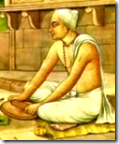
Even the person in the highest position in material life has something to learn from the saint in the bhakti tradition. Money and power are not everything. Without Rama’s help, maya will take hold, and through the instrument of time everything accumulated eventually vanishes. The lone exception is the favor of the Supreme Lord, who stays with the individual from life to life.

In Closing:

Ever since glories of Rama to sing,

Worshiping his feet even the kings.


Not like past from door to door,

For Tulsidas to beg no more.


Still the difference recalling,

How now the Lord helper calling.


High or tall, famous or barely known,

Bhaktas Shri Rama calling His own.

Sunday, January 21, 2018

Trouble Finding Even Spare Change

[Goswami Tulsidas]“The one who never even received broken currency, who was so poor and nobody wanted - Tulsi says that Shri Rama, the protector of the poor, has made him worth so much.” (Dohavali, 108)

lahai na phū।tī kau।dihū ko cāhai kehi kāja |
so tulasī maha'go kiyo rāma garība nivāja ||

Download this episode (right click and save)

It was a long day at the office. You don’t feel like cooking anything. You shouldn’t be eating food from outside, but in this case you feel like there is no choice. You go ahead and order a pizza. While the online system for many places accepts credit cards, this restaurant is more old-fashioned. It’s cash only. The restriction is worth the bother since the food tastes so good.

You don’t even go to the place to pick up. Delivery brings its own joy. You sit there on the couch while waiting for the food to arrive. When it does, you answer the door, ask how much, and then fetch your wallet. Uh oh. Big problem. Not enough money. You’re about a dollar short.

[spare change]You decide to scour the entire house. There has to be enough change lying around. Looking here and there, in shirt and pant pockets, between the cushions in the sofa, you eventually find enough to make the payment. What a relief!

Imagine being in a similar situation but not finding enough money. There is also no guarantee of getting more the next day. Goswami Tulsidas says that his situation was so bad that he couldn’t even get broken currency. He was a beggar by profession, one he accepted voluntarily.

Why would someone suddenly decide to become homeless? Was he not able to work? Was he not willing to put in the necessary effort to hold down a job and sustain a family? By accepting the renounced order of life, sannyasa, Tulsidas agreed to stay poor. This would allow him to better focus on spiritual matters.

The means of eating is begging, going door to door. Don’t accept too much, either; just enough to eat for the day. No saving up for the future. No collecting and gathering. By controlling the senses in this way, Tulsidas lived up to the title of Goswami.

In the beginning he was not very successful in begging; nor was there a lot of prestige. Since he was doing bhajana for Shri Rama, everything eventually changed. He wrote a few poems, and his popularity exploded. He became of the highest value, since what wise person isn’t interested in connecting with the Supreme Personality of Godhead?

Tulsidas reflects on this change, which the wise are known to do. It is seen that one of the qualities of the devotees is thankfulness. An outsider might ask what there is to be thankful about? Even the most popular sannyasi in the world is still a beggar. They are not supposed to have a bank balance. They are not supposed to be wealthy, making million dollar loans here and there.

Shri Rama is gariba nivaja, or the protector of the poor. The stipulation is that the poor must have a connection to Him. Otherwise what is poverty to one person is prosperity to another, since everything is relative in the material world. The poor in this case also means surrendered; they rely entirely on Shri Rama to protect them, to provide for them.

And why shouldn’t He? The animal community does not pray. They do not attend church. They do not show up at the temple with offerings. Still, they get sufficient food to eat. We wouldn’t prefer their quality of living, but it is living nonetheless. They eat, sleep, mate and defend, just like human beings do.

[Goswami Tulsidas]The saints don’t take up devotional service to earn a name, reputation, or fame. They don’t want sufficient food or money. They don’t want to be respected by the entire world. The Supreme Lord is so kind that these things happen automatically. Tulsidas follows the path of Shri Hanuman, who is the best example in this regard. Hanuman is the most famous, though he never seeks any fame. He gets everything he needs for his service to Shri Rama, provided by Rama’s wife Sita, who is the goddess of fortune. The example is there to provide comfort and relief, to give confidence to anyone wishing to surrender completely to the path of bhakti-yoga.

In Closing:

For pizza ordered on the phone,

To pay later, delivered to home.


But with the balance due deficient,

Searching everywhere for change sufficient.


Imagine life always like this then,

Tulsi recollecting previous time when.


But help coming from protector of the poor,

Who welfare of devotees to ensure.

Sunday, January 14, 2018

That Peacock Is Mine

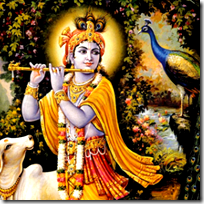
[Krishna with peacock]“The peacock has a strange body, speaks in a cowardly way, eats snakes for food, and has a ghastly mind. Tulsi says that Shri Hari still uses its feathers to adorn the head, and therefore everyone now says, ‘mine.’” (Dohavali, 107)

tanu bicitra kāyara bacana ahi ahāra mana ghora |
tulasī hari bhae pacdhara tāte kaha saba mora ||

Download this episode (right click and save)

Shri Chaitanya Mahaprabhu has said that as Krishna is worshipable, so is His land. The reason is rather obvious. The land is intimately associated with Krishna. Just visiting a place like Vrindavana brings to mind the darling child of Nanda and Yashoda. That boy was naughty in His youth, stealing butter from the homes of the neighbors. The mothers living in those homes would complain, but inside they were delighted by the visits. They didn’t really want Yashoda to punish her child, who was attractive in every way.

Krishna is worshipable since He is the Supreme Personality of Godhead. Another word used in shastra is Hari. This refers to how God takes away pain and distress from the devotees. In the material world something otherwise giving the appearance of auspiciousness turns out to be inauspicious. For instance, earning a lot of money can be detrimental to the path of self-realization. Hari might take certain things away, but the benefit is always there for the devoted soul, after whom He is looking.

[Krishna with butter]Since Krishna is known as the butter thief, in many paintings and statues He is seen in a childhood form with one hand in a pot of butter. A Krishna conscious person can bring to mind such an image simply by opening the refrigerator in the kitchen, where butter is kept.
As the land is worshipable, so is food offered to Him, which when returned becomes known as prasadam. There is tremendous potency in that food, and similarly a single glance at His transcendental form can keep within the mind the vision of that amazing protector of the devotees.

In the above referenced verse from the Dohavali we get another way to remember Krishna. There is a certain visual to the Supreme Lord in that original form. It is not imagined, nor is it merely symbolic. The description is factual, provided by eyewitnesses of the highest character and passed on through the generations in written word.

One aspect to that visual is the peacock feather. It fits nicely on Krishna’s head. The association of that feather with Krishna is so fixed in the minds of the devotees that a simple sighting of such a feather immediately brings to mind the life and soul of Shrimati Radharani.

Tulsidas references the Hindi word mora, which has several meanings. In one meaning it is “mine.” The devotee thinks of Krishna as mora, as the closest friend. That Krishna is so benevolent and compassionate that He can simultaneously be “mine” for every single living entity in the world.

Interestingly, the peacock is otherwise not known for having good characteristics. Its body is strange, due to the complexion. If a person were to have multiple colors on their body, people would certainly think something was wrong. They would ask, “What happened? Did you get some disease? Did you get attacked by some chemical?”

[Krishna with peacock]The peacock speaks in a cowardly way and it eats snakes. Its mind is considered ghora, or ghastly. Still, since it is associated with Shri Hari in His form of Krishna, it earned the name mora. Association with Bhagavan can have this effect. Vibhishana was from a Rakshasa family. Prahlada appeared in a line of Daityas. Vrindavana is made up of dirt, after all. Since there is association with Hari in a mood of love, since there is service rendered, any bad qualities are overlooked, and instead everyone has a favorable view, all due to Hari’s mercy.

In Closing:

Cowardly words to speak,

Snakes for food to seek.


Strange body with colors to see,

How addressed as mine to be?


Because feather on His head considered the same,

Peacock addressed as mora the name.


Connection with Bhagavan having this effect,

Even inauspicious earning respect.