Showing posts with label feature. Show all posts

Tuesday, May 5, 2020

Narasimha Chaturdashi 2020

[Narasimhadeva]“Prahlada Maharaja continued: I received this knowledge from the great saint Narada Muni, who is always engaged in devotional service. This knowledge, which is called bhagavata-dharma, is fully scientific. It is based on logic and philosophy and is free from all material contamination.” (Shrimad Bhagavatam, 7.6.28)

Download this episode (right click and save)

श्रुतम् एतन् मया पूर्वं
ज्ञानं विज्ञान-संयुतम्
धर्मं भागवतं शुद्धं
नारदाद् देव-दर्शनात्

śrutam etan mayā pūrvaṁ
jñānaṁ vijñāna-saṁyutam
dharmaṁ bhāgavataṁ śuddhaṁ
nāradād deva-darśanāt

In a verse in the Shrimad Bhagavatam, Prahlada Maharaja describes Narada Muni as a person who always sees the Divine [deva]. This confirms the truth that a spiritual master, guru, is a tattva-darshi, or one who has seen the truth.

तद् विद्धि प्रणिपातेन
परिप्रश्नेन सेवया
उपदेक्ष्यन्ति ते ज्ञानं
ज्ञानिनस् तत्त्व-दर्शिनः

tad viddhi praṇipātena
paripraśnena sevayā
upadekṣyanti te jñānaṁ
jñāninas tattva-darśinaḥ

“Just try to learn the truth by approaching a spiritual master. Inquire from him submissively and render service unto him. The self-realized soul can impart knowledge unto you because he has seen the truth.” (Lord Krishna, Bhagavad-gita, 4.34)

Narada Muni gave both jnana and vijnana to Prahlada. Simply from hearing there was theoretical understanding and also the practical application of the principles. No field work required, as the bhagavata path is unique and superior in this way. On the occasion of Narasimha Chaturdashi, we celebrate the transfer of power, how Narada Muni gave Prahlada the same ability to always see the Divine.

Anyone can claim that they have jnana and vijnana. The actor wears a lab coat and pretends to be a scientist on the popular television drama series. Wearing the shirt and tie and sitting behind a desk in an important office, another person portrays the leader of a nation.

Prahlada’s jnana was evident in his instructions to the sons of Daityas. These were children of the demon-class, to which Prahlada also belonged. They congregated in school, to be taught on the ways of material life, for ascending to the highest levels of sense enjoyment.

Since Prahlada had contact with Narada Muni much earlier, during the time in the womb, in fact, the priorities were different. The child of only five years was focused on serving the Supreme Lord, Bhagavan. He wanted to impress the idea on to the other students, who were his peers.

Proof of jnana is in the presentation of the principles. If I can memorize certain formulas in mathematics and give the proper answers on a formal examination, it proves that I have learned the material. This is at least to the satisfaction of the instructors.

Prahlada proved vijnana through his unwavering determination in yoga. This was the field work; something like the scientist going to the laboratory to conduct experiments, to prove hypotheses. Prahlada accepted the jnana from Narada, but also acted on it. This is one of the reasons shravanam, hearing, is the most recommended way towards transcendence. It does not require much to practice, and the benefits are enormous.

[Narayana resting]Narada can pass on jnana and vijnana because he has seen the truth and continues to see it. He is a traveler of the three-worlds, and he can visit Vaikuntha anytime he likes. There he sees God in the four-handed form of Narayana, who is lying in rest. Comfortably seated on the serpent bed of Ananta-Shesha Naga, the Supreme Lord has His feet massaged by His wife, Lakshmi Devi, who is the goddess of fortune.

Narada carries that image wherever he goes, retaining the association through chanting the holy name of Narayana. Narada’s disciples are able to do the same, and thus they feel liberated even prior to quitting the body.

Proof of Prahlada’s amazing vision would arrive through the descent of the avatara known as Narasimha. Prahlada always saw Narayana, but the atheistic father refused to believe. He could not acknowledge Narayana as God. Otherwise, the life in pursuit of world dominance would be invalidated. All of Hiranyakashipu’s work would be in vain.

Narayana showed a direct vision to the doubting soul, who could have benefitted from accepting the valuable words of advice from the son. This vision wasn’t the same four-handed one seen in Vaikuntha. It was ferocious and awe-inspiring. It was a special version of kala, which is death. Kala is the way that every person eventually meets God, face-to-face.

[Narasimhadeva]As angry as Narasimha was, because of the torture Hiranyakashipu had previously inflicted on the innocent Prahlada, it was an auspicious occasion, one that continues to be celebrated today. Narayana is the protector of the devotees, and He is never lost to them.

In Closing:

For world domination at any cost,
But for proper direction lost.

Since those words hearing,
And not to transcendence steering.

From saintly son heard,
But only further anger stirred.

Until death as Narasimha to descend,
Celebration to this day to extend.

Wednesday, April 1, 2020

Rama Navami 2020

[Rama firing arrow]“Just as a tree starts to blossom during the proper season, so the doer of sinful deeds inevitably reaps the horrible fruit of their actions at the appropriate time.” (Lord Rama speaking to Khara, Valmiki Ramayana, Aranya Kand, 29.8)

Download this episode (right click and save)

अवश्यं लभते जन्तुः फलं पापस्य कर्मणः।
घोरं पर्यागते काले द्रुमाः पुष्पमिवार्तवम्।।

avaśyaṃ labhate jantuḥ phalaṃ pāpasya karmaṇaḥ।
ghoraṃ paryāgate kāle drumāḥ puṣpamivārtavam।।

It is only understandable to turn to prayer in times of great difficulty. Where the reality of the fragile nature of the body-life combination hits home. Where the event known to be inevitable gives a reminder of its closely approaching arrival.

Nature’s law must still operate. It is only fair, after all. Prayers will not do much, if not directed towards a higher purpose. These are the teachings of His Divine Grace A.C. Bhaktivedanta Swami Prabhupada, who follows in a line of self-realized leaders originating with the Supreme Personality of Godhead Himself.

[Shrila Prabhupada]On the occasion of Rama Navami, we celebrate the rare, but special instances of God the person delivering the appropriate consequences to action. As His words are eternally beautiful, so are the lessons He imparts through His lila.

The setting for one of those lessons was the Dandaka forest. As a brief background, a group of man-eating ogres had been invading the area on a regular basis. They were looking for humans to eat. They waited until nighttime, so as to not be seen. They chose an opportune moment for them, when their future prey would be otherwise distracted.

Notably, those victims were the most innocent in society. Vedic teachings give the formula for both material and spiritual happiness. If a society desires peace, prosperity and an absence of distress, there are certain entities which must be protected.

The brahmanas are foremost among them. This is the priestly class, determined specifically by guna and karma. The material qualities must be there, along with corresponding work. The brahmanas are very dear to the Supreme Lord, as they generally do not look for an income, material comforts, or personal advancement. In response to that sacrifice, they are protected by those in charge of preventing injury [kshatriya].

In the Dandaka forest the brahmanas did not expect any trouble. The area was away from civilized society. I am not bothering anyone by taking up residence in a remote place. There I am better able to fix my consciousness on the lotus feet of the Divine.

Those plans were ruined by the Rakshasas coming from Lanka. They would attack during the time of yajna. This was the moment of fruition for the brahmanas in their religious efforts. The Rakshasas knew that as more yajnas were successfully conducted, the stronger the forces of good would be, which were concentrated in the heavenly region.

The Rakshasas would attack in a most cowardly way. Taking false forms and then eating their victims, they assumed everything went unnoticed. After all, there were no immediate consequences. It would be as if the criminals were let out of jail and the government did nothing to stop it.

As mentioned previously, the laws of nature are not deficient. They respond at the appropriate time and with the proper punishment. The avatara of Rama spoke this lesson to one of the greatest sinners, Khara. He was soon to meet the fate of the many brahmanas he had previously killed.

This moment is glorious because it is another instance of the victory of dharma over adharma. It proves that the ever-watchful eye does not blink. Antaryami witnesses everything. This is one of Rama’s features. While He typically remains neutral and allows His material nature to handle punishment and reward, in special cases He personally intervenes.

[Rama firing arrow]On the negative side the intervention is with the Rakshasas of Lanka, and on the positive it is with the devotees who are always thinking of Him. Rama boosts their devotional efforts to a level empowering a guaranteed return trip to the spiritual world after the completion of this life, where the harsh material nature no longer applies.

In Closing:

On this Rama Navami day,
To Sita’s husband to pray.

That my punishments just,
For proper arrival trust.

Like with demon Khara found,
Once on Dandaka ground.

That watching lotus-eye never closing,
Squashing those dharma opposing.

Sunday, March 8, 2020

Gaura Purnima 2020

[Lord Chaitanya]“According to their karma, all living entities are wandering throughout the entire universe. Some of them are being elevated to the upper planetary systems, and some are going down into the lower planetary systems. Out of many millions of wandering living entities, one who is very fortunate gets an opportunity to associate with a bona fide spiritual master by the grace of Krishna. By the mercy of both Krishna and the spiritual master, such a person receives the seed of the creeper of devotional service.” (Chaitanya Charitamrita, Madhya 19.151)

Download this episode (right click and save)

ब्रह्माण्ड भ्रमिते कोन भाग्यवान् जीव
गुरु-कृष्ण-प्रसादे पाय भक्ति-लता-बीज

brahmāṇḍa bhramite kona bhāgyavān jīva
guru-kṛṣṇa-prasāde pāya bhakti-latā-bīja

If you have heard the maha-mantra you are very fortunate. You fall into the category of “bhagyavan jiva”, as expressed in a wonderful Bengali verse by Chaitanya Mahaprabhu, the golden avatara appearing specifically to rescue the souls lost in this dark age of quarrel and hypocrisy, Kali-yuga. The occasion of Gaura Purnima falls on the day of the year of His appearance, based on the lunar calendar .

The seed of the creeper of devotion, bhakti, arrives through the via medium of the spiritual master. Such contact is not a chance occurrence. A person must be very fortunate; they have to be favored by the Almighty, who is known as Bhagavan since He possesses every fortune simultaneously and to the fullest extent.  He is also known as Krishna since He is all-attractive.

[Lord Krishna]In the form of the human body I can find myself in a variety of situations. We notice the vast difference between taking birth in a poor country versus living in a place full of modern amenities, where there is no shortage of food or clothing.

I could be surrounded by sense gratifiers; people who are only interested in the animal activities of eating, sleeping, mating and defending. Increasing the degree of indulgence in each area, but never finding true happiness. Considering this life to be everything; not preparing for the next. Having no idea of the distinction between body and spirit; overjoyed at acceptance and deeply saddened at separation.

On the other side, I could know the differences. Confirming my suspicions aroused through many years of experience, I learn that simply engaging the senses will never make a person happy. Not that dry renunciation will help much, either.

I must have a higher goal. I must work towards the satisfaction of the master of all senses, Hrishikesha. He is all-attractive, so the effort to please Him is not devoid of fun and excitement. The bliss only increases, with the reservoir impossible to fill, as confirmed by Maharishi Valmiki in his conversation with Shri Rama wonderfully presented in the work of Goswami Tulsidas known as the Ramacharitamanasa.

If I know the futility of material life and how serving God is everything, I have been blessed by higher powers. The spiritual master has reached my world to influence me. Another person may not be so lucky. They may not be favored, in spite of being blessed with the same auspicious human form.

Because of Chaitanya Mahaprabhu, so many more people have become fortunate. Rather than wait for the possible meeting, the Supreme Lord increases the chances of it happening. He does not remain satisfied with creating a system of parampara and supporting it with sacred texts like Bhagavad-gita and Shrimad Bhagavatam.

He arrives in this manifest world as Chaitanya Mahaprabhu to display how to live the principles of those important works composed in the Sanskrit language. He distributes the mercy of the Divine to every person, irrespective of their pedigree determined by birth. He does not discriminate between man or woman, as every person is an individual soul eternally tied to the Supreme Lord.

[Lord Chaitanya]Chaitanya Mahaprabhu creates auspicious circumstances through the sankirtana movement, which is the chanting of the holy names: Hare Krishna Hare Krishna, Krishna Krishna, Hare Hare, Hare Rama Hare Rama, Rama Rama, Hare Hare. Chaitanya earns the honor of being the most munificent avatara of the Almighty, and on Gaura Purnima we take special time to remember and serve Him.

In Closing:

So fortunate is He,
Chaitanya’s form to see.

Because then easily to understand,
That identity not from leg or hand.

That spiritual life with purpose meant,
From village to village Gaura went.

So that every person getting the chance,
Their fortunes greatly to enhance.

Sunday, October 27, 2019

Govardhana Puja 2019

[Govardhana Puja]“When everything was complete, Krishna assumed a great transcendental form and declared to the inhabitants of Vrindavana that He was Himself Govardhana Hill in order to convince the devotees that Govardhana Hill and Krishna Himself are identical. Then Krishna began to eat all the food offered there.” (Krishna, The Supreme Personality of Godhead, Vol 1, Ch 24)

Download this episode (right click and save)

Bhakti-yoga is not a dry or tasteless activity, reserved only for the time after the transition to statelessness. The individual can never be without individuality. They always have the service tendency, though sometimes it can be greatly suppressed or misdirected.

As the occasion of Govardhana Puja relates to Bhagavan, the Supreme Personality of Godhead, it is an ideal case study on the emotions that can be involved in the direct interaction with the person who is beyond the material world and the different concepts in duality, such as birth and death, manifest and unmanifest, and close by and far away.

1. Gratefulness

The setting is the farm community of Gokula Vrindavana. The people are simple, but also intelligent. They are not chasing after money, wealth or fame. They are satisfied with what the cows and the land produce. The animals under their care are happy and free to roam about. They are not afraid of untimely death for the purpose of satisfying the human taste buds.

[Krishna with cows]The tradition in that area is to worship the god of heaven, Indra. There is a puja in his honor, and it is more or less a formality. The people are grateful for the rain arriving from up above. This is an aspect of nature that can never be controlled or replaced. No matter how much technology advances, the essential aspects of life like sunlight, rain, air, and land remain.

Nanda Maharaja leads the way. He directs the entire community. No one has an issue with the Indra-puja, except for Nanda’s son Krishna. As children are known to be, Krishna is curious as to what is going on. Why the preparations? Who is this Indra that needs to be worshiped? What happens if you don’t pay homage?

2. Envy

As He is the Supreme Lord, Krishna has the most intelligence. At a young age He gives wonderful arguments to the father. The objective is to direct the puja paraphernalia to the nearby Govardhana Hill instead. Krishna gives the justification that the cows are the most dear to the community. Since Govardhana is dear to the cows, it should be worshiped instead of Indra.

Nanda proposes conducting both worship ceremonies simultaneously, but Krishna convinces him to focus only on Govardhana Hill. What will happen if you skip Indra’s puja for one year? There should be some satisfaction from the many past performances.

Unfortunately, the ways of envy are not logical. Indra immediately forgets the past and focuses only on the present, which he considers to be the greatest insult. Envious of Krishna’s influence on the people, Indra directs the cloud of destruction, the one reserved for the end of the world, to target the Govardhana area. This would surely wipe everyone out, but revenge was primary on his mind.

3. Fear

Even in the presence of the Supreme Lord there can be fear. Not necessarily that He will attack or punish without justification; fear that something bad will occur. That is possible when the relationship is so close that a person forgets they are in the presence of the Almighty.

This fear is actually auspicious. Though the residents were afraid for their lives, they had the shelter of Shri Krishna. After Indra’s attack, Nanda’s son wisely used the just worshiped hill as an umbrella. A small child is capable of lifting a gigantic hill and holding it up in the air only if the visual of the body has no bearing on potency.

This incident proves that Krishna is not limited by the supposed form He manifests. He can eat with His eyes, run with His mind, and hear with His hands. He can rest the heaviest object on the weakest finger on the typically non-dominant hand and not feel any discomfort.

4. Forgiveness

Under common law, a person who intentionally tries to wipe innocent people out with a targeted attack of massive amounts of water would face stiff punishment. The justice system would send them away for a long time.

[Govardhana Puja]Shri Krishna is so kind that He forgives instantly. He would have to; otherwise no one could return to His spiritual kingdom. Every person has some flaws, defects, or past behavior over which they are not proud. Indra’s transgression happened to occur on the largest scale, but his subsequent words of contrition were enough to win the favor of the Supreme Lord.

In Closing:

Despite from envy spinning,

Indra later His favor winning.


Emotion in bhakti life to see,

Not like motionless stone to be.


Grateful for the cows and land,

Fear from lack of control to command.


Amazing but events not fictitious,

When related to Krishna auspicious.

Saturday, October 26, 2019

Diwali 2019

[Sita-Rama on Pushpaka]“O Sita, see the golden lord of mountains [Mainaka], which is golden-peaked and which rose up, piercing the ocean, to provide rest to Hanuman.” (Lord Rama speaking to Sita Devi, Valmiki Ramayana, Yuddha Kand, 123.18)

Download this episode (right click and save)

हिरण्यनाभन् शैलेन्द्रन् काञ्चनं पश्य मैथिलि ||
विश्रमार्थन् हनुमतो भित्त्वा सागरमुत्थितम् |

hiraṇyanābhan śailendran kāñcanaṃ paśya maithili ||
viśramārthan hanumato bhittvā sāgaramutthitam |

Diwali is commonly known today as the festival of lights, associated primarily with the Hindu faith. At its foundation, the annual tradition follows in the footsteps of residents of a specific city many thousands of years ago.

If there is any faith involved, it was in the eager anticipation of the return of the prince of Ayodhya. He is the Supreme Lord Himself, but to the common people He was the beloved son of King Dasharatha, their leader for so many years.

The lights were aligned as a great welcome, a homecoming of the triumphant son, who defeated the forces of evil concentrated in Lanka at the time. Since Lanka was far away, an island, Rama and company used a special aerial car to return.

[Sita-Rama on Pushpaka]Known as the Pushpaka, its path crossed over many places relevant to Rama’s journey to victory. His wife Sita was separated from Him during most of that time, so Rama took the opportunity of the plane ride to point out various places of significance.

1. Mount Mainaka

It almost seems strange that Dasharatha’s eldest son would mention this. The incident was brief, but to the participants the interaction meant everything. The mountain called Mainaka, which has a beautiful golden color, rose through the ocean to offer assistance to Shri Hanuman.

This was worth mentioning to Sita because it shows that Hanuman had well-wishers. The brave Vanara warrior was the one who first searched for Sita in Lanka, while Rama and company were back on the other side of the ocean. Hanuman’s journey was a difficult one, but Mainaka was kind enough to offer a resting place, though Hanuman did not require it.

2. People killed by Hanuman

From reading the sacred Ramayana poem of Maharishi Valmiki, we quickly realize that Hanuman holds a special place in the estimation of the Supreme Lord. Rama made sure to point out other areas of significance related to Hanuman.

He showed Sita where various enemies were killed by that brave Vanara warrior. It was a massive fight to defeat Ravana and his Rakshasa forces. These evildoers were not ready to give up the daughter of King Janaka without a fight.

Rama is God, so He does not require assistance in accomplishing tasks. Yet He understands the service mentality ingrained in the spirit soul. When the fortunate ones are in His company, Rama provides ample opportunity for service to take place, in a mood suited to the individual’s qualities.

Hanuman’s qualities are so deep and far-reaching that he exercises service in a variety of ways. He can use his brain to cleverly maneuver difficult circumstances. He can expand his stature and leap a great distance. He can also heroically fight against combatants holding the most powerful weapons and using black magic to assist in their illusion.

3. Building the bridge

Hanuman crossed the ocean by leaping over it, but this could not be done by everyone else. Rama was with His younger brother Lakshmana, and the two intentionally moved by foot to stay true to a vow of ascetic life.

Rama could not return home to use His royal army, either. But since Bhagavan is automatically related to everyone, He was able to find capable warriors in the forest of Kishkindha. The Vanara-king Sugriva joined the cause, bringing his many enthusiastic warriors with him.

Those servants built a bridge out of floating rocks. This allowed for Rama and everyone else to cross to reach Lanka, where Ravana had hidden Sita. Rama showed this bridge to Sita and explained how everything was done for her.

4. Receiving Mahadeva’s prasada

[Worshiping Mahadeva]A popular painting depicts Rama worshiping a deity of Mahadeva, Lord Shiva. This is done prior to the final battle against the Rakshasas of Lanka. Though God does not require help in gaining victory, He holds tremendous affection for those aligned with Him. Rama sets the proper example in the respect that should be extended to Lord Shiva. On the aerial car, Rama showed the specific area where the worship took place, where Mahadeva gave his prasada, or mercy.

5. Mount Rishyamukha

Around this area is where the aerial car made a brief landing. Listening attentively to her husband, Sita could not help but think of the wives of the Vanaras. They were separated from their husbands, just as she was. Sita wanted them to board the plane and return home for the triumphant celebration. Like her husband, the goddess of fortune is not a miser when it comes to accepting honor and glory.

Understanding the amazing characteristics of that Divine couple, it is not a surprise that Ayodhya celebrated the way they did. It is also not surprising that the tradition carries on to the modern day, where Sita and Rama continue to extend their mercy to the devotees.

In Closing:

Mercy continuing to extend,

From original tradition to descend.


Where Ayodhya’s people to earn,

That long awaited return.


While on aerial car seated,

Events shown like Rakshasas defeated.


And Hanuman leaping over ocean where,

The Divine couple of sacrifices aware.

Monday, October 7, 2019

Dussehra 2019

[Shri Rama]“The mighty Rama, who possessed extraordinary strength, consecrating in accordance with the mantras prescribed in the Vedas, taking that great arrow – which was capable of removing the fears of the entire world and the Ikshvaku dynasty, capable of taking away the glory of His enemies, and conducive to His own happiness – fixed it on His bow.” (Valmiki Ramayana, Yuddha Kand, 108.13-14)

Download this episode (right click and save)

It is not just a religious holiday to be observed as part of tradition or what others in the community pressure you into. It is not merely for paying respect, as one look at this vast creation is enough to be spellbound at the artistic ability of the creator.

Like other notable occasions in the annual Vaishnava calendar, Dussehra is meant for giving pleasure. The soul is naturally blissful. The property is known as ananda, and it descends from the Supreme Lord, who is always full of bliss and knowledge.

Events relating to the triumph of Vishnu over the asura elements of society give pleasure to the fallen souls who are struggling through the myriad births in various species. The elevated, important personalities also take great joy in both witnessing the original event and commemorating on the subsequent anniversary days.

1. Agastya

The jar-born one is an important rishi of the Vedic tradition. Shri Rama, who is the incarnation of Vishnu central to the Dussehra celebration, offers Agastya the highest praise. Rama tells His younger brother Lakshmana that Agastya’s piety is at such a high level that the wrongdoers cannot even approach the rishi’s ashrama.

Agastya takes pleasure in the event of Rama slaying the Rakshasa leader named Ravana. Though God does not require help in accomplishing a task, He allows others to participate, giving opportunities for the active tendency in service to manifest. Prior to finally defeating Ravana in a long, drawn-out battle, Rama receives assistance from Agastya on how to proceed.

2. The sun-god

The help is in the form of a mantra. Agastya advises Rama to worship the sun-god. This is appropriate for many reasons. The sun dissipates darkness. The sun is light, or the mode of goodness, and darkness is the mode of ignorance. Rama is the original effulgence of this universe, as hinted at by Shri Krishna in the Bhagavad-gita.

न तद् भासयते सूर्यो
न शशाङ्को न पावकः
यद् गत्वा न निवर्तन्ते
तद् धाम परमं मम

na tad bhāsayate sūryo
na śaśāṅko na pāvakaḥ
yad gatvā na nivartante
tad dhāma paramaṁ mama

“That abode of Mine is not illumined by the sun or moon, nor by electricity. One who reaches it never returns to this material world.” (Lord Krishna, Bhagavad-gita, 15.6)

Rama also appears in a dynasty of kings that originates with the sun-god, Vivasvan. Therefore, it is something like the family tradition to be blessed by the maker of the day. The sun-god is a distinct personality, and he takes great pleasure in playing a role in the defeat of the dread of the saintly class, Ravana.

3. Lord Brahma

He is the creator. Also known as Svayambhu, he is the first living entity. Not knowing what to do at first, he meditates. He hears the sound of tapa, which means “austerity.” Through that practice he receives further guidance from the Supreme Lord on how to proceed in life.

स चिन्तयन् द्व्य्-अक्षरम् एकदाम्भस्य्
उपाशृणोद् द्विर्-गदितं वचो विभुः
स्पर्शेषु यत् षोडशम् एकविंशं
निष्किञ्चनानां नृप यद् धनं विदुः

sa cintayan dvy-akṣaram ekadāmbhasy
upāśṛṇod dvir-gaditaṁ vaco vibhuḥ
sparśeṣu yat ṣoḍaśam ekaviṁśaṁ
niṣkiñcanānāṁ nṛpa yad dhanaṁ viduḥ

“While thus engaged in thinking, in the water, Brahmaji heard twice from nearby two syllables joined together. One of the syllables was taken from the sixteenth and the other from the twenty-first of the sparsha alphabets, and both joined to become the wealth of the renounced order of life.” (Shrimad Bhagavatam, 2.9.6)

[Lord Brahma]It is Brahma’s arrow which gets released to deal the final blow to Ravana. Thus Brahma is an integral part of the origin of the Dussehra event. Though he helps both saints and sinners alike, Brahma’s actual interest is on the side of good. Whatever boons Ravana may have received previously were nullified through another blessing from Brahma, but this time offered to Rama.

4. Durga Devi

Dussehra occurs at the end of a series of days dedicated to worshiping the wife of Lord Shiva. One of her names is Durga, and she is something like the manager of the fort that is the material world. That fort is difficult to cross over; hence her name.

Rama killing Ravana gives her great pleasure, as she is always on the side of good, like her husband. She is associated with the event, as well, for the Supreme Lord includes others in festive occasions. Just as the Vanaras from Kishkindha helped in defeating the Rakshasa army in Lanka, so Durga Devi was there to offer assistance.

5. Mahadeva

This is interesting for the reason that it is well-known that Ravana was a devotee of Shiva. In truth, the relationship started out differently. As he was towards practically any powerful person, Ravana tried to compete with Lord Shiva. After being defeated and releasing a loud scream of pain, he finally surrendered.

Mahadeva is a great devotee of Rama, though. The relationship with Ravana was something like business associates, though there was no real interest for Shiva to meet. The husband of Durga Devi rejoices in Rama’s victory. He is also associated in a way, since Rama prays to Mahadeva for a successful outcome just prior to the battle. During the return trip home to Ayodhya, Rama points out the location of the puja to His wife Sita Devi. He specifically says Shiva gave his prasada, or mercy.

The victory is more than just the triumph of good over evil. The suras and the asuras have been at odds since the beginning of time. Like the changing of seasons, sometimes the influence of good rises, and sometimes the most sinful ascend to the top.

[Shri Rama]The uniqueness of Ravana’s fall is that it took place directly at the hands of the Supreme Lord. Thus there is added significance, which can be studied, remembered, and discussed for years and years, with further enlightenment taking place throughout the process.

In Closing:

On further enlightened ground,

When topics of Dussehra to sound.


Annual occasion worth celebrating,

Where God His power demonstrating.


Brahma and others included too,

When Rama that arrow drew.


For the benefit of mankind released,

After too much asuras increased.

Thursday, September 5, 2019

Radhashtami 2019

[Shrimati Radharani]“In the same Karnamrita there is another statement about the chanting of Radharani. It is said by one of the associates of Radharani: ‘O Lord Govinda, the girl who is the daughter of King Vrishabhanu is now shedding tears, and She is anxiously chanting Your holy name - Krishna! Krishna!’” (The Nectar of Devotion, Ch 18)

Download this episode (right click and save)

Friend1: I particularly enjoy visiting a temple on Radhashtami day.

Friend2: Explain what that is.

Friend1: The appearance day anniversary for Shrimati Radharani. Something like a birthday, but more.

Friend2: And who is Radharani?

Friend1: She is the energy of God. The feminine side to the Divine. The Supreme is both male and female. Just as the two mix in this world to continue life, so the combination of male and female are responsible for the entire cosmic manifestation. The male is the enjoyer and the female the enjoyed.

Friend2: Who is the enjoyer?

Friend1: Shri Krishna, the Supreme Personality of Godhead.

[Radha-Krishna]Friend2: What about Vishnu? Where does He fit into this?

Friend1: The same Almighty manifesting in different ways. You never lose the combination of male and female. Radha is with Krishna. Lakshmi Devi with Vishnu. Sita Devi with Rama. The energy on the right side of the image and the energetic on the left.

Friend2: Are we not the energy, too?

Friend1: A different category, but with a similar position of “enjoyed.” We think otherwise; that I am the greatest enjoyer, purusha. Actually, we are prakriti in comparison to the original purusha. That is what makes Radharani so special. She is the ideal companion to Krishna. She is the energy, but one that is completely pure in consciousness. She never falls into illusion, or maya. We have that vulnerability, but she does not.

Friend2: Why do you prefer her appearance day? What about Krishna’s? How about Diwali and other celebrations?

Friend1: On Janmashtami the temples get very crowded. Don’t get me wrong, I’m not putting down any of the other holidays on the Vaishnava calendar. To me there’s just something special with the energy of God. It’s like we almost prefer to celebrate her more.

Friend2: That is the mood in Vrindavana, which is a spiritual place. The residents tend to say, “Radhe, Radhe,” more than they do Krishna’s names.

Friend1: Speaking of names, I know that one of Radha’s other names is Vrishabhanu-suta.

Friend2: This means “daughter of King Vrishabhanu.” He lives in a town nearby Krishna’s Gokula. These are from the pastimes in the manifest world, which are described in sacred texts like the Puranas and derivative works by saints appearing in the disciplic succession.

Friend1: There is something to that bond between father and daughter. Vrishabhanu must be very special to have received the goddess of fortune in his family.

Friend2: Absolutely. That is one way to look positively on the birth of a female child. The daughter is an extension of Lakshmi Devi. In Vrishabhanu’s case it was Lakshmi herself in his home.

Friend1: What about the issue of separation? In Vedic culture that is of particular concern for the father of the bride. He knows that one day he will have to part ways with someone so dear to him. It is a kind of torture, if you think about it.

Friend2: How is that?

Friend1: You were going through life just fine prior. Then this amazing person appears. They give you more happiness than you ever imagined possible. But one day you will have to part ways. The responsible thing to do is to arrange for a marriage at the appropriate age.

Friend2: Ensure that the child is always protected. Rather than be selfish, think of the wellbeing of your dependent.

Friend1: It just seems unfair, the separation aspect.

[Shrimati Radharani]Friend2: Sadly, separation is part of life. Fortunately, with the Supreme Lord and His energy you can always keep them close by. Upanayana is the formal ceremony marking the approach towards the representative of Radha and Krishna. The guru teaches how to maintain their association, to never feel like you are separated from them. The Radhashtami celebration is a tradition aimed at that purpose. We can remember the daughter of Vrishabhanu every single day through saying her names like Hare and Radhe, and also on the special occasions relating to her dealings with Krishna.

In Closing:

Baby arriving in home one day,

Daughter of Vrishabhanu to say.


Radhashtami the appearance celebrating,

Who of pure devotion demonstrating.


That eventual separation not fair,

Joy now but of future aware.


From guru approach technique learning,

That distance into closeness turning.

Thursday, May 16, 2019

Narasimha Chaturdashi 2019

[Prahlada thrown off cliff]“Hiranyakashipu could not kill his son by throwing him beneath the feet of big elephants, throwing him among huge, fearful snakes, employing destructive spells, hurling him from the top of a hill, conjuring up illusory tricks, administering poison, starving him, exposing him to severe cold, winds, fire and water, or throwing heavy stones to crush him. When Hiranyakashipu found that he could not in any way harm Prahlada, who was completely sinless, he was in great anxiety about what to do next.” (Shrimad Bhagavatam, 7.5.43-44)

Download this episode (right click and save)

दिग्-गजैर् दन्दशूकेन्द्रैर्
अभिचारावपातनैः
मायाभिः सन्निरोधैश् च
गर-दानैर् अभोजनैः
हिम-वाय्व्-अग्नि-सलिलैः
पर्वताक्रमणैर् अपि
न शशाक यदा हन्तुम्
अपापम् असुरः सुतम्
चिन्तां दीर्घतमां प्राप्तस्
तत्-कर्तुं नाभ्यपद्यत

dig-gajair dandaśūkendrair
abhicārāvapātanaiḥ
māyābhiḥ sannirodhaiś ca
gara-dānair abhojanaiḥ
hima-vāyv-agni-salilaiḥ
parvatākramaṇair api
na śaśāka yadā hantum
apāpam asuraḥ sutam
cintāṁ dīrghatamāṁ prāptas
tat-kartuṁ nābhyapadyata

The father was determined; of that there is no doubt. Once the decision was made to terminate the existence of the obstinate son, who refused to abandon worship of Vishnu despite every warning of the impending consequences to such action, Hiranyakashipu would go to any length to see success. On the occasion of Narasimha Chaturdashi, we celebrate his colossal failure, which was not due to a lack of effort.

Those acquainted with Vedic culture have likely heard the story. There is the annual celebration of Holi, known for its many colors tossed here and there amongst friends and family. The origin is an incident involving Prahlada Maharaja, who withstood an attack from the father. He survived being placed in fire, while the father’s sister, who was thought to be immune, perished and left behind ashes of different colors.

It was a triumph of good over evil, similar to Dussehra, but with additional significance. The exercise of devotion receives protection from the mighty arm of the Supreme Lord. Even when sufficient physical strength appears to be lacking, when the antagonist has the weight of force and manpower supporting them, the exercise is allowed to continue. In Prahlada’s case it flourished.

Hiranyakashipu went to unspeakable lengths. This is symbolic of the mentality of the asura. Despite so much evidence to the contrary, they continue in their opposition to God. They would rather stamp out every mention of His name than pause for a moment to ponder the thought of His existence and supremacy.

From a single verse in the Shrimad Bhagavatam we get a sampling of the efforts made against the innocent son. Prahlada’s only crime was showing allegiance to the origin of everything. Vishnu is the source of strength, including the ability employed by the father and his attendants.

1. Thrown beneath elephants

This should have been sufficient. How could a five-year-old boy tolerate such a massive weight placed on his body? This defies the laws of physics.

2. Throwing among snakes

Poison acts quickly. Just one snake is enough, but for Prahlada there were many. The king had no problem seeing his son in such a dangerous situation.

3. Employing destructive spells

In the modern day someone with such an ability might mistakenly be identified as God. In truth, destructive spells have been around since before anyone can remember. It is a kind of art form, and sometimes the bad people, the asuras, use them to further their plans of destruction.

4. Hurling from the top of a hill

[Prahlada thrown off cliff]A struggling parent may have this urge every now and then when dealing with a child who won’t stop crying, but only a crazy person carries through. Hiranyakashipu had every intent from the beginning. It was a premeditated attack, and also one that failed.

5. Conjuring up illusory tricks

From the Ramayana we learn of incidents where Rakshasas showed false visions on the battlefield. This is a way to dispirit the enemy. Something like a psychological operations campaign, make the other side think that there is no hope. The Supreme Lord dispelled those illusions by releasing arrows, and for the devotees He does the same through the torchlight of knowledge.

6. Administering poison

If the snakes can’t succeed, then feed directly. Mix poison into the food. Perhaps have the child drink it. Regardless, no need to mess around.

7. Starving him

Improper food not having an effect? Go in the reverse direction. Simply withhold food or drink. Make Prahlada starve. That didn’t work, either, though. The son of the Daitya king showed amazing resilience.

8. Exposing to severe cold, winds, rain and fire

It is common to complain about the situation during the winter.

“I swear, I am never tolerating this again. I have had enough. Who wants to live in a freezer for three months out of the year? This is too much to take. I would prefer anywhere else.”

Then when the summer rolls around, the complaints go in the opposite direction.

“This is unbearable. Not even the air conditioner is helping. I must say, this is much worse than the winter. I will take the cold and snow over this any day.”

Mother nature is one of the primary sources of misery in a material existence. The elements each have their role to play, but in severe form they can cause great distress. Hiranyakashipu used this to his advantage, though none was forthcoming. Prahlada continued to meditate on Vishnu.

9. Throwing heavy stones

Crush Prahlada with weight. Though elephants didn’t work, maybe there wasn’t a direct strike. See firsthand how Prahlada handles the drastic difference in weight.

[Narasimha]From the broad spectrum of weapons employed we see that Hiranyakashipu left no stone unturned (no pun intended). Amazingly, it would take just the nails on a lion-like figure to do away with the father. The same strength that was protecting Prahlada the entire time manifest in an amazing half-man/half-lion creature. This was the same Vishnu worshiped by the son and hated by the father.

In Closing:

To kill Prahlada to try,

With lethal force to apply.


Underneath elephants to trample,

Or fed with poison ample.


Off of cliff to hurl,

Snakes around him to curl.


The son every time to survive,

Until finally Vishnu to arrive.

Friday, April 12, 2019

Rama Navami 2019

[Shri Rama]“Of all the aquatics the shark is one of the biggest and is certainly the most dangerous to man. Thus the shark represents Krishna. And of rivers, the greatest in India is the Mother Ganges. Lord Ramachandra, of the Ramayana, an incarnation of Krishna, is the mightiest of warriors.” (Shrila Prabhupada, Bhagavad-gita, 10.31 Purport)

Download this episode (right click and save)

It is a date marked in bold on the Vedic calendar, which is based on the lunar cycle. This means that the observance does not necessarily fall on the same date every year in the modern calendar, but the season and month are more or less predictable. The occasion of Rama Navami is for celebrating the appearance in this world of the Supreme Lord Rama. He is considered an avatara, or one who descends. As stated in the Bhagavad-gita, there is a specific purpose along with accompanying conditions to trigger the travel from another world.

यदा यदा हि धर्मस्य
ग्लानिर् भवति भारत
अभ्युत्थानम् अधर्मस्य
तदात्मानं सृजाम्य् अहम्

yadā yadā hi dharmasya
glānir bhavati bhārata
abhyutthānam adharmasya
tadātmānaṁ sṛjāmy aham

“Whenever and wherever there is a decline in religious practice, O descendant of Bharata, and a predominant rise of irreligion - at that time I descend Myself.” (Lord Krishna, Bhagavad-gita, 4.7)

Displaying a human-like form, Shri Rama is relatable. Though He walked this earth during an ancient time period, where the primary method of travel was horse and chariot and governments were monarchies, the lessons from the events described in the Ramayana are timeless.

There is significance to everything Bhagavan does. The image of Vishnu lying down in rest, for instance, has extensive symbolism. Vishnu creates the universes, and the work gets accomplished effortlessly. He lies down and breathes. That is it. Upon exhaling everything manifests and upon the subsequent inhaled breath everything returns to the origin.

With Shri Ramachandra, the hero of the Raghu dynasty, the interactions with friends and foes provide lessons applicable to every person in this world, at whichever stage of progress they may find themselves.

Gave service to others

As shown with Vishnu, God can accomplish the most difficult work without much exertion. I struggle to wake up on time in the morning to get ready for work. I am bogged down by requests coming from every direction. I am tired of having to carry supplies into the house every day. When will I find peace?

As visible in the Varaha incarnation, the Supreme Lord can put the entire burden of the world on His shoulders. He does not shrug or show signs of fatigue. This means that Rama could have done whatever was necessary, whenever the time was right.

Instead, He allowed others to serve Him. They were eager to do so. The wife Sita Devi would not leave His side, if she had the choice. The younger brother Lakshmana would sacrifice sleep in order to ensure the safety of Sita and Rama.

[Shri Hanuman]Hanuman, who was not a direct relative, put everything at risk in his service to Rama. He travelled to foreign territories, inhabited by hostile combatants, only for the purpose of search and locate. Hanuman’s friends, numbering in the many thousands, also contributed efforts on Rama’s behalf.

Showed His allegiance to devotees

This service spirit is inherent within all of us. The new father makes sacrifices he never before thought possible. He gets up in the middle of the night to drive the baby to the hospital, when needed. He may change diapers, prepare formula, or even walk around with the child to help them fall asleep.

The ideal match for the drive for service is the Supreme Lord. This is the dharma of the individual. They cannot live without this property. Shri Rama allows others to serve Him because He knows that will make them happiest.

Though they seek nothing in return, Rama is forever loyal to them. He accepts the monkey-like person named Sugriva as an equal. He gives liberation to the departing vulture known as Jatayu. Rama risks spoiling His own reputation in order to preserve the good name of His wife.

Fought alone against the greatest materialist

The material world is conducive to challenging God. That is the fuel of the engine of reincarnation. For as long as a person wants to try to become the supreme being themselves, they get to remain in a shadow copy of the spiritual realm. Life after life, birth after birth, until they finally tire and wave the white flag of surrender.

Rama matched up against the greatest materialist. The ten-headed king of Lanka thought he had everything necessary to dominate in perpetuity. Ravana was living comfortably, but he was uneasy in consciousness. His senses drove him instead of the other way around.

Because of the many despicable acts committed, Ravana had amassed a large debt of punishment ready to mature. Rama could have taken care of Ravana in so many ways, but in the end He decided to fight in seemingly neutral circumstances. On the battlefield, in Ravana’s home territory, using weapons of the time.

[Shri Rama]Ravana had the advantage of ten heads and twenty arms; Rama was just standing on His chariot. The materialist was allowed to challenge however they wanted, but they still lost. Rama and the dharma He supported prevailed, as they always do. On the occasion of Rama Navami we remember that most merciful one, who is the life and soul of heroes like Shri Hanuman and saints like Goswami Tulsidas.

In Closing:

By just releasing arrow or two,

Shri Rama easily can do.


Not having on others reliance,

But still with Sugriva an alliance.


And Hanuman’s bravery accepting,

The turncoat brother not rejecting.


Since the service spirit facilitating,

Honored on Rama Navami celebrating.

Tuesday, March 19, 2019

Gaura Purnima 2019

[Lord Chaitanya]“Shri Chaitanya Mahaprabhu's special mission is the deliverance of all fallen souls in Kali-yuga. Devotees of Krishna must persistently seek the favor and mercy of Shri Chaitanya Mahaprabhu to become fit to return home, back to Godhead.” (Shrila Prabhupada, Chaitanya Charitamrita, Madhya 14.16 Purport)

Download this episode (right click and save)

Kali-yuga is like an ocean of faults. No one has a complete understanding of just how deep the difficulties stretch. There is one problem after another, with forces impeding genuine progress on all sides. The material world itself is like a vast ocean of suffering that is difficult to cross, and in the age of quarrel and hypocrisy the degree of difficulty increases significantly.

Thankfully, someone special once arrived on a full moon night in the month of Phalguna. Soon to be known as Chaitanya Mahaprabhu, He induced others to chant the holy names right from the beginning. Penetrating through the barriers presented by the age, He showed the way towards transcendence.

Taking the situation of a person who has made the decision to take up spiritual life, the road ahead is not easy. So many problems arise, and the stresses mount to the point that it seems like a higher authority is giving the message to quit, to abandon the pursuit.

Family responsibilities

I have to care for my spouse and children. There is no one else invested with the responsibility. They may have their own affairs to tend to, but in the isolated case the burden is entirely with me.

I am up to the task, but then sacrifices have to be made. I like to engage in reading scriptural works like Shrimad Bhagavatam, Bhagavad-gita and Ramayana, but the young children wake me up early in the morning. This is the most ideal reading time for me, since I have the most energy to dedicate.

[Ramayana_book]Yet that is not a possibility in my case. I have to tend to affairs in the home since there are no other hands available to help. This means that should any time free up later in the day, I might be too tired to pick up a book.

Fear of taking to the life of a beggar

Of course, one solution is to take to the renounced order, sannyasa. Maybe not become one in the official sense, but at the very least run away and go live in a temple. Then there are no responsibilities. No family members to demand this and that. No spouse to nag at you over trivial issues.

The problem is that a person may not be willing to become publicly identified in such an occupation. They would rather take up spiritual life gradually, without making a show of it. Wearing a certain dress and living in a house of worship can invite scrutiny at a time when it cannot be properly handled.

Maintaining a steady income

Back to the home life it is. In addition to the daily responsibilities, there is the “umbrella” issue of an income. In other words, how are you going to pay for stuff? The house doesn’t come for free. Food doesn’t put itself on the table.

A professional must stay up to date in their respective field. There is a certain success track, which involves progressing from one job to the next, with hopefully higher incomes along the way. This may mean changing locations, which is another heavy task to complete, uprooting the family and shifting to a new place.

Fighting lethargy

The easy way to spend the day is to sit on the sofa and watch television. There is enough programming available to consume many lifetimes over. If you’re feeling overly tired, lay down in bed and do the same.

As there is the saying that a body at rest tends to stay at rest, success in the difficult endeavor of spiritual life requires motion. That is to say something has to be done. Even the supposedly passive activity of hearing requires that a person be awake and alert. How to fight off lethargy when there are so many forces causing fatigue on a daily basis?

Chaitanya Mahaprabhu appeared in this world on the occasion soon to be known as Gaura Purnima. He is an avatara of the Supreme Lord, but with a unique purpose. Instead of actively defending the saintly class from outside attack, He shows the way towards transcendence. He freely gives away Krishna-prema, or love of God.

Even if others are not enthusiastic in the beginning, not ready to make the journey to see Him, Chaitanya Mahaprabhu creates a mechanism whereby the prema comes to them. This is the sankirtana movement, the congregational chanting of the holy names: Hare Krishna Hare Krishna, Krishna Krishna, Hare Hare, Hare Rama Hare Rama, Rama Rama, Hare Hare.

[Lord Chaitanya]Every person can set aside some time each day to engage in this practice. The most merciful Mahaprabhu, who pays no attention to offenses committed in the process, guarantees a successful result. He unlocks the pathway to liberation in this most degraded age.

In Closing:

Kali’s forces so attacking me,

That no hint of success to see.


Genuine interest inside,

But with responsibilities to reside.


This need and that always pressing,

Situation bleak and depressing.


Thankfully Chaitanya for rescue to dedicate,

The full moon this darkness to eradicate.

Wednesday, November 7, 2018

Govardhana Puja 2018

[Lifting Govardhana Hill]“When the cowherd men of Vrindavana, under instruction of Krishna, stopped offering sacrifice to the heavenly King, Indra, the whole tract of land known as Vraja was threatened with being washed away by constant heavy rains for seven days. Lord Krishna, out of His causeless mercy upon the inhabitants of Vraja, held up the hill known as Govardhana with one hand only, although He was only seven years old. He did this to protect the animals from the onslaught of water.” (Shrimad Bhagavatam, 2.7.32)

Download this episode (right click and save)

गोपैर् मखे प्रतिहते व्रज-विप्लवाय
देवे ऽभिवर्षति पशून् कृपया रिरक्षुः
धर्तोच्छिलीन्ध्रम् इव सप्त-दिनानि सप्त-
वर्षो महीध्रम् अनघैक-करे सलीलम्

gopair makhe pratihate vraja-viplavāya
deve 'bhivarṣati paśūn kṛpayā rirakṣuḥ
dhartocchilīndhram iva sapta-dināni sapta
varṣo mahīdhram anaghaika-kare salīlam

Emergency preparedness. In times past there were periods of constant threat of bombs from foreign attackers. There was the possibility of nuclear war. Children in school were taught how to take shelter underneath their desks in the classroom. There are also fire drills, where an orderly evacuation is necessary to avoid chaos in the case of an unexpected fire.

In Vrindavana a long time ago all the preparation in the world wouldn’t have predicted the emergency situation that suddenly arose. It was after a religious ceremony; a time of otherwise great joy and bliss. Who would have thought the weather would turn into a lethal threat at that precise moment? On the occasion of Govardhana Puja we remember who and what exactly saved the residents. In this instance, we look to the places they did not go for help.

1. Caves

Things went a little differently this year in the farm community headed by Nanda Maharaja, whose beautiful son Krishna was the darling of the town. Everyone felt like He was their own. There wasn’t a rivalry, where children were compared to one another, with the parents wondering why Krishna was a certain way and the other children different.

Nanda was accustomed to worshiping Indra, the king of heaven. A tradition related to sacrifice for higher benefits, it was known as a yajna. This year Krishna stepped in. Though a small child, He could speak with great philosophical backing. He managed to convince Nanda to use the preparations for worshiping Govardhana Hill instead. The logic was that Govardhana did more for the community than the king of heaven. It was the grass that the countless cows ate, and cows were so important to the people. Besides, what harm was a single deviation going to cause?

In business dealings there is something known as the customer loyalty discount. A store provides incentives for repeat patronage. If you shop at a particular store on a regular basis, the owners will give discounts on future purchases. Never is it imagined that suddenly choosing a different store will result in punishment. The dealership from where you bought your last three cars won’t come after you with a hammer should you buy the next car from some other place.

Yet this is what happened in Vrindavana. Indra was so insulted by Krishna’s persuasion that he punished the entire area for the supposed misdeed. The king of heaven sent the cloud of devastation to target the area. He wanted to wash the people away in a great flood, and he almost succeeded.

[Govardhana Hill]Govardhana is a massive hill; its circumference is many miles. The truth is attested to by personal observation, as the hill is in the same place today. As with any mountain-like structure, there are caves. The people in Vrindavana at the time did not seek shelter in these places, though caves are known for protecting against the rain.

2. The side of the hill

Perhaps the side of the hill. One side there is rain, maybe the opposite end will provide respite. Maybe the rain is only over a certain area. Yet the people did not choose this route, either. They had no time to travel the distance for only a chance at safety.

3. Under a tree

Vrindavana is a beautiful, forest-like area. There are many trees. Maybe one of them could provide shelter. The people could rush underneath to get some relief.

4. Under the cows

A last resort, underneath the cows was maybe an option. They could protect against the rapidly falling water. The cows provided so much to the community already; maybe they could protect against someone whose anger went too far.

…

These options were not chosen because the rain was devastating in nature. The cows were being washed away by the flash-flooding. Trees would be uprooted, and there was no time to find a shelter wide enough to cover everyone.

Yet there was no reason to fear. The same Krishna whose idea it was for the original puja decided to uproot Govardhana Hill. He lifted it up and held it in the air, calling everyone to come and take shelter. There was no other option, and the people had always trusted Krishna anyway.

[Lifting Govardhana Hill]On the occasion of Govardhana Puja we remember that all-attractive son of Yashoda and Nanda, who is the supreme shelter for all living entities. The identification of “devotee” is for those who are blessed to recognize His position. They abandon all other options for safety, comfort and happiness, and as a result they eternally bask in the bliss that is surrender to God the person.

In Closing:

When Indra’s devastation making,

People not other options taking.


Like in Govardhana’s many a cave,

Or large tree under to save.


Rain maybe not on other side,

But always before in Krishna to confide.


Who that massive hill for them lifted,

And danger away soon drifted.

Tuesday, November 6, 2018

Diwali 2018

[celebrating Diwali]“Today evening in the city of Raghuvira there is great splendor and beauty. The Lord of Ayodhya is seeing the lovely festival of Diwali, which does so much good.” (Gitavali, 309.01)

Download this episode (right click and save)

साँझ समय रघुबीर-पुरीकी सोभा आजु बनी |
ललित दीपमालिका बिलोकहिं हित करि अवधधनी ||

sām̐jha samaya raghubīra-purīkī sobhā āju banī |
lalita dīpamālikā bilokahiṁ hita kari avadhadhanī ||

This person is addressed as “Babaji.” There is a certain look to accompany the title. A long beard, simple clothes, a serious demeanor, a string of beads around the neck. Wandering from place to place and only speaking on one topic, there is no misunderstanding or misidentification. The respect received from the public is deserved, for most cases. Cheaters are everywhere, but the genuine saint has renounced everything in order to take up a life of service to Bhagavan, the Supreme Personality of Godhead.

Questions of a similar nature often arise in response to such a visual.

“Do I have to follow the same route? Is that the only way to become advanced, so to speak? Is the path towards the eternal heaven through their example? How do I give up so much when I have such strong attachments? How can I maintain a job and still advance spiritually?”

The occasion of the first Diwali provides some answers. The original incident did not have the associated name. There was a spontaneous reaction, an outpouring of affection that was neither coerced nor staged. In fact, it was like one side to a bookend; a preceding event saw a similar response.

The time in between was fourteen years. The people of Ayodhya learned that their beloved Rama was leaving for the forest, to not return until the time of exile was up. The response to the news was despair. Feeling hopeless, the citizens wondered how they would survive such a long gap. They wanted to see Shri Rama and His immediate family every single day.

[Leaving Ayodhya]A spontaneous call to action, similar to what would be shown upon Rama’s return, the people left the city and followed the trio into the forest. Rama was leaving and taking the younger brother Lakshmana with Him. Rama’s wife, Sita Devi, insisted on going, as well. The citizens would rather live in the forest with Rama than stay in a majestic city devoid of His association.

The people eventually returned home after Rama was able to flee undetected. It was regrettable, but had to be done. Rama did not want His devotees to suffer on account of Him. The people returned to their daily lives, but the consciousness did not change. Every person was awaiting the Lord’s return.

Therefore, when years later news of Rama’s imminent arrival broke, the people reacted without external encouragement. They did not think that they were advancing through some religious practice. If dharma had dictated to act as if nothing were happening, they wouldn’t abide. They were not interested in any personal benediction to receive from Rama, who would now rightfully take the throne that had belonged to Him in the first place.

Men, women, children, laborers, merchants, artisans, drivers, servants, and even beggars were alike in mindset. They prepared to welcome the approaching aerial car, the Pushpaka, with diyas. Placed together in what seemed to be many rows, the lit lamps created a wonderful sight. Thus, Diwali came to be, and the tradition has been followed annually ever since. Rama even got to enjoy subsequent celebrations in His kingdom.

[celebrating Diwali]The babaji, the renounced mendicant, the parivrajaka spiritual leader, travelling from place to place helps to rescue souls by reminding them of their original friend, the Supreme Lord, who is always close by. The same heights of consciousness can be reached by a person just doing their regular jobs. The well-wishes of the honest street sweepers are appreciated just as much as the poetic words of the expert devotional singer. Shri Rama lacks discrimination in this way, and for this reason people become more attached to Him, year after year.

In Closing:

This babaji so much respected,

From their behavior to be expected.


Success only in that way to reside,

Where family and home casting aside?


Lesson from first Diwali celebration take,

Where people of all kinds to make.


For advancement or piety not caring,

Only how Shri Rama and family faring.

Thursday, October 18, 2018

Dussehra 2018

[Shri Rama]“The mighty Rama, who possessed extraordinary strength, consecrating in accordance with the mantras prescribed in the Vedas, taking that great arrow – which was capable of removing the fears of the entire world and the Ikshvaku dynasty, capable of taking away the glory of His enemies, and conducive to His own happiness – fixed it on His bow.” (Valmiki Ramayana, Yuddha Kand, 108.13-14)

Download this episode (right click and save)

The newborn continues to reach important milestones. While one day they are content playing on the floor mattress, jumping up and down and rolling over countless times, suddenly they realize that crawling can get them to wherever they want to go.

They venture out into unchartered territories, sometimes taking a quick peek back to see if the parents are watching. Maybe they know deep down that they shouldn’t be entering the kitchen. Those curtains in front of the patio door – perhaps they shouldn’t be pulled upon.

As they get older, the children see what the parents do on a daily basis. It is basic imitation. If a particular activity is sanctioned for the parents, why not also the child? Growing up in a house that follows traditions of the Vedas, one day the young one sees the parents celebrating something called Dussehra. They then pose several questions to the father, wanting further details. The visuals are enough to capture their interest, but there must be something behind the tradition.

1. What is it?

Also going by names such as Vijaya-dashami and Rama-vijayotsava, Dussehra is for commemorating the moment when Shri Rama, the prince of Ayodhya, defeated the ten-headed king of Lanka, Ravana, once and for all. Victory is always a certainty for the Supreme Lord, who is known as Ajita, or unconquerable. The details are simply a matter of time; they will manifest when appropriate.

[Dussehra Puja]Dussehra marks such a moment, when after days of intense battling the conflict finally came to an end. The ten-headed one crashed to the ground, both literally and symbolically. The reign was over, and now Lanka would be ruled by a pious leader, Ravana’s younger brother Vibhishana.

2. Why celebrate this particular victory of good over evil?

In the more secular analysis, the celebration is for the triumph of good over evil. Rama represents good and Ravana evil. Rama abided by principles of dharma, which is righteousness, religiosity, duty, etc. Ravana was committed to adharma, which essentially represents the opposite. Though he expected others to respect his own property, Ravana did not extend the same courtesy to others. This is the foundation of adharma – act only in your self-interest, in duplicity, and never consider the impact on others.

Good triumphs over evil all the time. What is known as justice arrives at the appropriate moment and in the proper magnitude. This was taught by Shri Rama Himself, when one time battling an aggressor sent by Ravana to cause trouble.

“Just as a tree starts to blossom during the proper season, so the doer of sinful deeds inevitably reaps the horrible fruit of their actions at the appropriate time.” (Lord Rama speaking to Khara, Valmiki Ramayana, Aranya Kand, 29.8)

Therefore Dussehra must be about more. It is the pure good, shuddha-sattva, gaining victory against maya and everything she is able to do. Her greatest accomplishment is to fool an otherwise intelligence species, the human being, into thinking that material comforts and the fruits of personal accomplishments will last forever. Time is the great devouring force, and in Ravana’s case the Supreme Lord decided to show the world that He is time itself.

3. Why invoke a weapon that came from Brahma?

The culminating yuddha, or military conflict, described in the Ramayana is between two large armies. Rama’s side consists of monkeys and bears, and Ravana’s of black-magic enhanced Rakshasas, who are like man-eating ogres. There are terrific and capable fighters on both sides, and they each get to show their worth.

At the end it is Rama and Ravana fighting against each other. This conflict is difficult, but only because the Supreme Lord allows it to be. In the end He summons a weapon handed to Him by Agastya Rishi. This arrow is originally from Lord Brahma, the creator. Rama empowers the weapon by using a mantra, and once released it is the end for Ravana.

Rama does not require the use of such a weapon. Nor does He need mantras to empower anything. His actions in the manifest world illustrate key principles that mankind should follow. Using Brahma’s arrow pays respect to the creator, who is a spiritual master in his own right. The same Brahma was worshiped by Ravana to rise to power, and now the benefactor has shown that his benedictions paired with Divine strength are no match for material rewards used in the mindset of adharma.

4. Why worship the sun-god?

Rama received the weapon from Agastya, who had urged Rama to first worship the sun-god. The Supreme Lord in that incarnation appeared in the solar dynasty, a family of rulers who started with Vivasvan. The act thus paid honor to the people who previously appeared in the family.

Many spiritual traditions show a similar level of respect to the sun. Without the heat and light it provides man would not be able to survive on earth. An empowered being, everyone benefits from its presence – both good and bad alike.

5. Why so many celebrations for Shri Rama?

There is Rama Navami, which is like Rama’s birthday. There is Diwali, which celebrates the Supreme Lord’s return home to Ayodhya after the defeat of Ravana. There is Dussehra, also, and so the child is sure to wonder why there are several celebrations on the calendar for a single person.

[Shri Rama]God the person does not require our service. The celebrations in His honor are not necessary for His happiness and wellbeing. Every tradition passed on from authority is for our benefit, for purifying our consciousness. Rama is so kind that He allows for every day to be an utsava, a celebration in His honor. This is most easily accomplished through harinama-sankirtana, chanting the holy names of God together with others.

In Closing:

Father showing lamp of ghee,

Celebration small child to see.


Naturally to wonder the reason,

Why Dussehra in this season?


To good winning over evil more,

About Rama and His victory to ensure.


How sun-god and Brahma respecting,

To help us, worship never expecting.

Saturday, September 15, 2018

Radhashtami 2018

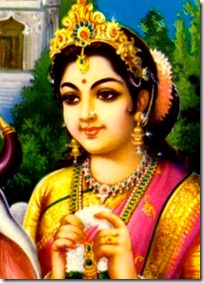
[Shrimati Radharani]“To perform devotional service means to follow in the footsteps of Radharani, and devotees in Vrindavana put themselves under the care of Radharani in order to achieve perfection in their devotional service. In other words, devotional service is not an activity of the material world; it is directly under the control of Radharani. In Bhagavad-gita it is confirmed that the mahatmas, or great souls, are under the protection of daivi prakriti, the internal energy - Radharani. So, being directly under the control of the internal potency of Krishna, devotional service attracts even Krishna Himself.” (The Nectar of Devotion, Ch 1)
Download this episode (right click and save)

Friend1: I’ve noticed that a lot of people in the Vedic tradition don’t observe the occasion of Radhashtami.

Friend2: Give a brief overview of what that is.

Friend1: Take it from the name. The ashtami, or eighth day of the moon cycle, in relation to Radha, who is Shrimati Radharani.

Friend2: And why is a particular day in the annual calendar associated with her? What is the significance?

Friend1: The eternal consort of the Supreme Personality of Godhead. The internal energy. The pleasure potency. Essentially the female side of the Divine.

Friend2: Who is the male?

Friend1: Shri Krishna. The all-attractive one. Also known as Vishnu and His other avataras like Rama, Narasimha and Matsya.

Friend2: What is the purpose of Radhashtami?

Friend1: I don’t know about a purpose, exactly, but it is a birthday. It marks the appearance of Radharani in this world. She is the queen of Gokula, appearing as the daughter of Vrishabhanu.

Friend2: What were the circumstances of her birth?

Friend1: I think it was similar to how King Janaka found Sita Devi. Radharani came to the family in an unusual way, with the father finding her. It wasn’t your typical cycle involving a pregnancy.

Friend2: Why is the occasion celebrated?

[Shrimati Radharani]Friend1: Because she is the topmost devotee of the Supreme Lord.

Friend2: Can there be different grades? I thought God would have to love everyone equally.

Friend1: He does. Proof is there in the presence of the Supersoul. This is the expansion of the Divine, considered unseen or unmanifest, residing within the heart next to the individual soul, jivatma.

Friend2: How can you say someone is the topmost devotee, then?

Friend1: God loves everyone equally, but the reciprocation is not the same. In the material world there is forgetfulness caused by maya, which is the illusory energy sent from the Divine.

Friend2: Is devotion to God different?

Friend1: Yes, because it is above maya. It is connecting directly with Krishna, bypassing the material elements altogether. Radharani is the topmost devotee because of the way she lives. Her consciousness is always pure. She is always thinking of the Supreme Lord and how to please Him.

Friend2: What would be a lower-grade devotee?

Friend1: Someone whose desires are mixed. They understand the need to serve, to escape maya, but they fall down every now and then. They may want material prosperity or the elimination of distresses. They may be connected in yoga for a period of time and then accidentally break away.

Friend2: And this never happens with Radharani?

Friend1: Not possible. She is the eternal consort for a reason. Radha-Krishna, two becoming one, or two as one. That is why they are worshiped together.

[Radha-Krishna]Friend2: Okay.

Friend1: Back to my original point, why is the celebration not more widespread?

Friend2: In comparison to?

Friend1: Janmashtami. Diwali. Holi. These are celebrated by practically everyone whose spiritual tradition is linked to the Vedas, the ancient scriptural tradition of India.

Friend2: I mean the answer is obvious. With Radharani you only worship for one thing: continued devotion. Her recommendation to Krishna is enough to guarantee success.

Friend1: Okay, but Janmashtami is celebrating Krishna directly.

Friend2: Yes, but people are known to approach God with certain desires. Their motivations may not be pure in the beginning. They know He has the capacity to fulfill the most difficult orders.

“O best among the Bharatas [Arjuna], four kinds of pious men render devotional service unto Me—the distressed, the desirer of wealth, the inquisitive, and he who is searching for knowledge of the Absolute.” (Lord Krishna, Bhagavad-gita, 7.16)

Friend1: Radharani is different?

Friend2: As Lakshmi Devi people approach her for material rewards, but in the original form she is known only for devotion. Not everyone desires that at present, though it is what will benefit them the most. That is why purification, samskaras, training under a spiritual guide, following rules and regulations and the like are necessary.

Friend1: Is there any harm in worshiping her if you still have material desires?

Friend2: The approach is always purifying. She is the internal energy, which the great souls, mahatmas, come under. They receive her shelter and thus get protection from falling back down into the ocean of birth and death. Without her favor success is not possible.

“O son of Pritha, those who are not deluded, the great souls, are under the protection of the divine nature. They are fully engaged in devotional service because they know Me as the Supreme Personality of Godhead, original and inexhaustible.” (Lord Krishna, Bhagavad-gita, 9.13)

Friend1: Whereas the default condition is to be under the control of the non-divine prakriti.

Friend2: That is maya. There is no protection; everything can be lost within a second. Maya is the catalyst for change, for maintaining a fearful condition. Bhakti is fearlessness, knowing that Krishna will protect. He does so through the favor of His beloved Radharani, who should be remembered every single day, including on the auspicious occasion of her appearance day.

In Closing:

Her devotion to Lord most endearing,

Path to success for devotees clearing.


Radha like to others not the same,

Not for wisdom or wealth to attain.


For love of Shri Krishna known,

In Vraja pastimes shown.


Same spirit to others can give,

So that in eternal ananda to live.