Showing posts with label conversations. Show all posts

Saturday, August 21, 2021

Constantly Fueling The Fire

“It is said in the Manu-smriti that lust cannot be satisfied by any amount of sense enjoyment, just as fire is never extinguished by a constant supply of fuel. In the material world, the center of all activities is sex, and thus this material world is called maithunya-agara, or the shackles of sex life. In the ordinary prison house, criminals are kept within bars; similarly, the criminals who are disobedient to the laws of the Lord are shackled by sex life.” (Shrila Prabhupada, Bhagavad-gita, 3.39 Purport)

Download this episode (right click and save)

Friend1: Are you aware of how diametrically opposed to conventional thinking the science of self-realization is?

Friend2: In what respect? Is this in terms of health, where Ayurveda has a different approach than the expensive, newly developed therapeutics that are on the market?

Friend1: Well, that is a component to it, but only a small one. I am talking bigger picture.

Friend2: Give me an example.

Friend1: If you happen to immerse yourself in pop culture, there is no way to avoid the sexual overtones.

Friend2: As in, they are promoting sexual behavior?

Friend1: Of all kinds. The movies might center around family life, but it is always about enjoying. That is the primary concern.

Friend2: If we are honest about it, the same sentiment is shared in religious circles. You approach God so that He will help you out. They rationalize the behavior by speculating that God wants everyone to enjoy, so why limit yourself?

Friend1: Limitations are necessary for vitality and proper functioning. Everyone acknowledges this, at least subtly. You can’t eat an entire pizza pie for dinner each night and expect to feel good in the aftermath. You put a limit on eating. It is a restriction.

Friend2: Okay, but that is different from advising to never eat pizza. That is probably where people get the wrong idea of scriptural provisions. They think that we are trying to eliminate the fun.

Friend1: Look at the teaching about lust. Known as kama in Sanskrit, in Bhagavad-gita we learn that lust is the great devouring enemy of this world. Shri Krishna advises that it be controlled right from the start.

Friend2: He is right, and He would certainly know, based on His standing as the Supreme Personality of Godhead.

Friend1: His Divine Grace A.C. Bhaktivedanta Swami Prabhupada is more direct in the instruction. He says that sex life is the great trap of the material world. It is like pouring gasoline on the fire, indulging the senses in that way.

Friend2: Difficult to argue against.

Friend1: For sure, and I laugh out loud whenever I come across such statements.

Friend2: Why is that?

Friend1: Not because I disagree. He is just so blunt and unafraid to go against the conventional thinking. Men like to joke that being married is like getting sent to prison, but the acharya compares sex life to the same. You won’t hear that anywhere else.

Friend2: It’s brutal honesty that we need to hear. Everyone else is steering us in the wrong direction. Better to control lust than to indulge it.

Friend1: How do you get passed the stigma of being seen as someone who is condemning everyone else?

Friend2: That is easy. We are being condemned through kama. No one is happy. At least I don’t see anyone who is. A person may be expert at indulging the senses in this way, but eventually they want something more. Not to mention the many associated problems.

Friend1: Such as?

Friend2: You look at the people who are really in trouble in life, and uncontrolled sex always seems to be at the root. A divorced man having to pay child support. Someone dropping out of school early in order to support the child that arrived unexpectedly. Drug and alcohol addiction through association with people interested only in sense gratification.

Friend1: It is fairly common to find rehabilitated addicts turning to God.

Friend2: And so the Vedas advise to make the turn prior to the problems. Prevention is better than a cure. Don’t wait for rehab. Fix yourself now. It is certainly difficult, as Arjuna asked Krishna. We’re basically trying to control the wind, but through practice and detachment we have a chance. That is why the true acharya gives the positive in addition to the negative.

Friend1: What do you mean?

Friend2: He will provide restrictions, such as avoiding meat eating, gambling, intoxication and illicit sex. But he will also give the more important positive side. This is the regulative practice of connecting with the Supreme Lord. Even if done only mechanically at first, through steady progression a transformation will take place: Hare Krishna Hare Krishna, Krishna Krishna, Hare Hare, Hare Rama Hare Rama, Rama Rama, Hare Hare.

In Closing:

A transformation to take place,
Attention on restriction to erase.

Where what not to do,
Lust and intoxication too.

Meant for higher taste finding,
Principles list daily reminding.

Otherwise like a fire raging,
This battle against kama waging.

Saturday, August 14, 2021

What Is Wrong In Being An Animal Lover

“Whatever state of being one remembers when he quits his body, that state he will attain without fail.” (Lord Krishna, Bhagavad-gita, 8.6)

Download this episode (right click and save)

यं यं वापि स्मरन् भावं
त्यजत्य् अन्ते कलेवरम्
तं तम् एवैति कौन्तेय
सदा तद्-भाव-भावितः

yaṁ yaṁ vāpi smaran bhāvaṁ
tyajaty ante kalevaram
taṁ tam evaiti kaunteya
sadā tad-bhāva-bhāvitaḥ


Friend1: A person might argue that the outpouring of affection towards pets is not wasted.

Friend2: Who is saying that it is a waste? Isn’t sanatana-dharma the only legitimate religious system in the lot that applies ahimsa to most circumstances?

Friend1: Non-violence, though the primary work in which you find that word has the backdrop of a battlefield.

Friend2: Bhagavad-gita. The prologue is Shri Krishna, the Supreme Personality of Godhead, speaking to a hesitant warrior. You could say Arjuna is a conscientious objector.

Friend1: Right, and you will find the discussion on ahimsa in that presentation, but the conclusion is violence. Arjuna decides to fight in the war, to preserve justice for humanity.

Friend2: An apparent contradiction that makes Bhagavad-gita that much more appealing to the inquisitive, the distressed, the desirer of wealth, and the person seeking knowledge of the Absolute.

चतुर्-विधा भजन्ते मां
जनाः सुकृतिनो ऽर्जुन
आर्तो जिज्ञासुर् अर्थार्थी
ज्ञानी च भरतर्षभ

catur-vidhā bhajante māṁ
janāḥ sukṛtino ‘rjuna
ārto jijñāsur arthārthī
jñānī ca bharatarṣabha

“O best among the Bharatas [Arjuna], four kinds of pious men render devotional service unto Me—the distressed, the desirer of wealth, the inquisitive, and he who is searching for knowledge of the Absolute.” (Lord Krishna, Bhagavad-gita, 7.16)

Friend1: You know what I mean, though. The acharyas of the Vedic tradition tend to decry obsession with animals in the home. For starters, the dog is considered unclean. A person should not be sleeping with their dog in bed. That animal serves a vital purpose in providing protection, but it is from outside the home.

Friend2: Shaucham is another key principle. Cleanliness, both outside and inside, is important for advancing in consciousness.

Friend1: I guess I am specifically referring to the common complaint that man tends to be more interested in dog than in God. At least that is the situation in the modern day.

Friend2: Can you honestly dispute that?

Friend1: No, but I am trying to look at the positives. A person will say that at least they are showing love. They are not completely cold-hearted. They may be childless in adulthood, but at least they are taking care of someone.

Friend2: You would be interested to know that the Sanskrit word for “son” has a deeper meaning.

Friend1: Which word is that? Putra?

Friend2: Yes. The root definition is someone who delivers from hell. Put is a hellish region, and tra refers to delivering. The son delivers the father and other ancestors from hell, if they should happen to fall there in the afterlife.

Friend1: I see. The dog can’t do the same, I assume.

पुन्नाम्नो नरकाद् यस्मात् पितरं त्रायते सुतः।
तस्मात् पुत्र इति प्रोक्तः पितॄन् यः पाति सर्वतः।।

punnāmno narakād yasmāt pitaraṃ trāyate sutaḥ।
tasmāt putra iti proktaḥ pitṝn yaḥ pāti sarvataḥ।।

“Since a son delivers his father from the hell named ‘Put’, a son is called putra; he who protects his ancestors in every way.” (Lord Rama, Valmiki Ramayana, Ayodhya Kand, 107.12)

Friend2: Putra attains the status through deeds. They deliver the ancestors through specific offerings, in the ritual known as shraddha. A good son satisfies the debt incurred to the forefathers.

Friend1: How does one assume that debt?

Friend2: From the time of birth. A good son can also rescue past generations through pleasing the Supreme Personality of Godhead, who is known as yajna because religious sacrifice is ultimately for His pleasure.

Friend1: Listen, I am not arguing the merits of having children. I am trying to say that there is nothing wasted in showing affection for a cat or a dog kept in the home. Would you rather they be ignored? Would you rather someone not care for any other living being, acting completely selfishly their entire life?

Friend2: Of course it is good to be compassionate. Shri Krishna has a favorite animal, as well. If you are kind to a cow, that accumulate spiritual merits, sukriti. We should generally be nonviolent, as necessary per the situation.

Friend1: Okay, then you agree that it is not a waste.

Friend2: There is a danger. That is one of the reasons the acharya will give warnings.

Friend1: What kind of danger?

Friend2: Of developing too strong an attachment. If you forget religious principles and focus entirely on serving the cat or dog, that will affect the consciousness moving forward. You will achieve a state of being identical to what was on the consciousness at the time of death.

Friend1: Oh, so if I am too much infatuated with my dog, I will become a dog in the future?

Friend2: For sure, and keep in mind that the principle applies to all kinds of attachment. The human birth is meant for tapasya, which has the incorporated feature of vairagya. This Sanskrit word means “lack of attachment.” You can be close with others in any kind of birth, but as a human being you have the chance to break the cycle of dependency. You can focus on the permanent instead, and be forever benefitted.

In Closing:

If pet in the home to keep,
And at night in same bed to sleep.

Then from affection to sway,
Consciousness in material way.

Where opportunity for liberation lost,
For short-term interest a mighty cost.

Putra with higher value so,
This life for towards Supreme to go.

Monday, August 9, 2021

Why Don't More People Research The Cause Of Suffering

“Suffering without knowledge, without remedy, is animal life. One who cannot understand that he is suffering and who thinks that he is very well off is in animal consciousness, not human consciousness. The human being should be cognizant of suffering the threefold miseries of this planet. One should know that he is suffering in birth, suffering in death, suffering in old age and suffering in disease, and one should be inquisitive as to how he may avoid the suffering. That is real research work.” (Shrila Prabhupada, Easy Journey To Other Planets, Ch 2)

Download this episode (right click and save)

Friend1: Why don’t more people do research into the root cause of suffering?

Friend2: What do you mean? People try to alleviate suffering all the time. That is the entire basis of modern science and health.

Friend1: Well, I would take issue with that statement.

Friend2: Why?

Friend1: Science is not about avoiding suffering.

Friend2: It isn’t?

Friend1: Just see what the world has been put through the last year and change. The aim was to prevent people from catching disease, though that never has been an objective in the past.

Friend2: They have been giving those injections to children for decades.

Friend1: If they know that such treatment will prevent disease, fine, but even those don’t promise that anymore. They give you comparison pictures of the suffering of a person with the injection and those who don’t take it. The idea is that you won’t suffer as much if you get the shots.

Friend2: I see.

Friend1: This is for some of the diseases. Anyway, the remedies applied to society as a whole in recent times have been to stay locked in the home and obstruct your breathing while out in public.

Friend2: Yes, even though the same scientists previously stated that asymptomatic spread does not cause a pandemic and that the face coverings are practically useless in stopping the spread of contagious disease.

Friend1: We can cover the hypocrisy and dishonesty of the credentialed medical community on another day, but I am more focused on the suffering aspect. They are supposedly trying to stop disease, but the suffering is still there.

Friend2: How so?

Friend1: Being locked at home for a year. Not seeing your friends and relatives. Telling children that the world is too unsafe to go outside. Not even the worst dictators of the previous century thought of inflicting that kind of harm to their people. Ravana from the Ramayana was a man-eating ogre, but he never tortured his people in this way.

Friend2: It really is bad, if you think about it.

Friend1: Therefore, I conclude that science is not about avoiding suffering. Maybe trying to mitigate disease and the like, but they rarely consider quality of living or other unintended consequences to their recommendations.

Friend2: True.

Friend1: That is I why I am wondering why more people don’t research the cause of suffering itself.

Friend2: If you can’t get them to see the bigger picture when it comes to treatment of disease, you are sure out of luck with something they would consider metaphysical or religious in nature.

Friend1: Yes, they throw the word “religion” out there as a way to discredit.

“Why even bother going down that route? Just live your life. Be miserable like everyone else and await guaranteed death.”

Friend2: I will say that they are trying to stop that death. That seems to be the bond shared by the asuras of the different generations and ages. They think they can live forever. They want to rise to the stature of Almighty, though they never come close.

Friend1: What would research into the cause of suffering involve?

Friend2: It is the question posed by the wise human being. If you meet a genuine spiritual master, someone who has seen the truth [tattva-darshi], you can ask this question. You can inquire into why you are suffering, who you really are, and what the point to living is.

Friend1: What are the responses?

Friend2: To truly understand requires a lifetime of study and contemplation, beginning with implementing the principles of the science of self-realization. You have the opportunity to understand immediately, as no one is automatically disqualified from understanding the reality based on their qualities from this birth.

Friend1: Not only would I like to understand, but I would hope that others would be interested in hearing from me after I have learned.

Friend2: Good luck with that, but at least your heart is in the right place. Be thankful that you have the interest, which doesn’t occur even after many lifetimes. Simply endeavoring for perfection of living is noteworthy, and out of those who try hardly one will succeed.

मनुष्याणां सहस्रेषु
कश्चिद् यतति सिद्धये
यतताम् अपि सिद्धानां
कश्चिन् मां वेत्ति तत्त्वतः

manuṣyāṇāṁ sahasreṣu
kaścid yatati siddhaye
yatatām api siddhānāṁ
kaścin māṁ vetti tattvataḥ

“Out of many thousands among men, one may endeavor for perfection, and of those who have achieved perfection, hardly one knows Me in truth.” (Lord Krishna, Bhagavad-gita, 7.3)

In Closing:

This amazing thing I’ve found,
Through connecting with sound.

That cause of suffering all,
From higher realm to fall.

But now easily to correct,
When consciousness to direct.

Towards the one Supreme go,
Further research not required so.

Sunday, August 1, 2021

Are We Destined To Merge Into Brahman

“Never was there a time when I did not exist, nor you, nor all these kings; nor in the future shall any of us cease to be.” (Lord Krishna, Bhagavad-gita, 2.12)

Download this episode (right click and save)

न त्व् एवाहं जातु नासं
न त्वं नेमे जनाधिपाः
न चैव न भविष्यामः
सर्वे वयम् अतः परम्

na tv evāhaṁ jātu nāsaṁ
na tvaṁ neme janādhipāḥ
na caiva na bhaviṣyāmaḥ
sarve vayam ataḥ param

Friend1: Have you heard of this analogy involving pots and sky?

Friend2: What is it used to describe?

Friend1: I am guessing the nature of the spirit soul and what will happen after liberation.

Friend2: What is liberation?

Friend1: Mukti. Release from the cycle of birth and death. No longer suffering on the wheel of transmigration, changing from one body to the next. You get different philosophical schools based on the understanding of liberation.

Friend2: Personalist and impersonalist is the primary distinction.

Friend1: Yes, and so the impersonalist might use the comparison to the pot. If you put water inside of a pot, the water will take the shape of the vessel. Yet as soon as you remove the pot, the water takes a different shape. It might return to what it was previously, like the entire ocean.

Friend2: The same applies with the sky. The vessel is nothing more than an artificial barrier. The spirit soul stays inside of the vessel known as the body. That identity lasts for a number of years, on average.

Friend1: The goal of liberation is to shed the vessel, but permanently. Everyone leaves the current one behind at some point.

Friend2: Death.

Friend1: Which is not a significant achievement. No person has to try for it. It will occur eventually; this is the nature of time, who is known as kala. Liberation for the impersonalist is making sure that there is no vessel in the future.

Friend2: Then what happens to the individual?

Friend1: They merge into the collective. Like returning to the sky or the ocean. The individual soul merges into Brahman, which is the total spiritual energy.

Friend2: What happens to the vessels?

Friend1: They get left behind. Or maybe they get used for those individuals who have yet to achieve liberation. The vessels are prakriti or maya; they are not Brahman.

Friend2: Does this make sense to you?

Friend1: I can see why someone would believe it. It seems logical enough. What is the argument from the other side, from the personalists?

Friend2: They use Shri Krishna as the authority figure. He explains in Bhagavad-gita that every person existed in the past and they will continue to exist in the future. Nothing can remove their identity.

Friend1: Okay, but do I lose identity when merging into Brahman?

Friend2: Absolutely; if that is the goal. You can be Brahman-realized prior to giving up the vessel, also. That is a discussion for another time, but suffice it to say the vessel does not have to remain in the category of maya perpetually. It could be part of my spiritual adventure for a length of time; thereby removing any negative influence.

Friend1: If we don’t want to merge into the sky of Brahman, where do we go after liberation?

Friend2: If Arjuna, the direct recipient of Bhagavad-gita wisdom, will remain an individual moving forward, then he must have some kind of vessel. He will live as a liberated soul, following the instruction and guidance of the Supreme Personality of Godhead.

Friend1: The vessel will just be of a different nature?

Friend2: Shifting in time and place. Krishna appeared in the material world, but He did not interact with maya. If Arjuna will be His companion in the future, they will not associate with maya. The personalist’s view is that there is something known as a spiritual body. In another realm, which is indestructible, there are residents who don’t live under the jurisdiction of karma and time.

Friend1: Vaikuntha.

Friend2: The place free of anxieties. It is the destination for the devoted souls, and even prior to quitting the body they are able to create a Vaikuntha-like atmosphere, through always maintaining a connection to Krishna and singing His glories: Hare Krishna Hare Krishna, Krishna Krishna, Hare Hare, Hare Rama Hare Rama, Rama Rama, Hare Hare.

In Closing:

Truth to keep in mind,
That never a time,

Where not living,
Nature a body giving.

Whether in past or future so,
With same identity as spirit to go.

Question then of to realm where,
Best when Shri Krishna standing there.

Sunday, July 25, 2021

Krishna Is Still Teaching Today

“Physical presence is sometimes appreciable and sometimes not, but vani continues to exist eternally. Therefore we must take advantage of the vani, not the physical presence. Bhagavad-gita, for example, is the vani of Lord Krishna. Although Krishna was personally present five thousand years ago and is no longer physically present from the materialistic point of view, Bhagavad-gita continues.” (Shrila Prabhupada, Chaitanya Charitamrita, Concluding Words)

Download this episode (right click and save)

Friend1: You hear this lamentation sometimes. At least I do, anyways. It’s in relation to finding a spiritual master.

Friend2: A bona fide guru, the person who provides the second birth, making you a genuine dvija.

Friend1: Twice-born. That is the specific advantage of the human birth. While it is nice that you find a way to defend against wild animals using advanced weaponry, the vulnerability to death is the same.

Friend2: Known as kala in Sanskrit, time is the all-devouring agent. You are correct, though. The human birth is not auspicious because of the intelligence applied in survival. Otherwise, the tree would be considered the superior form in the evolutionary cycle. The tree can stand in the same place for thousands of years, unaffected by severe weather conditions.

Friend1: The lamentation is that someone else has found a guru they can trust. My friend is set; their spiritual leader did not fall down. They were a “pure devotee,” if using that terminology.

Friend2: That means there are no hints of material desire mixed in. That guru wasn’t interested in advancing to a higher planetary system or perfecting mystic yoga practice. They don’t even want liberation; they are ready to serve wherever the Supreme Lord places them in the future.

Friend1: Obviously, if you read the history documented in Vedic literature you will find that hardly anyone is a pure devotee. To become a perfected being is rare; requiring many lifetimes to even take up the endeavor:

बहूनां जन्मनाम् अन्ते
ज्ञानवान् मां प्रपद्यते
वासुदेवः सर्वम् इति
स महात्मा सु-दुर्लभः

bahūnāṁ janmanām ante
jñānavān māṁ prapadyate
vāsudevaḥ sarvam iti
sa mahātmā su-durlabhaḥ

“After many births and deaths, he who is actually in knowledge surrenders unto Me, knowing Me to be the cause of all causes and all that is. Such a great soul is very rare.” (Lord Krishna, Bhagavad-gita, 7.19)

Friend2: The illusory energy of maya is known to be strong for a reason.

Friend1: If I can’t find someone today, who will guide me along the path of eternal life, I will feel dejected. I might curse at my misfortune. Others were able to be saved, but not me. I might even be jealous of Arjuna.

Friend2: Why is that?

Friend1: Because he heard directly from Krishna, who is Bhagavan. The Supreme Personality of Godhead spoke directly to him on the battlefield. Arjuna had no room for doubt, though he was kind enough to reassure everyone through the request of the visual of the virata-rupa, the universal form.

मन्यसे यदि तच् छक्यं
मया द्रष्टुम् इति प्रभो
योगेश्वर ततो मे त्वं
दर्शयात्मानम् अव्ययम्

manyase yadi tac chakyaṁ
mayā draṣṭum iti prabho
yogeśvara tato me tvaṁ
darśayātmānam avyayam

“If You think that I am able to behold Your cosmic form, O my Lord, O master of all mystic power, then kindly show me that universal self.” (Arjuna, Bhagavad-gita, 11.4)

Friend2: Okay, but there is no reason to be jealous.

Friend1: Why is that?

Friend2: For starters, you know about the incident. You are aware of what took place. You have access to the exact same words used. The original language remains intact. The Sanskrit shlokas that you can memorize and sing were repeated by spiritual leaders hundreds and also thousands of years ago.

Friend1: Through the parampara system.

Friend2: His Divine Grace A.C. Bhaktivedanta Swami Prabhupada explains that Bhagavad-gita is the vani of Krishna. That instruction is eternal, though the physical presence may no longer be available. In that sense, Krishna is still teaching to this day.

Friend1: Because of the vani.

Friend2: Yes. The relationship with the spiritual master is the same way. One person may have direct contact, through vapu. They may serve in a way to offer physical comfort. But there will eventually be separation. The vani, however, remains. It never dies. The great spiritual leaders of the past continue to rescue countless souls through their Divine instructions, which are ultimately rooted in the teacher of Arjuna, who is complete knowledge personified.

In Closing:

Arjuna the wisdom heard,
When for guidance deferred.

To Shri Krishna before standing,
Authority as guru commanding.

Though ages ago occurring,
Still to that dialogue referring.

Meaning others too can connect,
Through vani contact direct.

Saturday, July 24, 2021

What About Explaining Dharma To Non-Devotees

“For one who explains the supreme secret to the devotees, devotional service is guaranteed, and at the end he will come back to Me.” (Lord Krishna, Bhagavad-gita, 18.68)

Download this episode (right click and save)

य इदं परमं गुह्यं
मद्-भक्तेष्व् अभिधास्यति
भक्तिं मयि परां कृत्वा
माम् एवैष्यत्य् असंशयः

ya idaṁ paramaṁ guhyaṁ
mad-bhakteṣv abhidhāsyati
bhaktiṁ mayi parāṁ kṛtvā
mām evaiṣyaty asaṁśayaḥ

Friend1: You know me, I like to be a stickler with the details. When hearing instruction, I accept the words literally.

Friend2: That is a good thing. It means you are paying attention.

Friend1: As an extension, I look at the negation to certain principles. For instance, in Bhagavad-gita we have the proclamation that no one is more dear to Krishna than the person who explains the supreme science to the devotees.

Friend2: The science refers to the confidential information just presented to Arjuna, the disciple. This is at the end of that sacred conversation, which has been passed down through the ages in the Sanskrit text known as Bhagavad-gita.

Friend1: It is a nice thing to say, since it could have been left as a confidential matter.

Friend2: What do you mean?

Friend1: Krishna, the Supreme Personality of Godhead, was talking to Arjuna. It was a private conversation. It was Arjuna who had the doubts on how to proceed, whether to fight in the Bharata War. It was Arjuna who asked the questions. No one else was involved, though there were many soldiers assembled on the battlefield.

Friend2: We know of the information through the blessings provided to Sanjaya.

Friend1: He could witness the events on the battlefield. This was a benediction offered by Vyasadeva. In that sense, we are so thankful to be privy to the information. Not only did someone else witness what was going on, everything was documented in Sanskrit shlokas. The original sounds, as they were first produced, are preserved through today, despite the absence of advanced technology during that time period.

Friend2: I could argue that Sanjaya had the most advanced technology anyone can imagine, but I know what you mean.

Friend1: So I automatically think of the negative. If the person who describes the science to the devotee is dear, then someone doing the same, but to non-devotees would not be dear.

Friend2: There are a lot of clauses to the particular proof you are conducting, but I would say you are on the right track. I could get on board with that.

Friend1: Of course that raises a question. Why does the target audience determine the level of satisfaction in Krishna?

Friend2: Do you really have to ask?

Friend1: Sure.

Friend2: Try to play out the situation of describing Krishna’s teachings on the living entity, the material nature, eternal time, karma, and the Supreme Lord to someone who is not a devotee already.

Friend1: Such a person is not difficult to find. Okay, if I were to try I would likely meet opposition.

Friend2: In what sense?

Friend1: The person might blow me off. They might be restricted by dogmatic insistence, wherein they refuse to have an open mind about cultures that are foreign to them. They may deride Krishna as a womanizer, not reading the entire Bhagavata Purana, but only cherry-picking select verses.

Friend2: Alright, so let’s say that you are the recipient of this opposition. Take every case. How would you be dear to Krishna, then?

Friend1: Why would I not be dear, though? I am trying to explain the highest wisdom to someone who desperately needs it. Shouldn’t I get credit for the effort?

Friend2: The words are falling on deaf ears. You are basically wasting your time. It is like explaining calculus to someone in the first grade. If I barely know the times tables, how will I understand advanced concepts such as algebra?

Friend1: Are you saying that the devotee audience is more likely to understand the science of self-realization?

Friend2: They will have so much to gain from it. Their attachment to Krishna will only increase. They will advance on the path of liberation.

Friend1: How is someone expected to be a devotee without hearing such information?

Friend2: You can try to introduce them to the concepts. If the target audience has a genuine interest, then those following in the line of Chaitanya Mahaprabhu try to explain. Mind you, they will not simply share the conversation between Arjuna and Krishna. They will provide elaborate commentary and explanation in the process.

Friend1: And then if the people hearing have interest, they are essentially friendly to the material.

Friend2: It is similar to the concept of deity worship in the temples. Not like the nonsense they pull today, where they try to determine a person’s qualifications simply by looking at them. Originally, the idea was that only people who had some faith would be allowed into the temples. It makes sense, if you think about it.

Friend1: Why?

Friend2: Because if someone else sees a statue made of stone, resin or wood worshiped like God, they might get the wrong idea. They will think it is idol worship or a made-up, false God.

Friend1: That happens now.

Friend2: Exactly. Such a mindset is extremely offensive. The person gets no benefit out of meeting the deity. The same holds true with the Bhagavad-gita content. The person who explains to the devotees is most dear, and so the kind-hearted souls try to make as many devotees as possible through means such as prasadam distribution and the congregational chanting of the holy names: Hare Krishna Hare Krishna, Krishna Krishna, Hare Hare, Hare Rama Hare Rama, Rama Rama, Hare Hare.

In Closing:

First devotees make,
Where opposition to forsake.

Then ready to hear,
To Krishna becoming dear.

Since supreme science explaining,
Blessed with highest wisdom gaining.

One by one the verses to save,
Profound is every page.

Wednesday, July 21, 2021

Why Do Devotees Think They Are Better Than Everyone Else

[Lord Vishnu]“Salokya means that after material liberation one is promoted to the planet where the Supreme Personality of Godhead resides. Samipya means remaining an associate of the Supreme Personality of Godhead. Sarupya means attaining a four-handed form exactly like that of the Lord. Sarshti means attaining opulences like those of the Supreme Lord, and sayujya means merging into the Brahman effulgence of the Lord. These are the five types of liberation.” (Shrila Prabhupada, Chaitanya Charitamrita, Madhya 6.266 Purport)

Download this episode (right click and save)

Friend1: Don’t you get the feeling that devotees think they are better than everyone else?

Friend2: In what context?

Friend1: In terms of practicing spiritual life.

Friend2: I’m assuming you are referring to devotees in the Vedic tradition, which aligns with what is known as bhakti-yoga.

Friend1: Sure; devotion to the Supreme Personality of Godhead, Bhagavan.

Friend2: And then who is the “everyone else” you are using for comparison?

Friend1: People who follow spiritual life. They may not be avowed devotees of the Supreme Lord, but they are genuinely interested in pursuing higher goals.

Friend2: Paramartha instead of svartha.

Friend1: That is a good way to put it. They want to achieve long-term goals. They believe in the afterlife. They are interested to hear the difference between matter and spirit, how the individual transmigrates from one form to another, and what will happen in the future.

Friend2: Specifically in how to influence the destination. They are not necessarily afraid of being condemned to hell for not following a certain religion based on dogmatic insistence, but they know that there is some way to influence what will happen in the next life.

Friend1: That describes it perfectly. Don’t you get the air of superiority from the devotee side? That they think even the genuinely interested are still inferior?

Friend2: What makes you say that?

Friend1: All of the derogatory remarks about impersonalists. Such as that they are the worst sinners because they want to merge into the Brahman effulgence.

Friend2: How is that sinful? I don’t believe you are making an accurate depiction.

Friend1: Well, we do hear about how devotees would never want to merge into the transcendental body of the Supreme Lord.

Friend2: Why not?

Friend1: Because they consider it worse than death.

[Lord Vishnu]Friend2: Loss of identity. Almost a stateless existence. They would rather maintain their individuality and serve directly the person they separately identify as worshipable.

Friend1: Okay, that’s fine. Be happy in your choice. Why belittle others?

Friend2: Who is belittling them?

Friend1: The devotees.

Friend2: You are taking it that way, but I don’t believe that is the case. There are five kinds of liberation, or mukti. Each option is available. No one is restricted or prohibited. This is the amazing kindness of Bhagavan. He does describe how the impersonal path is more difficult, but He never belittles anyone for choosing that option.

क्लेशो ऽधिकतरस् तेषाम्
अव्यक्तासक्त-चेतसाम्
अव्यक्ता हि गतिर् दुःखं
देहवद्भिर् अवाप्यते

kleśo ‘dhikataras teṣām
avyaktāsakta-cetasām
avyaktā hi gatir duḥkhaṁ
dehavadbhir avāpyate

“For those whose minds are attached to the unmanifested, impersonal feature of the Supreme, advancement is very troublesome. To make progress in that discipline is always difficult for those who are embodied.” (Lord Krishna, Bhagavad-gita, 12.5)

Friend1: Right, and so people not interested in devotion to the manifest side might feel marginalized.

Friend2: But Krishna is simply telling the truth. Don’t you want Him to be honest?

Friend1: I don’t like criticizing people who are genuinely interested in advancing in spiritual life.

Friend2: It is not criticism. It is like being on a game-show, where you are offered a choice between two different curtains. Fortunately, the guru informs you what is behind each curtain. Make an informed decision. The devotees say that you will be happier in maintaining your individuality. They reject merge-liberation not because of a need to stand out, but because of a loss of opportunity.

Friend1: It is almost like they are children trying to show off how much they love their parents.

Friend2: And what is the other side doing? They are simply taking, enjoying for themselves. The parents here, Radha and Krishna, are so kind and loving that they do not discriminate. But wouldn’t you admit that the children that want to serve without motive and without interruption are superior?

Friend1: See. I got you to admit it. A superiority complex.

[Radha-Krishna]Friend2: Well, guilty as charged. Be thankful for people who give you the complete picture, who talk straight. They do not show false compassion by equating two things that are indeed not equal. Everyone follows the Supreme Lord in all respects, and the devotees look only for the opportunity that brings eternal living.

In Closing:

Rather not that option to choose,
Where identity to lose.

Agreed that liberation true,
And offered by Supreme too.

But merging to suicide compared,
At lost opportunity despair.

Acharya the choices revealing,
To devotees service appealing.

Saturday, July 17, 2021

The Early Life Crisis

[Ajamila saved]“As a ripe fruit has no other fear than to fall, so a man who is born has no other fear than death.” (Lord Rama, Valmiki Ramayana, Ayodhya Kand, 105.17)

Download this episode (right click and save)

यथा फलानां पक्वानां नान्यत्र पतनाद्भयम्।
एवं नरस्य जातस्य नान्यत्र मरणाद्भयम्।।

yathā phalānāṃ pakvānāṃ nānyatra patanādbhayam।
evaṃ narasya jātasya nānyatra maraṇādbhayam।।

Friend1: Are you familiar with the concept of a midlife crisis?

Friend2: Yes.

Friend1: I think you always hear about that growing up but don’t really understand it until approaching the age.

Friend2: You mean you have to reach the midpoint of the average lifespan of a human being, experiencing the actual crisis, in order to properly understand it?

Friend1: You realize that you have reached the halfway point. You have lived so much of life already.

Friend2: Though there is no guaranteed future. As soon as a person takes birth, their destiny is death. Shri Rama compares the predicament to that of the ripened fruit. It has no other fate than to fall, and so the overarching fear for the mature human being is death.

[apple tree]Friend1: The crisis, as we will call it, makes total sense. At least to me, I understand why there is some concern over the future. You have lived for so long and there is something lacking. You might even be married with children, pulling in a steady and reliable income, and still feel a deep void.

Friend2: Whatever you have done so far is not enough.

Friend1: To make matters worse, time is running out. You have lived half your life already. Is that all there is? Shouldn’t there be more? Aren’t we meant to experience something better?

Friend2: This is reaching the fruition of the potential for intelligence in the human being.

Friend1: What do you mean?

Friend2: We separate ourselves from the animals when we pose such questions, when we make the higher inquiries. The animals never have any sort of crisis precisely because they cannot contemplate to such depths.

Friend1: They live off the animal instincts: eating, sleeping, mating and defending.

Friend2: The crisis, as you describe it, should take place from the time of birth. There should be a great awakening from the beginning.

Friend1: Okay, but that will rarely occur. A person hasn’t experienced enough of life to know that they need something more.

Friend2: But others have! They can explain everything to you. The teachers appearing before them also record and document their experiences. There is no reason to wander blindly.

Friend1: How will someone even be interested in such information at a young age? I don’t see that happening.

Friend2: The entire Vedic culture, in the proper implementation, is based on this premise. The human birth is the chance to escape suffering. It is the best opportunity to decipher the actual cause of suffering, which is repeated birth and death. I have the ability to know who I truly am, spirit soul, and work in such a way that my soul will be happy.

Friend1: That is a little deep for a child to contemplate.

Friend2: We find such inquiries made by Sanatana Gosvami in approaching Shri Chaitanya Mahaprabhu. That is the ideal conversation between disciple and guru. The spiritual master should be able to guide me along such a path that I will no longer feel that time is running out. They will give me eternal life, both in terms of outlook and also the future.

Friend1: You mean the destination after death?

Friend2: How the soul continues to live on. Never was there a time that I did not exist, nor will I ever cease to be in the future.

न जायते म्रियते वा कदाचिन्
नायं भूत्वा भविता वा न भूयः
अजो नित्यः शाश्वतो ऽयं पुराणो
न हन्यते हन्यमाने शरीरे

na jāyate mriyate vā kadācin
nāyaṁ bhūtvā bhavitā vā na bhūyaḥ
ajo nityaḥ śāśvato ‘yaṁ purāṇo
na hanyate hanyamāne śarīre

“For the soul there is never birth nor death. Nor, having once been, does he ever cease to be. He is unborn, eternal, ever-existing, undying and primeval. He is not slain when the body is slain.” (Lord Krishna, Bhagavad-gita, 2.20)

Friend1: I guess it would be better to have the same crisis early on in life.

[Ajamila saved]Friend2: In whatever time period I learn the truth, that I make the proper inquiries, at least I have gone in the right direction. It is never too late, as even at the moment of death I can make the proper turn towards the Supreme Personality of Godhead, as Ajamila did.

In Closing:

When even at death’s gate,
To turn never too late.

At midpoint halfway gone,
The lacking life to dwell upon.

Crisis in this way made,
That life soon over afraid.

But in sobriety inquiry make,
Advantage of intelligence take.

Tuesday, July 13, 2021

How Was Arjuna Sure That The Virata-Rupa Was Real

[virata-rupa]“The Blessed Lord said: My dear Arjuna, O son of Pritha, behold now My opulences, hundreds of thousands of varied divine forms, multicolored like the sea.” (Bhagavad-gita, 11.5)

Download this episode (right click and save)

श्री-भगवान् उवाच
पश्य मे पार्थ रूपाणि
शतशो ‘थ सहस्रशः
नाना-विधानि दिव्यानि
नाना-वर्णाकृतीनि च

śrī-bhagavān uvāca
paśya me pārtha rūpāṇi
śataśo ‘tha sahasraśaḥ
nānā-vidhāni divyāni
nānā-varṇākṛtīni ca

Friend1: His Divine Grace A.C. Bhaktivedanta Swami Prabhupada explains how the human being has four general defects.

Friend2: Can you name them?

Friend1: Without peeking…let me see. Committing mistakes. The tendency to cheat. To be easily illusioned. Wow; I cannot remember the fourth one.

Friend2: Imperfect senses.

Friend1: There you go. The list tends to come up when discussing the discovery of God.

Friend2: What do you mean by discovery?

Friend1: Exactly that. Someone is trying to find the Almighty. They are searching for the supreme Divine Being.

Friend2: What if they don’t believe in one?

Friend1: That is part of the discovery process. They debate with themselves if they believe such a being could exist. Then they try contemplating, and so forth.

Friend2: Which is a flawed method.

Friend1: Because of the defects, right?

Friend2: Well, that also, but I was thinking in terms of the Dr. Frog comparison. If I am trying to find someone who is better than everyone else, I should at least have experience with every person in the universe first.

Friend1: Otherwise, I only have what I know to go off of.

[Pacific Ocean]Friend2: The frog in the well does not understand the outside world. If you try to explain to them the size of the Pacific Ocean, they will try to contemplate in terms of the well.

“Is the ocean two or three times the size of the well? Is it forty times? What exactly is this ocean you speak of?”

Friend1: Okay, so maybe it doesn’t align exactly, but that limitation is sort of in the category of imperfect senses.

Friend2: Even if you had perfect senses, you don’t have the time, ability, or memory power to consume all there is to see or hear in the universe.

Friend1: Okay, so this is bound to be a follow-up question in the discussion. If I acknowledge that man has the four principal defects, then why am I even listening to you?

Friend2: What do you mean?

Friend1: You are explaining these defects to me, but how am I going to understand, considering I have imperfect senses, and all?

Friend2: You listen to the person who lacks the defects.

Friend1: But I didn’t hear of any exceptions. I am listening to a human being. The guru, the spiritual master, is just like you and me. They have their own defects.

Friend2: That is true. The explanation is that since they are connected to the original person, adi-purusha, the information they accept is perfect. They are something like a parrot, passing along the information as it is, as they first heard it. But they make sure not to adulterate, and they also understand the principles based on their own assimilation.

Friend1: Hmm, so it is because of the link to Krishna?

Friend2: He was there prior to the creation. He is here right now and He will be around after everything gets annihilated.

अहम् एवासम् एवाग्रे
नान्यद् यत् सद्-असत् परम्
पश्चाद् अहं यद् एतच् च
यो ऽवशिष्येत सो ऽस्म्य् अहम्

aham evāsam evāgre
nānyad yat sad-asat param
paścād ahaṁ yad etac ca
yo ‘vaśiṣyeta so ‘smy aham

“Brahma, it is I, the Personality of Godhead, who was existing before the creation, when there was nothing but Myself. Nor was there the material nature, the cause of this creation. That which you see now is also I, the Personality of Godhead, and after annihilation what remains will also be I, the Personality of Godhead.” (Shrimad Bhagavatam, 2.9.33)

Friend1: Okay, but what about the case of direct perception? For instance, Arjuna seeing the universal form. Since he has imperfect senses, how could he authenticate the image? How could he validate that this was indeed everything in the universe and more?

Friend2: For starters, he asked to see the virata-rupa. It was something of which he already had an idea. It wasn’t a concoction or some magic show that Krishna decided to put on. It wasn’t:

“Hey dude, check this out. You don’t know what this is? Let me explain it to you. I am God. I am everything. Surrender unto me.”

Friend1: Still, there is the issue of committing mistakes. How could Arjuna really be sure?

[virata-rupa]Friend2: This was visual confirmation for something he already knew. Arjuna made sure to reference authorities in his subsequent praise of Krishna. The viewpoint was shared by notable personalities like Vyasa and Narada. We will always have defects, as will others. The claim is that the Vedas are perfect, since they originate in the infallible one, Achyuta. We can test for ourselves through the processes and principles passed on by the acharya to see if there is truth.

In Closing:

Everything in Supreme Divine Being,
Arjuna in virata-rupa seeing.

But how in that case sure?
Since man with defects four.

Idea that origin the one,
From whom knowledge has come.

Others confirming the same,
Arjuna referencing by name.

Friday, July 9, 2021

The Advanced Potential For Intelligence Is Not A Curse

[Radha-Krishna]“Suffering without knowledge, without remedy, is animal life. One who cannot understand that he is suffering and who thinks that he is very well off is in animal consciousness, not human consciousness. The human being should be cognizant of suffering the threefold miseries of this planet. One should know that he is suffering in birth, suffering in death, suffering in old age and suffering in disease, and one should be inquisitive as to how he may avoid the suffering. That is real research work.” (Shrila Prabhupada, Easy Journey To Other Planets, Ch 2)

Download this episode (right click and save)

Friend1: I once heard His Divine Grace A.C. Bhaktivedanta Swami Prabhupada discuss the differences between animals and human beings in terms of the ability to detect suffering.

Friend2: What do you mean?

Friend1: In the case of the slaughterhouse, the goat or lamb has no idea what is about to happen. This other living entity is approaching, ready to inflict the worst kind of suffering. The animal has no way to mitigate.

Friend2: They are not smart enough to realize.

Friend1: Whereas the human being has discrimination. They can discern the warning signs. Through observation, experiment, memory and recall, they might be able to avoid the situation.

Friend2: Which can go wrong in the extreme, as well.

Friend1: What do you mean?

Friend2: Well, if for instance my foot is hurting. I decide that to get rid of the pain, it is best to just chop off the foot.

Friend1: Amputation?

Friend2: Right, which in some cases is required, but not here. Another example is when I am afraid of catching a virus. To mitigate the risk, I decide to put a face covering on.

Friend1: That seems to be the requirement these days.

Friend2: Of course any biased study will confirm the hypothesis. If you prevent someone from breathing, they surely will have less of a chance of catching a virus and giving it to someone else.

Friend1: And if you can’t breathe, you can’t really live.

Friend2: That’s why I said the discrimination aspect can be a negative. I am so afraid of what will happen to me in the outside world that I decide to lock myself in the home for one year or more.

Friend1: Which is ridiculous, if you think about it. That’s not living.

Friend2: Yet people are doing it.

Friend1: Anyway, the ability to discriminate is still a distinction from the animal species. The human being can try to avoid suffering. Yet, to me that seems like a curse more than a benefit.

Friend2: Why?

[smiling puppy]Friend1: The animal is happy-go-lucky. They have no idea what is going on. Okay, they cannot easily avoid oncoming attack without extra assistance. They cannot see that the person wielding the knife is not a friend. Yet they reach the same fate as the human being.

Friend2: In what sense?

Friend1: Death. The ultimate end.

Friend2: But the human being can try to escape the suffering and live longer.

Friend1: Who cares? The tree stands there for thousands of years. It doesn’t contemplate suffering. How is the human birth superior, then?

Friend2: Because we have the chance to get to the root cause of the suffering. You are correct. We try to fix the pain in the foot. We attempt to avoid contagious respiratory illnesses through hiding in this place and that. We fix the economic problem by advancing in a corporate field.

Friend1: These are little problems. There will always be suffering.

Friend2: Thus arises the need to get to the bottom of the issue. Find out what is causing all of the suffering. The acharya explains that it is birth itself.

Friend1: Which birth? As an animal or as a human being?

Friend2: Any and all. As soon as you enter the material world, you have to live by the rules of the land of birth and death, mrityu-loka.

Friend1: Is there a way to prevent such a birth from taking place.

Friend2: Someone who reaches Shri Krishna’s abode never has to return to mrityu-loka.

आ-ब्रह्म-भुवनाल् लोकाः
पुनर् आवर्तिनो ऽर्जुन
माम् उपेत्य तु कौन्तेय
पुनर् जन्म न विद्यते

ā-brahma-bhuvanāl lokāḥ
punar āvartino ‘rjuna
mām upetya tu kaunteya
punar janma na vidyate

“From the highest planet in the material world down to the lowest, all are places of misery wherein repeated birth and death take place. But one who attains to My abode, O son of Kunti, never takes birth again.” (Lord Krishna, Bhagavad-gita, 8.16)

[Radha-Krishna]Friend1: Barring this pursuit, the human birth would definitely be a curse.

Friend2: Because you know about the suffering and can’t really do anything about it?

Friend1: Exactly. If I tell someone about the ultimate cause of suffering, how will they believe me?

Friend2: That is the objective of the spiritual master. Enlighten those who are inquisitive. Reveal to them their true identity and the cause of their suffering. To approach a guru is mandatory for the human being. Without such a link to the Divine, through the chain of disciplic succession, there is no way to assemble the bits and pieces of information in time for quitting the body.

Friend1: The information has to be accepted instead of gathered?

Friend2: We cannot discover it on our own. That is the negative reality, but on the positive the Supreme Lord is kind enough to send empowered disciples to this world to rescue us. Upon approaching such a person, we meet the full potential of the human birth and feel eternal gratitude as a result.

In Closing:

The full potential meeting,
When guru greeting.

Who the cause revealing,
Of suffering feeling.

When to this world sent,
Forced in this way spent.

But human being blessed,
Since real problem addressed.

Thursday, July 1, 2021

Can You Be A Devotee In Theory

[Radha-Krishna]“In the Hari-bhakti-vilasa there is the following statement about self-surrender: ‘My dear Lord, a person who has surrendered himself unto You, and is in firm conviction that he is Yours, and actually acts in that way by his body, mind and words, can actually relish transcendental bliss.’” (The Nectar of Devotion, Ch 11)

Download this episode (right click and save)

Friend1: Can someone be a devotee in theory?

Friend2: What do you mean?

Friend1: A theoretical devotee.

Friend2: I still don’t understand. What is the opposite? Is there an analogous category?

Friend1: A practicing devotee. Someone who is actually engaged in the work.

Friend2: What identifies such a person?

Friend1: The tilaka on the forehead. Tulasi beads around the neck. Visiting places of pilgrimage, tirtha; maybe even living there. Associating with other devotees. Hearing hari-katha. Chanting the holy names: Hare Krishna Hare Krishna, Krishna Krishna, Hare Hare, Hare Rama Hare Rama, Rama Rama, Hare Hare.

Friend2: What identifies the theoretical devotee? They don’t follow any of the behaviors you just listed?

Friend1: They might desperately want to. They make lofty plans; they promise to one day follow. They are just devoted in theory; at least from an external viewpoint. They have so much love for God in their heart. They always think about Him. They are always remembering His pastimes, such as with Shri Rama and Shri Krishna.

[Radha-Krishna]Friend2: That is very nice.

Friend1: They don’t necessarily chant the holy names. The daily responsibilities take up the majority of the time. But they never stop thinking; they relate their experiences to something spiritual.

Friend2: In what way?

Friend1: For instance, on a morning where they feel extremely tired, even after having slept for a sufficient amount of time, they can’t help but remember Lakshmana.

Friend2: The younger brother of Rama.

Friend1: They appreciate Lakshmana’s sacrifice in the forest period, as described in the Ramayana. He would go without sleep so as to keep a careful watch on Rama and His wife Sita.

Friend2: The best brother you could ever hope to find.

Friend1: This person applies butter to their bread for the morning meal. They immediately think of young Krishna and how much He loves butter. They wonder if what they are eating at the moment would be up to Krishna’s preferred standard.

[stealing butter]Friend2: The person you are describing is not a theoretical devotee. They are dear to Krishna, in truth.
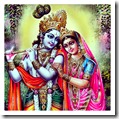
Friend1: Okay, but no one would ever identify them as such. They are not following the principles for practical realization.

Friend2: Does it matter?

Friend1: I am asking you. What is the purpose to the rules and regulations, then? Why are people living in the temples? Why even have a specific house of worship? If you can succeed in theory, why do you need reality?

Friend2: It is not easy to reach the standard you described. In Bhagavad-gita Krishna advises to always think of Him, to become His devotee, and to be saved in that manner. But who can actually carry out that recommendation? We need help. We require assistance. The practical life of a devotee, in terms of following the recommendations of the spiritual master, facilitate elevation to the highest platform of consciousness.

Friend1: Let’s say that I am at the platform of understanding. Does this mean I should abandon the rules and regulations?

Friend2: You can, but more often than not someone like that takes the rules even more seriously.

Friend1: Why is that?

Friend2: Several reasons. They are afraid of falling into the illusion of maya. They don’t want to take the chance. They might also wish to help others by giving an example to follow. This is the easiest way to teach children. Example is better than precept. Countless people have been liberated through simply desiring to imitate the devotional activities of their parents.

Friend1: That makes sense. If a child can imitate his father shaving a beard, why not also in offering worship to the Supreme Personality of Godhead?

Friend2: The living example is vital. It proves that the theoretical can manifest into reality. It is a way to prove that the principles of sanatana-dharma can make a lasting impact.

In Closing:

Not with tilaka known,
Keeping to themselves alone.

Not with standard dress,
How God then to bless?

Though in theory considered,
By consciousness delivered.

Since mattering most the connection,
Perhaps not by outward detection.

Monday, June 28, 2021

Hell and Heaven In The Same Day

[Radha-Krishna]“O son of Kunti, the nonpermanent appearance of happiness and distress, and their disappearance in due course, are like the appearance and disappearance of winter and summer seasons. They arise from sense perception, O scion of Bharata, and one must learn to tolerate them without being disturbed.” (Lord Krishna, Bhagavad-gita, 2.14)

Download this episode (right click and save)

मात्रा-स्पर्शास् तु कौन्तेय
शीतोष्ण-सुख-दुःख-दाः
आगमापायिनो ऽनित्यास्
तांस् तितिक्षस्व भारत

mātrā-sparśās tu kaunteya
śītoṣṇa-sukha-duḥkha-dāḥ
āgamāpāyino ‘nityās
tāṁs titikṣasva bhārata

Friend1: You often hear His Divine Grace A.C. Bhaktivedanta Swami Prabhupada talk about the need to accept one’s allotment in life.

Friend2: In terms of? Food? Clothing? Shelter?

Friend1: I guess necessities or maybe things that you would enjoy. I wish I could remember the exact verbiage. It is in the neighborhood of the discussion about over-endeavoring.

Friend2: Oh, as in trying too hard for something?

Friend1: That is how I understood it. Basically, if you already have one house, why do you need a second one? Why keep jumping from job to job if you are steady and secure in the one that you have? Why look for another partner if you have sufficient happiness in the current relationship?

Friend2: This is a world of duality, after all. For every one of these cases, you could legitimately argue either side.

Friend1: I understand the basic premise. Just take what life gives you. Don’t try to change too much. You can try as hard as you want, but sometimes success won’t happen.

Friend2: Nature will get in the way. Another person might interfere. Things that are out of your control.

Friend1: I think this point is a little difficult to sell to a new person. They might equate it with blind faith.

Friend2: As in?

Friend1: For instance, someone thinks that by praying their diseases will go away. Medical treatment is not necessary. If God wants us to heal, He will take care of it.

Friend2: I see. But that is a little naïve, don’t you think?

Friend1: Of course, but I am saying that is the impression people might take away when they hear the teaching about not over-endeavoring.

Friend2: You don’t need to go to such an extreme to understand. Let me ask you something. Have you ever experienced something horrible and something great in the same day?

Friend1: You mean both ends of the spectrum? Really good and really bad?

Friend2: Yes.

Friend1: Actually, that just happened to me.

Friend2: When?

Friend1: The other day. I needed to get a photo inspection done on my car.

Friend2: What is that?

Friend1: I wasn’t sure at first, either. This is different from the annual inspection required by the state.

Friend2: Oh, okay. That is the one I am familiar with; emissions test and the like.

Friend1: This is for insurance purposes. You get some place to take photos of the car, just to make sure there isn’t any ridiculous damage that would need to be fixed right away.

Friend2: I see [no pun intended].

[car inspection]Friend1: Anyway, it wasn’t easy to find a place that would take the photos. They have to be approved and assigned by the insurance company to perform such a task. I finally found one that was near where I live.

Friend2: How long does the process take?

Friend1: I was thinking it would be a few minutes. Anyway, I called up the place beforehand and they said to come on over. I did just that and had a horrible experience.

Friend2: What happened?

Friend1: First, there was hardly any parking. I went into the office area and it was ridiculously tiny. There was a seating area next to the counter, but I stood up and waited for someone to greet me.

Friend2: And?

Friend1: No one did. I stood there for like twenty minutes. Then, the person behind the counter finally asked what I was there for. She seemed upset that I wanted to get the inspection, that I was inconveniencing her. She made some excuse about why I probably didn’t need it done right away.

Friend2: That’s not cool.

Friend1: I was ready to leave, anyway, so I used that as an opportunity to walk out. It was a miserable experience; I don’t know why bad customer service bothers me so much. I am never going back to that place again.

Friend2: What was the good experience, then?

Friend1: When I got in my car, I searched for another place to do the inspection. I found one and called ahead of time, drove over, and they did everything in five minutes. No wait. No rudeness. I was so happy to have gone there. I felt so good about it, afterwards.

Friend2: There you go. Hell and heaven in one day.

Friend1: Yeah.

Friend2: And so there was nothing you could do to create or alter the situation. You got to experience both without trying. Shri Krishna explains to Arjuna in Bhagavad-gita that happiness and sadness arrive in the same way, like the seasons. We just have to tolerate.

Friend1: Okay, but won’t people use that as an excuse to not work? I at least put in the effort to look for another place to do the inspection.

Friend2: That is fine. Of course you should do the work necessary, but don’t worry too much if things don’t go well. If you have a bad day or two, they will be balanced out by some really good days. The key is to look for something lasting, something permanent.

Friend1: How do I find that if I am just tolerating what life throws at me?

[Radha-Krishna]Friend2: Spiritual happiness. You should certainly strive for this. That is the reason for our vibrancy. We are alive to meet this lofty goal, which has thus far remained elusive. Follow your prescribed duties. Do enough to maintain body and spirit, but always keep the primary focus on pleasing the Supreme Personality of Godhead. He is known as Mukunda because He is the giver of liberation.

In Closing:

Not too far to extend,
Both heaven and hell to send.

Maybe even in single day,
No work or having to pray.

The extremes learn to accept,
That life’s flow to expect.

Steady on the spiritual path remain,
And eventually higher realm attain.

Friday, June 25, 2021

How To Deal With People Who Don't Want To Work

[Bhagavad-gita]“You have a right to perform your prescribed duty, but you are not entitled to the fruits of action. Never consider yourself to be the cause of the results of your activities, and never be attached to not doing your duty.” (Lord Krishna, Bhagavad-gita, 2.47)

कर्मण्य् एवाधिकारस् ते
मा फलेषु कदाचन
मा कर्म-फल-हेतुर् भूर्
मा ते सङ्गो ऽस्त्व् अकर्मणि

karmaṇy evādhikāras te
mā phaleṣu kadācana
mā karma-phala-hetur bhūr
mā te saṅgo 'stv akarmaṇi

Friend1: When we are explaining the science of self-realization, Krishna consciousness, bhakti-yoga, or whatever the preferred term, we assume a certain baseline from the audience.

Friend2: What do you mean, exactly? A physical baseline, as in they are holding an object?

Friend1: Ability. For instance, if we are publishing a book on the subject, we expect the target audience to be able to read.

[learning to read]Friend2: I see. Literacy in the language of publication.

Friend1: I guess you could also add interest to the list of qualifications. The people with whom we are speaking must have some sort of interest in the subject matter.

Friend2: As in searching for more to life, a curiosity for spirituality, wanting to know more about karma, and the like.

Friend1: Then there are the more subtle requirements; ones that we don’t necessarily talk about.

Friend2: Such as?

Friend1: We assume that the people consuming the content have a general desire to work, that they want to be a good person. They have a certain level of respect for their fellow man.

Friend2: Hmm, I never thought about that one before. I guess that applies to when you discuss the different kinds of work and how to deal with the fruits of the labor.

Friend1: For sure. There is a direct quotation from Bhagavad-gita. We have the right to work but not to enjoy the fruits.

Friend2: Yes, that is a popular one.

Friend1: Okay, so we assume people understand that verse, that they apply the teaching to their own life, but what about people who don’t want to work?

Friend2: What do you mean? The unemployed?

Friend1: That might be someone who is looking for work but doesn’t have a job at the moment. I am talking about someone who has made the conscious decision to stay out of the workforce.

Friend2: Okay, but then how will they survive?

Friend1: Their parents.

Friend2: But people eventually move on. They die. Death is guaranteed as soon as you have birth [another teaching from Bhagavad-gita].

Friend1: You sound surprised to hear this, and so was I in the beginning. These people have essentially gamed the system. They don’t have to work because of the wealth of their parents. If they try employment somewhere, as soon as they have a negative experience they quit.

Friend2: Okay, but then you find another job.

Friend1: To them, there is no need. Why take the risk? Stay home, instead. Live off their parents.

Friend2: But not everyone can do that.

Friend1: Who cares about everyone else?

Friend2: Yes, but you are still asking others to make a sacrifice that you are not. They are going out into the world, getting yelled at by their bosses, developing chronic fatigue and illness, just so you can sit around and do nothing.

Friend1: Okay, that is not my problem. My parents have money. I don’t need to work.

Friend2: Alright, let’s say there is a population that meets that description.

[Bhagavad-gita]Friend1: An ever-increasing population, I might add. How do Bhagavad-gita and Shrimad Bhagavatam apply to them?

Friend2: Whatever mode of nature a person lives in, there is always a connection to the Almighty. The science of self-realization is for every person, even if they are mired in the mode of ignorance.

Friend1: How will such a person understand, then? None of the teachings apply to them, based on the lack of life experience.

Friend2: In Kali-yuga people are generally unfortunate and lacking intelligence. They cannot be expected to follow the strict rules and regulations passed down in Vedic culture. Chaitanya Mahaprabhu still rescues them. He has made possible the full and complete perfection of an existence simply through association, such as with transcendental food [prasadam] or the chanting of the holy names [sankirtana]: Hare Krishna Hare Krishna, Krishna Krishna, Hare Hare, Hare Rama Hare Rama, Rama Rama, Hare Hare.

In Closing:

“Working not for me,
Many difficulties to see.

Employment not the way,
Instead at home I’ll stay.”

How then teachings to apply?
On assumption of work to rely.

Mahaprabhu rescuing all,
Even in laziness holy names call.

Friday, June 18, 2021

Isn't Life One Giant Roadside Hazard

[Govinda]“For one who has accepted the boat of the lotus feet of the Lord, who is the shelter of the cosmic manifestation and is famous as Mukunda or the giver of mukti, the ocean of the material world is like the water contained in a calf’s hoofprint. Param padam, or the place where there are no material miseries, or Vaikuntha, is his goal, not the place where there is danger in every step of life.” (Shrimad Bhagavatam, 10.14.58)

Download this episode (right click and save)

समाश्रिता ये पदपल्लवप्लवं
महत्पदं पुण्ययशो मुरारे:
भवाम्बुधिर्वत्सपदं परं पदं
पदं पदं यद् विपदां न तेषाम्

samāśritā ye pada-pallava-plavaṁ
mahat-padaṁ puṇya-yaśo murāreḥ
bhavāmbudhir vatsa-padaṁ paraṁ padaṁ
padaṁ padaṁ yad vipadāṁ na teṣām

Friend1: Have you ever had to change a tire?

Friend2: On a car?

Friend1: Yes, such as after getting a flat.

Friend2: I have been in the situation requiring such a change. Many times, in fact, but I never did the work myself.

Friend1: Is there a reason for that?

Friend2: I don’t know how. At least I think I don’t. There was either someone with us who did or we made a phone call to a local service that helped us out.

Friend1: Oh, like one of those auto-club memberships?

Friend2: Yes, back in the day, but now most of these car companies offer roadside assistance for free if you buy a new vehicle from them. Actually, some of the repair places offer the same service if you get new tires from them.

[changing tire]Friend1: I found myself in such a predicament recently. You don’t realize the danger of the situation until you are stranded on the side of the road, feeling helpless.

Friend2: You didn’t call someone?

Friend1: I did, but it took a few tries. Still, being on the side of the road, on a major highway, you see and hear just how fast everyone is passing you. It gets you to thinking. One small mistake by a driver and you are finished.

Friend2: Especially considering that everyone has smartphones now. If they get a text message that they feel needs to be answered, their attention could get diverted.

Friend1: I was lucky that my issue occurred in the daytime. What if it was at night, where visibility is significantly less? I escaped without a problem, but I can’t forget the danger. This could happen to anyone. What if it was someplace that had poor cell phone reception?

Friend2: Absolutely. You could be out in the middle of nowhere, on a road-trip. You could have young children with you, crying in the backseat. It could be extreme weather, as well.

Friend1: The middle of winter or under the scorching heat of the sun. This certainly reminded me of spiritual life and the teachings on how dangerous this world is. I think there is the verse from Shrimad Bhagavatam which explains.

Friend2: It says that there is danger at every step. No one is safe. At every moment we are vulnerable to the three sources of misery: from the heavens, from other living beings, and from within. Shri Hanuman compares the deha, the body, to a bubble, which can burst at any moment:

शोच्या शोचसि कं शोच्यं दीनं दीनाऽनुकम्पसे।
कस्य कोवाऽनुशोच्योऽस्ति देहेऽस्मिन् बुद्बुदोपमे।।

śocyā śocasi kaṃ śocyaṃ dīnaṃ dīnā’nukampase।
kasya kovā’nuśocyo’sti dehe’smin budbudopame

“Whom are you lamenting for when you yourself are pitiable? Why do you pity the poor when you yourself have now been made poor? While in this body that is like a bubble, how can anyone look at anyone else as being worthy of lamentation?” (Hanuman speaking to Tara, Valmiki Ramayana, Kishkindha Kand, 21.3)

Friend1: It puts things into perspective; for me, anyway. I will not boast about the type of car I have. Even if it is top of the line, I know that in a split second everything can change. The same goes with comfortable living at home. A good job, a loving family, supportive friends and neighbors. What do I really gain from that?

Friend2: The key is to bring everything together. While the world is full of danger, for one who has surrendered to Mukunda, the giver of liberation, the vast ocean of suffering shrinks to the size of a hoof-print left by a calf.

Friend1: That is amazing, if you think about it.

[Govinda]Friend2: To us it is amazing, since we are so helpless. For Narayana it is not much effort at all. He generates, maintains and destroys the infinite universes through His breathing. Why would it be so difficult for Him to change the nature of our experience here? He is the greatest well-wishing friend and we can use whatever we have in life to honor Him on a daily basis.

In Closing:

Since punctured by nail,
Front tire to fail.

Now stranded motorist sight,
With setting sun to fight.

Danger in every case the same,
Began when to this world came.

While in samsara battling wave,
Mukunda my fortunes to save.

Thursday, June 10, 2021

Was Vasudeva Possibly Hallucinating

[Krishna birth]“Vasudeva saw that wonderful child born as a baby with four hands, holding conchshell, club, disc, and lotus flower, decorated with the mark of Shrivatsa, wearing the jeweled necklace of kaustubha stone, dressed in yellow silk, appearing dazzling like a bright blackish cloud, wearing a helmet bedecked with the vaidurya stone, valuable bracelets, earrings and similar other ornaments all over His body and an abundance of hair on His head.” (Krishna, The Supreme Personality of Godhead, Vol 1, Ch 3)

Download this episode (right click and save)

Friend1: People are known to hallucinate, am I correct?

Friend2: Particularly when under the influence of chemicals that are known to induce such visions.

Friend1: Sort of like what you see in a dream, except you are awake. The hallucination is solid evidence that something is wrong. If you weren’t sure before, once you see something that doesn’t make sense, you know that you are not well.

Friend2: It can occur during an exceptional fever, as well. The body temperature rises to such an extreme that you are not sure what is up and what is down, which way to go, what time it is, or what you are doing in this world.

Friend1: We have established that hallucinations do occur. Let’s travel back in time, to the period described in Bhagavata Purana. You have the transcendental janma of Shri Krishna, the Supreme Personality of Godhead.

Friend2: Who arrived in a prison, of all places.

Friend1: To the loving parents, Vasudeva and Devaki. This was the Yadu-vamsha, and so Krishna would be known by such names as Yaduvara and Yadunandana.

Friend2: He would soon rescue those parents, who were otherwise in distress. They were held in the prison against their will, by the King of Mathura, Kamsa.

Friend1: We have the descriptions of the vision of the four-handed Narayana. This is how the father, Vasudeva, saw Krishna at the time of birth.

[Krishna birth]Friend2: A confirmation of Divinity. Leaving no room for speculation or error. Every indication was there. The four hands, the ornaments in the right place, the mark on the chest, the dazzling beauty, and the proper color cloth around the waist.

Friend1: It is an image that carries forward to this day. You have the parents offering their obeisances to the newborn, who is actually Narayana, the Supreme Lord. The manner of the arrival confirms that the birth of the Almighty is not ordinary.

Friend2: When we take birth, the clock starts ticking. The death watch ticks down. It is only a matter of time, though no one is entirely sure of their number. In between, we have our activities, karma. Everything is based on a material existence. Purusha and prakriti together. Jivatma associated with maya.

Friend1: For Krishna it is different.

Friend2: He never associates with maya. He is the controller of the various energies, and they are non-different from Him, in a sense. At the same time, He is not a component to any other object or person’s existence. It is the other way around; everything is in Him.

मया ततम् इदं सर्वं
जगद् अव्यक्त-मूर्तिना
मत्-स्थानि सर्व-भूतानि
न चाहं तेष्व् अवस्थितः

mayā tatam idaṁ sarvaṁ
jagad avyakta-mūrtinā
mat-sthāni sarva-bhūtāni
na cāhaṁ teṣv avasthitaḥ

“By Me, in My unmanifested form, this entire universe is pervaded. All beings are in Me, but I am not in them.” (Lord Krishna, Bhagavad-gita, 9.4)

Friend1: Alright, so one question I had is how did Vasudeva know that what he was seeing was real? Why did he not consider it a hallucination?

Friend2: Of course someone is bound to think that. It is not every day that you see a newborn child as the four-handed Narayana.

Friend1: Exactly. It could have been a trick by one of the asuras that was friends with Kamsa. It could have been stress-related, from being in prison for so long.

Friend2: The key is that everything was exactly as it should be. This person showed every indication of Narayana. He also spoke, giving a brief history of the parents in their previous lives. That is vital information that no one else can provide with complete accuracy. We think that when a person dies everything leaves with them, that it seems like they were never here in the first place.

Friend1: People say that you survive through the memories of others, how you impacted their lives, and so forth.

Friend2: That is certainly true. It is the evidence that you were here, but one day everyone who has memories of you will themselves pass on. The single, perfect witness is Narayana, who expands to reside in the heart of every living entity. He told the parents that they were pure devotees and that this appearance as their son was the fruit of their pious deeds.

Friend1: In other words, it sort of made sense that Krishna would be their child. It was not a big shock that Narayana was in that jail-cell as a baby.

[Vasudeva crossing the Yamuna]Friend2: There was the akasha-vani, as well. Remember, that was the reason the parents were in jail to begin with. A voice from the sky told Kamsa that Devaki’s eighth child would be his doom. Krishna was that eighth child. Everything fell into place. More important than seeing God is serving Him, and that is exactly the path Vasudeva chose in the aftermath. He was not simply stunned into submission and silence. He carried through on directions, against all odds and without fear.

In Closing:

Accepting directions clear,
Executing without fear.

Not into silence to stun,
By amazing vision to come.

The arrival certainly was real,
Prior the akasha-vani to reveal.

Now Narayana in person seeing,
Parents blessed by power freeing.

Tuesday, June 8, 2021

Why Not Show The Narayana Vision To Kamsa

[Krishna birth]“Vasudeva saw that wonderful child born as a baby with four hands, holding conchshell, club, disc, and lotus flower, decorated with the mark of Shrivatsa, wearing the jeweled necklace of kaustubha stone, dressed in yellow silk, appearing dazzling like a bright blackish cloud, wearing a helmet bedecked with the vaidurya stone, valuable bracelets, earrings and similar other ornaments all over His body and an abundance of hair on His head.” (Krishna, The Supreme Personality of Godhead, Vol 1, Ch 3)

Download this episode (right click and save)

Friend1: I think it is amazing that Vasudeva got to see the vision of Narayana directly, when Shri Krishna was born.

Friend2: The transcendental janma and karma. The birth and activities of the Supreme Personality of Godhead are divyam.

Friend1: I accept the information on authority, but what does it mean exactly?

Friend2: Well, take the same two terms and apply them outside of that realm. For instance, the janma and karma for you and me.

Friend1: Right, so our births are not Divine, but they are miracles, nonetheless. This spark of spirit flies in from nowhere and animates a tiny body. The same spark is in there for maybe one hundred years. Then, one day it vanishes. Back into the ether. No one knows to where it has gone. We can never communicate with that person again, no matter how much we try.

Friend2: Krishna’s janma is Divine because He is not forced into the situation. He is not compelled by the laws of nature to appear within a certain womb. The same applies to His karma. His activities do not affect the future development of a material body, precisely because Krishna’s body is also spiritual.

[Krishna birth]Friend1: Which we can see in the vision of the four-handed Narayana. It is something special to behold. Vasudeva is not an ordinary person.

Friend2: The same is true of Devaki, the mother.

Friend1: Why didn’t Kamsa receive that vision? Wouldn’t that have convinced him?

Friend2: Of what?

Friend1: That the voice had been telling the truth, that Devaki’s eighth child would be his doom. He would know for certain that there is a God and that God has oversight for activities and their appropriate consequences.

Friend2: Remember, this vision is special. It is not hastily distributed. Though the same Narayana is already inside of the heart of every living thing, He is rarely perceived that way. We require special training, the eyes of shastra in conjunction with the clear vision sculpted by the spiritual master, in order to see God.

Friend1: I understand, but Vasudeva had the direct vision. Why not show the same to Kamsa? That is all I am asking.

Friend2: Kamsa could not see the soul inside of the body. Otherwise, he wouldn’t have murdered the newborn children previously appearing from Devaki’s womb. He could not perceive all-devouring time, which has guaranteed a certain destiny for each person. He could not see the hand of God everywhere else in life, in his own ascent to power, in his maintaining authority over others, in sustaining the universe, and so on.

Friend1: You are basically saying that the vision would have gone to waste.

Friend2: No point to it. He would see Narayana in a different way. The same child born to those beloved parents, Vasudeva and Devaki, was seen as the darling butter-thief by the residents of Gokula. To the cowherd boys of Vrindavana He was the hero who devoured the forest fire. To the damsels of Vraja He was the all-attractive paramour who danced with them under the full moon.

[Krishna butter]Friend1: And to Kamsa?

Friend2: All-devouring death in the form of Krishna’s fist. As they surrendered, so they were rewarded. Everyone follows Krishna’s path in all respects.

ये यथा मां प्रपद्यन्ते
तांस् तथैव भजाम्य् अहम्
मम वर्त्मानुवर्तन्ते
मनुष्याः पार्थ सर्वशः

ye yathā māṁ prapadyante
tāṁs tathaiva bhajāmy aham
mama vartmānuvartante
manuṣyāḥ pārtha sarvaśaḥ

“All of them - as they surrender unto Me - I reward accordingly. Everyone follows My path in all respects, O son of Pritha.” (Lord Krishna, Bhagavad-gita, 4.11)

Vasudeva had been a devotee for a long time. He was properly rewarded with Narayana appearing as his son. It was not left up to speculation, either. There was visual confirmation. No mistaking it. This means that efforts in devotion never go to waste. At the most unexpected time, the transcendental effulgence will shine.

In Closing:

Though Kamsa ignorantly rejected,
That vision to parents unexpected.

Of Narayana the one,
As their eighth had come.

If shown to leader the same,
Nothing tangible to gain.

Since not even the soul could see,
In every case inimical was he.

Saturday, June 5, 2021

I Am Doubtful That Chanting Is Enough

[chanting]“For self-realization, the people in Satya-yuga, living a lifetime of a hundred thousand years, were able to perform prolonged meditation. And in Treta-yuga, when the duration of life was ten thousand years, self-realization was attained by performance of great sacrifice. And in the Dvapara-yuga, when the duration of life was one thousand years, self-realization was attained by worship of the Lord. But in the Kali-yuga, the maximum duration of life being one hundred years only and that combined with various difficulties, the recommended process of self-realization is that of hearing and chanting of the holy name, fame, and pastimes of the Lord.” (Shrila Prabhupada, Shrimad Bhagavatam, 1.1.21 Purport)

Download this episode (right click and save)

Friend1: How can chanting be enough?

Friend2: Enough for what?

Friend1: You know what I mean. Liberation from the cycle of birth and death. In the first age of the creation, in terms of population of the creatures, austerity was enough. People could meditate for a long time.

Friend2: The average duration of life was extended, by comparison, also. Today we think it remarkable that someone has reached the century mark, but in Satya Yuga you were just getting started at that point.

Friend1: In the second age, known oddly enough as Treta, you had the ability to conduct elaborate yajnas. These are religious sacrifices.

Friend2: Think of it in terms of a grand scale. Not simply the corner of a tiny room in the house. Not using only a spare bedroom to set up an altar that you visit a few times a day.

Friend1: Where we light incense and offer some prayers. That is actually doing a lot in modern times.

[arati]Friend2: You are a special person if you even approach the Almighty. Anyway, in Treta-yuga these yajnas were so amazing that the quantity of ghee poured into the fires would be astonishing, by today’s standard.

Friend1: In Dvapara-yuga, the next age, you have elaborate deity worship. Archanam, in Sanskrit.

Friend2: The temple is everything within that configuration. It is the center of the universe. A way to visit God, while otherwise estranged from Him, due to lack of understanding.

Friend1: Because He is always close by, within the heart.

ईश्वरः सर्व-भूतानां
हृद्-देशे ऽर्जुन तिष्ठति
भ्रामयन् सर्व-भूतानि
यन्त्रारूढानि मायया

īśvaraḥ sarva-bhūtānāṁ
hṛd-deśe ‘rjuna tiṣṭhati
bhrāmayan sarva-bhūtāni
yantrārūḍhāni māyayā

“The Supreme Lord is situated in everyone's heart, O Arjuna, and is directing the wanderings of all living entities, who are seated as on a machine, made of the material energy.” (Lord Krishna, Bhagavad-gita, 18.61)

Friend2: Today, many of the temples are dilapidated. They are barely hanging on. A few worship ceremonies a day and that’s it. No one receives an education while visiting.

Friend1: That is provided they are even allowed to enter. In the present age, you have harinama. Simply say the name of the Supreme Personality of Godhead. That is the preferred method.

Friend2: The acharyas explain that any of the methods is equally as effective in any of the ages, but that certain time periods warrant exclusive preference. This is because of the general conditions of the world.

Friend1: Adherence to dharma. If we considered allegiance to religious principles as a table with four legs, in Kali-yuga dharma is left standing on only one leg.

Friend2: That is why harinama is everything. I believe that was your original question.

Friend1: It seems too easy to me; that is all I am saying. I feel like I should be doing more. I hear and repeat the holy names in various ways throughout the day. I listen to recorded songs, i.e. other people chanting. Then I have my routine in japa, repeating the maha-mantra: Hare Krishna Hare Krishna, Krishna Krishna, Hare Hare, Hare Rama Hare Rama, Rama Rama, Hare Hare.

Friend2: What is the problem, then?

Friend1: How can that be sufficient? That is my doubt. I feel as though I am distracted throughout the day. Daily life is so difficult that I barely have time to breathe. One person after another, bothering me, pestering me. Everyone wants something. I have no peace.

Friend2: That sounds about right.

Friend1: How am I supposed to remember Krishna? Under so much pressure, it is easy to forget Him.

[chanting]Friend2: That is why every potency is within the name. Bhagavan understands the difficulty of life in Kali-yuga. He maintains an open-door. He is not restricted for someone because they are living in an inauspicious time. Devotional service, bhakti-yoga, is unmotivated and uninterrupted. The conditions of the material world cannot dictate whether I have the opportunity to succeed in this precious human birth. I will always have a way towards salvation, and thankfully I have come into the knowledge of the holy name and the potency it carries.

In Closing:

With Kali’s conditions tough,
Harinama vow enough.

Chanting creating sound,
In which all potency found.

So that near to Him still,
Days with devotion to fill.

Seeming simplistic as such,
But in the process trust.