Showing posts with label radhashtami. Show all posts

Monday, August 24, 2020

Radhashtami 2020

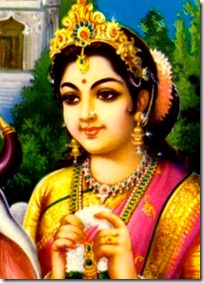
[Shrimati Radharani]“Shrimati Radharani is the center of all Vrindavana's activities. In Vrindavana, Krishna is the instrument of Shrimati Radharani; therefore all the inhabitants of Vrindavana still chant ‘Jaya Radhe.’” (Shrila Prabhupada, Chaitanya Charitamrita, Madhya 13.150 Purport)

Download this episode (right click and save)

Friend1: I know that Shri Krishna, the Supreme Personality of Godhead, is not alone. He has Radharani by His side.

Friend2: In certain depictions, yes.

Friend1: What do you mean?

Friend2: Well, sometimes, you have Krishna alongside the Queen of Dvaraka, Rukmini Devi. In some temples He will be with Satyabhama, another queen.

Friend1: Oh, right. I see what you mean. The focus today is on Radha-Krishna. I know they are factual personalities; not figments of the imagination. But there is also some symbolism to the image.

Friend2: How so?

[Radha-Krishna]Friend1: In what they represent. The male and female aspects of the Divine.

Friend2: True. God is one, but here you have two different sides to that one. Neither is necessarily inferior or subordinate.

Friend1: Radharani is also known as the goddess of fortune, Lakshmi. In this way, Krishna is the husband of the goddess of fortune.

Friend2: Which is the reason for another name, Madhava. You also have Shripati and Lakshmipati.

Friend1: That is so nice. I like how there are many forms of address. You can choose one to your liking and be equally as benefitted.

Friend2: The Supreme Lord is unlimited, after all. He could never be restricted to a single name, a single point of view, a single perspective, or a single tradition of spirituality. Sort of like how the sun goes by different names depending on which part of the world you live. Yet the sun is still the same; there aren’t multiple versions of it.

Friend1: One thing that a person might find odd is that in their earthly pastimes, Radharani appears in a part of the world that wouldn’t be considered fortunate.

Friend2: Why would you say that?

Friend1: It is a rural community. She is the daughter of Vrishabhanu. These are villagers, in essence. If she is the goddess of fortune, is there not a contradiction?

Friend2: An incompatibility of sorts?

Friend1: Yes; she is supposed to be the embodiment of fortune. Well then, where is it? Why is she living in some farmhouse? No electricity. No underground sewage system. No indoor plumbing. No high-speed internet.

Friend2: These are good questions. Radharani as goddess of fortune is one point of view. It is one perspective in honoring and worshiping her. It is an important view to have, since we should respect the Almighty and those dear to Him.

Friend1: What are you saying? She is not really the goddess of fortune?

Friend2: No; I am saying she is much more than that. In the temple, we dress the deities opulently because we look upon them as Vishnu and Lakshmi. The mood of worship is awe and reverence. This is the explanation of His Divine Grace A.C. Bhaktivedanta Swami Prabhupada.

Friend1: Okay.

Friend2: Radharani’s actual position is difficult to understand. The love between the two, Radha and Krishna, is so amazing that there is the Divine descent as Chaitanya Mahaprabhu in an attempt to understand.

Friend1: The golden avatara who teaches specifically about madhurya-rasa. In other words, reaching the pinnacle of bliss in bhakti life.

Friend2: And so the setting is a component to that love. Vrindavana is where Radha and Krishna enjoy the most. They are already the wealthiest people in the universe. It is not like Nanda and Vrishabhanu are poor. Just see how everyone is dressed, based on the paintings and depictions. Limitless cows. No economic problem. No lack of fresh air. Plenty of sunshine and exercise, without worrying about stock prices and your retirement account.

[Shrimati Radharani]Friend1: Oh, absolutely. I know what you mean. Jewels everywhere. The finest dresses. No one walks around like that today. It is the best fashion sense. The men, the women, the children – everyone looks amazing.

Friend2: Which is not by accident. To this day, in Vrindavana people are more attached to Radha than Krishna. They celebrate her appearance anniversary day, Radhashtami, with so much love, affection, and joy.

Friend1: Provided the tyrannical, atheist government allows people to congregate for such celebrations. Not giving some bogus excuse as to prevent the onset of disease, which is a risk at every second of an existence.

Friend2: That kind of worship is the embodiment of good health. It is the most beneficial for everyone involved. Radharani as the goddess of fortune showers her blessings on the fortunate inhabitants, who always remember and honor her.

In Closing:

As goddess of fortune known,
But how in Vrindavana shown?

Where living in rural setting,
And not highest standard getting?

The most joy deriving in that place,
Krishna and She of moonlike face.

Radharani countless blessings giving,
Attached those on bhakti path living.

Thursday, September 5, 2019

Radhashtami 2019

[Shrimati Radharani]“In the same Karnamrita there is another statement about the chanting of Radharani. It is said by one of the associates of Radharani: ‘O Lord Govinda, the girl who is the daughter of King Vrishabhanu is now shedding tears, and She is anxiously chanting Your holy name - Krishna! Krishna!’” (The Nectar of Devotion, Ch 18)

Download this episode (right click and save)

Friend1: I particularly enjoy visiting a temple on Radhashtami day.

Friend2: Explain what that is.

Friend1: The appearance day anniversary for Shrimati Radharani. Something like a birthday, but more.

Friend2: And who is Radharani?

Friend1: She is the energy of God. The feminine side to the Divine. The Supreme is both male and female. Just as the two mix in this world to continue life, so the combination of male and female are responsible for the entire cosmic manifestation. The male is the enjoyer and the female the enjoyed.

Friend2: Who is the enjoyer?

Friend1: Shri Krishna, the Supreme Personality of Godhead.

[Radha-Krishna]Friend2: What about Vishnu? Where does He fit into this?

Friend1: The same Almighty manifesting in different ways. You never lose the combination of male and female. Radha is with Krishna. Lakshmi Devi with Vishnu. Sita Devi with Rama. The energy on the right side of the image and the energetic on the left.

Friend2: Are we not the energy, too?

Friend1: A different category, but with a similar position of “enjoyed.” We think otherwise; that I am the greatest enjoyer, purusha. Actually, we are prakriti in comparison to the original purusha. That is what makes Radharani so special. She is the ideal companion to Krishna. She is the energy, but one that is completely pure in consciousness. She never falls into illusion, or maya. We have that vulnerability, but she does not.

Friend2: Why do you prefer her appearance day? What about Krishna’s? How about Diwali and other celebrations?

Friend1: On Janmashtami the temples get very crowded. Don’t get me wrong, I’m not putting down any of the other holidays on the Vaishnava calendar. To me there’s just something special with the energy of God. It’s like we almost prefer to celebrate her more.

Friend2: That is the mood in Vrindavana, which is a spiritual place. The residents tend to say, “Radhe, Radhe,” more than they do Krishna’s names.

Friend1: Speaking of names, I know that one of Radha’s other names is Vrishabhanu-suta.

Friend2: This means “daughter of King Vrishabhanu.” He lives in a town nearby Krishna’s Gokula. These are from the pastimes in the manifest world, which are described in sacred texts like the Puranas and derivative works by saints appearing in the disciplic succession.

Friend1: There is something to that bond between father and daughter. Vrishabhanu must be very special to have received the goddess of fortune in his family.

Friend2: Absolutely. That is one way to look positively on the birth of a female child. The daughter is an extension of Lakshmi Devi. In Vrishabhanu’s case it was Lakshmi herself in his home.

Friend1: What about the issue of separation? In Vedic culture that is of particular concern for the father of the bride. He knows that one day he will have to part ways with someone so dear to him. It is a kind of torture, if you think about it.

Friend2: How is that?

Friend1: You were going through life just fine prior. Then this amazing person appears. They give you more happiness than you ever imagined possible. But one day you will have to part ways. The responsible thing to do is to arrange for a marriage at the appropriate age.

Friend2: Ensure that the child is always protected. Rather than be selfish, think of the wellbeing of your dependent.

Friend1: It just seems unfair, the separation aspect.

[Shrimati Radharani]Friend2: Sadly, separation is part of life. Fortunately, with the Supreme Lord and His energy you can always keep them close by. Upanayana is the formal ceremony marking the approach towards the representative of Radha and Krishna. The guru teaches how to maintain their association, to never feel like you are separated from them. The Radhashtami celebration is a tradition aimed at that purpose. We can remember the daughter of Vrishabhanu every single day through saying her names like Hare and Radhe, and also on the special occasions relating to her dealings with Krishna.

In Closing:

Baby arriving in home one day,

Daughter of Vrishabhanu to say.


Radhashtami the appearance celebrating,

Who of pure devotion demonstrating.


That eventual separation not fair,

Joy now but of future aware.


From guru approach technique learning,

That distance into closeness turning.

Saturday, September 15, 2018

Radhashtami 2018

[Shrimati Radharani]“To perform devotional service means to follow in the footsteps of Radharani, and devotees in Vrindavana put themselves under the care of Radharani in order to achieve perfection in their devotional service. In other words, devotional service is not an activity of the material world; it is directly under the control of Radharani. In Bhagavad-gita it is confirmed that the mahatmas, or great souls, are under the protection of daivi prakriti, the internal energy - Radharani. So, being directly under the control of the internal potency of Krishna, devotional service attracts even Krishna Himself.” (The Nectar of Devotion, Ch 1)

Download this episode (right click and save)

Friend1: I’ve noticed that a lot of people in the Vedic tradition don’t observe the occasion of Radhashtami.

Friend2: Give a brief overview of what that is.

Friend1: Take it from the name. The ashtami, or eighth day of the moon cycle, in relation to Radha, who is Shrimati Radharani.

Friend2: And why is a particular day in the annual calendar associated with her? What is the significance?

Friend1: The eternal consort of the Supreme Personality of Godhead. The internal energy. The pleasure potency. Essentially the female side of the Divine.

Friend2: Who is the male?

Friend1: Shri Krishna. The all-attractive one. Also known as Vishnu and His other avataras like Rama, Narasimha and Matsya.

Friend2: What is the purpose of Radhashtami?

Friend1: I don’t know about a purpose, exactly, but it is a birthday. It marks the appearance of Radharani in this world. She is the queen of Gokula, appearing as the daughter of Vrishabhanu.

Friend2: What were the circumstances of her birth?

Friend1: I think it was similar to how King Janaka found Sita Devi. Radharani came to the family in an unusual way, with the father finding her. It wasn’t your typical cycle involving a pregnancy.

Friend2: Why is the occasion celebrated?

[Shrimati Radharani]Friend1: Because she is the topmost devotee of the Supreme Lord.

Friend2: Can there be different grades? I thought God would have to love everyone equally.

Friend1: He does. Proof is there in the presence of the Supersoul. This is the expansion of the Divine, considered unseen or unmanifest, residing within the heart next to the individual soul, jivatma.

Friend2: How can you say someone is the topmost devotee, then?

Friend1: God loves everyone equally, but the reciprocation is not the same. In the material world there is forgetfulness caused by maya, which is the illusory energy sent from the Divine.

Friend2: Is devotion to God different?

Friend1: Yes, because it is above maya. It is connecting directly with Krishna, bypassing the material elements altogether. Radharani is the topmost devotee because of the way she lives. Her consciousness is always pure. She is always thinking of the Supreme Lord and how to please Him.

Friend2: What would be a lower-grade devotee?

Friend1: Someone whose desires are mixed. They understand the need to serve, to escape maya, but they fall down every now and then. They may want material prosperity or the elimination of distresses. They may be connected in yoga for a period of time and then accidentally break away.

Friend2: And this never happens with Radharani?

Friend1: Not possible. She is the eternal consort for a reason. Radha-Krishna, two becoming one, or two as one. That is why they are worshiped together.

[Radha-Krishna]Friend2: Okay.

Friend1: Back to my original point, why is the celebration not more widespread?

Friend2: In comparison to?

Friend1: Janmashtami. Diwali. Holi. These are celebrated by practically everyone whose spiritual tradition is linked to the Vedas, the ancient scriptural tradition of India.

Friend2: I mean the answer is obvious. With Radharani you only worship for one thing: continued devotion. Her recommendation to Krishna is enough to guarantee success.

Friend1: Okay, but Janmashtami is celebrating Krishna directly.

Friend2: Yes, but people are known to approach God with certain desires. Their motivations may not be pure in the beginning. They know He has the capacity to fulfill the most difficult orders.

“O best among the Bharatas [Arjuna], four kinds of pious men render devotional service unto Me—the distressed, the desirer of wealth, the inquisitive, and he who is searching for knowledge of the Absolute.” (Lord Krishna, Bhagavad-gita, 7.16)

Friend1: Radharani is different?

Friend2: As Lakshmi Devi people approach her for material rewards, but in the original form she is known only for devotion. Not everyone desires that at present, though it is what will benefit them the most. That is why purification, samskaras, training under a spiritual guide, following rules and regulations and the like are necessary.

Friend1: Is there any harm in worshiping her if you still have material desires?

Friend2: The approach is always purifying. She is the internal energy, which the great souls, mahatmas, come under. They receive her shelter and thus get protection from falling back down into the ocean of birth and death. Without her favor success is not possible.

“O son of Pritha, those who are not deluded, the great souls, are under the protection of the divine nature. They are fully engaged in devotional service because they know Me as the Supreme Personality of Godhead, original and inexhaustible.” (Lord Krishna, Bhagavad-gita, 9.13)

Friend1: Whereas the default condition is to be under the control of the non-divine prakriti.

Friend2: That is maya. There is no protection; everything can be lost within a second. Maya is the catalyst for change, for maintaining a fearful condition. Bhakti is fearlessness, knowing that Krishna will protect. He does so through the favor of His beloved Radharani, who should be remembered every single day, including on the auspicious occasion of her appearance day.

In Closing:

Her devotion to Lord most endearing,

Path to success for devotees clearing.


Radha like to others not the same,

Not for wisdom or wealth to attain.


For love of Shri Krishna known,

In Vraja pastimes shown.


Same spirit to others can give,

So that in eternal ananda to live.

Monday, August 28, 2017

Radhashtami 2017

[Shrimati Radharani]“Since Krishna had departed from Vrindavana to Mathura, the inhabitants of Vrindavana, especially mother Yashoda, Nanda Maharaja, Shrimati Radharani, the gopis and the cowherd boys, were simply thinking of Krishna at every step.” (Krishna, The Supreme Personality of Godhead, Vol 1, Ch 45)

Download this episode (right click and save)

In the sacred land of Vrindavana the residents appear to be more attached to Shrimati Radharani, who is the goddess of fortune and the original and full manifestation of the pleasure potency of the Divine. Those residents are known to constantly say, “Radhe, Radhe,” in great ecstasy, hoping to win the favor of the beloved of Shri Krishna. The occasion of Radhashtami brings another chance to remember and honor her.

It’s a common retort from the atheists, or at least those who are not sure about religion and the concept of an Almighty, intelligent being watching over the creation.

“We have visual evidence of so many things. I know it is sunny by looking outside. I can tell where I am by my surroundings. In the same way, why can’t I just see God? Why can’t He appear before me? Then I will be sure.”

Those on the devotional path understand that He is actually everywhere. The very presence of life is proof of His existence. Nothing would manifest without His prior sanction. No result can come to be without His approval. This is true of both pious and sinful activities.

“The bewildered spirit soul, under the influence of the three modes of material nature, thinks himself to be the doer of activities, which are in actuality carried out by nature.” (Lord Krishna, Bhagavad-gita, 3.27)

The all-pervading aspect of God is often described as the impersonal side. The presence is there all the same, but distinguishable features are lacking. There is a personal side, as well, and when in the material condition there appears to be separation.

The idea is to worship in separation. There is some faith extended in the beginning, but gradually, through purification in practice, the faith aspect dissipates, turning into supreme confidence. At the same time, the attachment increases. You essentially become more attached to something you feel separated from.

In normal circumstances such separation is unfortunate. Wouldn’t we rather be with God? Wouldn’t that fix the problem? The attachment is actually more important, and those who have this attachment feel tremendous ecstasy. No one worships better in separation than Shrimati Radharani. She is Krishna’s eternal consort. Krishna is God in the original form. He is all-attractive, and that property extends to His devotees and the devotion they practice.

[Radha-Krishna]Radharani’s devotion is the most attractive, as she never stops thinking of her beloved. There is the philosophical evidence understood through theory and practical application. There is also the supporting historical evidence, found in works like the Shrimad Bhagavatam.

If Radharani is eternally with Krishna, what need is there for history? The Divine sometimes descends to the mortal world. He does so to accomplish several tasks, but primarily He likes to give even more pleasure to the devoted souls.

Krishna spends significant time in Vrindavana, which is a replica of the transcendental abode in the planetary system known as Vaikuntha. In this rural community, Krishna performs amazing and adorable pastimes, and Radharani features prominently in the real-life drama.

Unfortunately, one day Krishna leaves Vrindavana for Mathura. He never returns, and the residents are left to feel the tremendous separation. Radharani is the most affected, and she continues to remember her beloved day and night. She is not a stone. She continues to work. She does not abandon all responsibilities. The same goes for the other gopis, the cowherd women.

[Shrimati Radharani]In this way the person most dear to Shri Krishna is a shining example for every spiritual seeker. She worships in separation. She never stops thinking of the all-attractive one. She pleases Krishna so much with her devotion. Others on the path seek her favor first, as she is not selfish. She recommends devotees to Krishna. Her approval means the world, as she, better than anyone, understands worship in separation, vipralambha. Her potency is just as much present in the sacred maha-mantra, the sound vibration to soothe the pain of feeling away from God: Hare Krishna Hare Krishna, Krishna Krishna, Hare Hare, Hare Rama Hare Rama, Rama Rama, Hare Hare.

In Closing:

In worship not always close to be,

Sometimes desperate longing to see.


This platform considered highest of all,

Reason with ecstasy “Radhe” to call.


In Vrindavana following her with determination,

Who embodying worship in separation.


So on Radhashtami prayers her way to send,

Who gladly devotees to Krishna recommends.

Thursday, September 8, 2016

Radhashtami 2016

[Shrimati Radharani]“Lord Chaitanya also recommended that the highest mode of worship in the highest perfectional stage is the method practiced by the damsels of Vraja. These damsels (gopis, or cowherd girls) simply loved Krishna without a motive for material or spiritual gain.” (Shrila Prabhupada, Chaitanya Charitamrita, Preface)

Download this episode (right click and save)

Who is God? Can it be a person? Is that not too limiting? Is God male or female? Aren’t there defects in that? A male can’t give birth to a child. A female can’t impregnate someone else. If God is male, then it means He is lacking something, no? If He’s female, He’s to be considered weaker, right?

The Vedas teach that there is a male aspect to the Divine, accompanied by a female aspect. The male is known as Krishna. His name means “all-attractive.” This attractiveness is seen in a spiritual form. Something that is lacking attributes by definition cannot have attractive features. It is featureless. The Supreme Lord is the most beautiful person in all the universes. The same Krishna personally expands to other non-different forms like Rama, Narasimha, and Vishnu.

The female aspect to the Divine is known as Radha. She is the queen of Vrindavana, so she is also known as Radharani. Her complexion is golden, and she is the most beautiful woman. The only difference between the two is that one is the enjoyer while the other is enjoyed. On the occasion of Radhashtami we celebrate the enjoyed, who acts only for the pleasure of her beloved.

Shri Krishna Chaitanya Mahaprabhu has declared that the worship of the gopis is the best. This is when discussing bhakti-yoga, devotional service. The gopis are the cowherd women of Vrindavana, and Radharani is their leader. A person can spend many lifetimes studying the love of the gopis and still reach no end. Their superiority in devotion is shown in many ways. On the special day honoring the appearance of Shrimati Radharani, we look back to one time when Krishna fell ill.

Krishna has a headache

Vrindavana is the spiritual world, the topmost planet in the realm known as Vaikuntha. A replica version of Vrindavana exists in the material world, and occasionally, as defined in terms of the lengthy span of the creation, the Supreme Lord descends to show His lila, or pastimes. Radharani simultaneously appears in Vrindavana, as do the male and female friends, the sakhas and sakhis.

[Lord Krishna]In His manifest pastimes, Krishna does not stay in Vrindavana the entire time. At the onset of adulthood, He leaves for Mathura, and later becomes the king of Dvaraka. There He lives with many beautiful queens in exquisite palaces.

One time Narada Muni visited Krishna in Dvaraka. Narada is a triloka sanchari; He travels the three worlds spreading the message of bhakti. When the saint met Krishna, he found out that the Supreme Lord had a headache. Krishna knew what the remedy was. He needed the dust of the lotus feet of His devotees. He asked Narada to bring that for Him.

Narada searches for the dust

This was a strange request. In Vedic culture, taking the dust of someone’s feet is considered a sign of great respect. The junior takes the dust from the senior. In a household, the residents do this with the dust of a visiting saint. There is also a practice where the senior’s feet are washed, with the juniors then drinking the water.

Narada first went to the queens in Dvaraka. They were unhappy that Krishna had a headache, but they were reluctant to do as asked. “This is adharma. This goes against everything we practice. It will be so sinful to think we are superiors who can offer the dust from our feet to Krishna.” It is the custom for the wives to worship the husband.

Narada had to continue in his search. He went to Lord Brahma and Lord Shiva. These are highly exalted beings who are worshiped by so many. Shiva can grant amazing blessings, which he has done many times in the past. They both refused. They would not violate etiquette, even if it was what Krishna asked.

Narada visits the gopis

Narada returned to Krishna to tell the Lord of his failure. Krishna then asked if Narada had visited the gopis in Vrindavana. The saint hadn’t, and so he was soon on his way. The amazing thing about the gopis is that they don’t consider themselves to be great devotees. This mood is genuine; they are not faking humility as a means of garnering attention or advancing towards a higher objective.

The gopis didn’t like the request, either. They thought it was odd that someone would consider them to be great devotees. They were simple village girls, after all. They were in the pain of separation from their beloved, who had left them for the city life. Still, they were glad to see Narada, since the saint had news about Krishna.

The gopis aren’t afraid to suffer the reactions

Krishna asked for the dust from the feet of His devotees. The gopis didn’t consider themselves to be so exalted, but Krishna needed help. Shrimati Radharani generated some dust from her feet. Then her other gopi friends followed. Narada had enough to bring back. He wondered why they weren’t afraid to violate etiquette. The gopis responded that their lone objective was to see Krishna happy. If that meant suffering in hell afterwards, they were prepared to make the sacrifice.

[Shrimati Radharani]Narada returned to Krishna with the dust. Krishna was immediately cured and then spoke of the glories of the gopis. Radharani is so close to Krishna that she is not afraid to chastise Him sometimes. She and her friends make fun of Him and try to bring down His ego. Yet it is all in good fun, done out of pure love. Radha thinks only about Krishna, which makes her the most dear to the Supreme Lord.

In Closing:

Headache remedy in sage Narada to trust,

Sent to get from feet of devotees dust.


Though for their beloved ready anything to give,

Queens in Dvaraka afraid of sin impossible to forgive.


Brahma and Shiva also refusing,

Path of dharma steadfastly choosing.


Generating instantly the gopis by Radha headed,

Not afraid, even moment’s pain for Krishna dreaded.

Sunday, September 20, 2015

Radhashtami 2015

[Radha-Krishna deities]“When the spiritual body, mind and senses are completely purified, one can render service to the Supreme Personality of Godhead and His consort. In Vaikuntha the consort is Lakshmi, and in Goloka Vrindavana the consort is Shrimati Radharani.” (Shrila Prabhupada, Chaitanya Charitamrita, Madhya 8.229 Purport)

Download this episode (right click and save)

Shri Chaitanya Mahaprabhu says that a woman makes the home. This is common knowledge to those who have visited the typical “bachelor pad.” A refrigerator filled with beer and soda, a living room with scant furniture, dirty dishes piled up in the sink – males usually aren’t suited for homemaking. A woman makes the home in the big house up in the spiritual sky as well. On the occasion of Radhashtami we celebrate her unique position.

Is God a He? Why can’t the Supreme be a She? The Vedas provide the most clarity on the subject. The truths they present make up a science. This means that Vedic knowledge is not meant to be accepted blindly. Sure, you need humble submission at the beginning. The first grade student isn’t going to learn how to read and write if they don’t listen to the teacher. In the same way, to become truly enlightened about spiritual matters requires patience and respect to ingest necessary pieces of information.

Yet after everything has been taken in, there should be deliberation. Any lingering doubts should be squashed; no genuine question should be dismissed by the teacher. For instance, if the student asks why God can’t be a female, an answer should be forthcoming.

The female aspect of the Divine is well represented in Vedic teachings. In bhakti philosophy, which goes beyond Vedanta, the feminine aspect of the Supreme Lord is known as Radha. She is a distinct personality, though in interest she is merged with the male aspect, who is known as Krishna. Here we review some important details about Radha.

1. She is the feminine aspect of God.

[Radharani]Male and female together. In Sanskrit the corresponding terms are purusha and prakriti. Purusha is the enjoyer and prakriti is that which is enjoyed. In the higher scheme, there is only one purusha. He enjoys everything. No one can take that away from Him. Since He is the only enjoyer, it is natural for Him to be known as God.

Prakriti is that which He enjoys. The souls that go wayward, thinking themselves to be purusha, descend to a land that is like a shadow of the original realm. It must be this way, since the pursuit to enjoy separately of Krishna is itself illusion.

Radha is the prakriti that never mistakenly thinks she is purusha. She is always ready to give service to her beloved Krishna, to allow Him to enjoy her. This is what makes her happiest. Indeed, the same sentiment lies deep within all of us.

2. She is the pleasure potency.

[Radha and Krishna in Vrindavana]The living entities that fall into the material realm are known as jivas. This energy that comes from God is known as the jiva-shakti. Radha is the hladini-shakti, or the pleasure potency. She pleases Krishna more than anyone else can. It is for this reason that she is always depicted with Krishna in paintings. She sports with the jewel of Vrindavana under the moonlit night.

3. She is Krishna’s eternal consort.

The term “wife” doesn’t suffice for Radha. As she is the queen of Vrindavana, she is also known as Radharani. Marriage is an institution in dharma, which is like religiosity or virtue. Dharma exists to help the jivas return to the spiritual realm. As Radha doesn’t require such salvation, her relationship to Krishna is not bound by any code of ethics or rules of morality. She is forever with Krishna in an amorous relationship, more specifically known as madhurya-rasa.

4. She opens her eyes for the first time to see Krishna.

Radha and Krishna enjoy eternally in the spiritual realm and they sometimes appear in our world for our benefit. When Radha appears, the occasion becomes known as Radhashtami. She arrives at the same land of Vrindavana, around two weeks after the date of Krishna’s appearance. She gives a slight problem to her beloved parents, though. She fails to open her eyes in the beginning, causing them concern. The problem is solved when baby Krishna gets invited over. While the elders are off talking and taking care of other matters, Krishna comes over to Radha. She then opens her eyes for the first time, proving that she has eyes only for the Supreme Lord.

5. She recommends other devotees for service.

Being a pure devotee, Shrimati Radharani is extremely humble. She does not consider herself to be as elevated as she actually is. Because of this natural humility, she readily recommends others to Krishna. Those who are sincere in their desire to serve the Supreme Lord, to always be conscious of Him, to make both Him and His servants happy, seek the blessings of Radha. If she is pleased, then success in devotional service is assured. She has Krishna’s ear, and she will put in a good word for those who approach her.

[Radharani]Radha has every good quality imaginable, and her service proves that Krishna is pleased by both male and female. He is not particular. He does not restrict anyone from the highest religion that is bhakti-yoga. Devotion to God is already all-inclusive; no separate endeavor to equalize all religions is necessary. Radha and Krishna are the female and male aspects of God together, the ideal pair to worship for lifetime after lifetime.

In Closing:

As Krishna God is a He,

And Radha female aspect is She.


The Lord her service happily accepts,

Sincere devotee never He rejects.


Through Radha to Lord become dear,

Since in closeness she having His ear.


Eternal consort, more than a wife,

Ideal to worship in life after life.

Monday, September 1, 2014

Radhashtami 2014

[Radha-Krishna]“My dear friend, do You think that this walking personality is a tamala tree? If He is a tamala tree, then how is it possible for Him to walk and be so beautiful? Then, this personality might be a cloud. But if He's a cloud, then where is the beautiful moon within? Under the circumstances, I think it may be granted that this person is the same enchanting Personality of Godhead by whose flute vibration the three worlds are captivated. He must be the same Mukunda who is standing before Govardhan Hill.” (Shrimati Radharani, The Nectar of Devotion, Ch 30)

Download this episode (right click and save)

What does it mean to have perfect vision? Is it passing an exam prior to getting your motor vehicle license? Is it being able to read letters on a screen from a distance? Is it being able to identify something that should be known to you? One person in particular has perfect vision, and that perfection does not relate to any of these things. Rather, she sees Krishna everywhere. That Krishna is the Supreme Personality of Godhead, the definition behind the abstract concept of a supreme controller. Since she has this perfect vision, she is most worshipable and dear to Krishna. On the occasion of Radhashtami we celebrate her appearance in this world.

[eye exam chart]In the inverse situation, the poor vision does not see God anywhere. Perhaps we are in this situation presently. How can we see God when we don’t know what He looks like? Is He in the pillar holding up the building across the street? Is He in the wind that blows through the trees? Is He in the sound of the music that I most prefer to listen to? He is indeed in all of these things, but the person lacking the perfect vision cannot notice this.

Lacking the sight necessary for perceiving Him, such unfortunate souls might descend to the point that they’ll think God does not even exist.

“Everything occurs randomly. There is no order to the universe. People just made up God as a way to deal with death. It’s a primitive way of thinking. We are more advanced now. We can see within the body to identify the disease. We can see deep into outer space to study the universe. We can predict a hurricane several days prior to its arrival. Where is God’s influence in this? Why do you speak of a God when man has done all of this?”

[hurricane on radar]Actually, the ability to apply intelligence already indicates the presence of a higher force. Man has intelligence, there is no doubt about this. While he can do amazing things he can’t figure out why he has taken birth. He can’t figure out why he is compelled to die. Instead, in futility he tries to prolong life indefinitely. This endeavor is always a failure, and so success gets redefined down to living a few extra years from the average.

The periods of the seasons, the rising and setting of the sun, the ability to study the life cycle of the human being and other species, the predictability of disease and human behavior - these things all give an indication of God. But you don’t need to even dig that deep. Simply looking upon a tree can give you the vision of God. This is the case with Shrimati Radharani.

She lives in Vrindavana, which exists both in the earthly realm and in the spiritual sky. We know of her earthly pastimes based on works of literature passed on since many thousands of years. In Vrindavana there is a type of tree called tamala, which has a unique color. It is blue, which is rare for a tree. That color is a perfect match for the bodily hue of the Supreme Personality of Godhead Krishna. A few of those trees are still around in the earthly Vrindavana, so this allows one way of knowing exactly what God’s body looks like.

Shrimati Radharani sees Krishna everywhere in fact. This is due to her consciousness. Never for a moment does she forget Him. And that consciousness is in a loving mood. Not for her own satisfaction, but always looking for Shyama’s pleasure, Radharani constantly thinks of Him. This thinking makes a person more happy than otherwise possible. Real happiness is this thinking, and so Radharani is the ideal example for any human being wishing to know the inner secrets to the creation and their own existence.

[Shrimati Radharani]Radha’s vision is so perfect that simply upon seeing a tamala tree she thinks that Krishna has appeared. She embraces such a tree sometimes, thinking that her beloved has come. Indeed, why should not the tree remind us of Krishna? The pious trees provide fruits which allow us to live on. The impious trees at the very least provide shade and oxygen, which can help us to stay alive.

When Radha and her friends, known as the gopis, see an ordinary tree they also think of Krishna’s flute. The flute is made from wood that comes from the tree, and so they have so much appreciation for that tree. They then extend their appreciation to the flowers that surround the tree. Then the nearby river also gets praises.

Radha sees Krishna in His friends, who give the Lord so much pleasure with their daily play in the pristine forests of Vrindavana. She sees Him in the dark blue cloud that is ready to pour down rain. She sees Him in the Govardhana Hill, which Krishna once famously lifted to save the lives of the residents of Vrindavana. She sees Him in the cream that stands atop the pot of yogurt. She and her friends try to sell this yogurt in the neighboring town of Mathura, but Krishna intercepts them and playfully eats the cream, thus making the yogurt not very appealing for sale.

[gopis intercepted by Krishna]As Radha always sees Krishna, one who sees Radha the proper way will also see the Supreme Lord. He is always together with His pleasure potency expansion, the beloved daughter of Vrishabhanu and Kiritida. To please Radha means to easily get the mercy of Shri Krishna, whose single glance can transform a life previously spent in misery into one full of optimism that renews every day with the knowledge of the chance to serve the beloved pair, Shri Shri Radha and Govinda.

In Closing:

From just the vision of a tree,

Image of the Supreme Lord to see.


Tamala of the color blue,

Perfectly matches bodily hue.


Of Shri Krishna, to Radha so dear,

She having vision pure and clear.


Radhashtami celebrating day of her appearance,

By her favor, for bhakti’s success getting clearance.

www.krishnasmercy.org

Wednesday, September 11, 2013

Radhashtami 2013

Radha-Krishna“Radha-Krishna is one. Radha-Krishna is Krishna and Krishna's pleasure potency combined. When Krishna exhibits His pleasure potency, He appears to be two - Radha and Krishna. Otherwise, Radha and Krishna are one.” (Shrila Prabhupada, Chaitanya Charitamrita, Madhya 8.282 Purport)


When we say that someone has eyes for someone else, it means that they are attracted to that person. A symptom of that attraction is the behavior of their eyes: it will only focus on the object of attraction. In the case of the perfection of the energy of the Supreme Personality of Godhead, this phrase has both symbolic and literal meaning. It is symbolic in the sense that the energy is certainly attracted to the Supreme Lord, taking the utmost pleasure in seeing Him. It is literal in the sense that during the energy’s pastimes on earth in her original form, the first thing she saw was her beloved. She didn’t see anything else prior, so her vision was never tainted. On the occasion of Radhashtami we celebrate her wonderful sight, a sense which is dedicated exclusively to the Supreme Personality of Godhead.

“Hare Krishna Hare Krishna, Krishna Krishna, Hare Hare, Hare Rama Hare Rama, Rama Rama, Hare Hare,” is a mantra now famous throughout the world due to the tireless work of His Divine Grace A. C. Bhaktivedanta Swami Prabhupada and his many disciples. Taking the original Sanskrit definition, a mantra is a sequence of words to deliver the mind. To deliver implies that there is some danger. The mind is considered to be in perpetual danger when enveloped by maya. Maya is a Sanskrit word that can mean “that which is not.” It is actually just an energy, but based on how it is viewed it can create an illusion.

Light switchWhen the mind is suffering from the effects of maya, it needs to be rescued. Think of it like being stuck in a dark room and searching for the light switch. You have to be very careful in such a circumstance. If you walk too fast, you’ll likely bump into something. You could walk straight into a wall and cut your head open. So you keep your arms out, feeling for different objects, until you finally find the light switch. When the switch is flipped on, the light delivers you from the dangerous situation.

A mantra is like a light switch for the mind affected by maya. There are many mantras in the Vedas, the original scriptural tradition of India. There are different ailments that afflict the mind, and so many mantras exist to give aid. The aforementioned mantra is known as the maha-mantra, or the great sequence of words to deliver the mind. This mantra provides the best light, so to speak. It clears the mind of the illusion of false proprietorship over temporary objects. It clears up for the mind the doubt over the existence of a supreme controller. It allows the mind to know that there is both a Supreme Lord and an energy, and that both are meant to work together.

In the maha-mantra, the words Krishna and Rama address the Supreme Lord. They are two words to describe the same person. Another word for Krishna is Hari. And that which belongs to Hari is known as Hare. Hare is thus the energy of God; it is always with Him. We are part of the “Hare,” but we have a choice in how to act. Think of it like children who can either listen to the parents or ignore them. The Hare addressed in the maha-mantra is the purest form of that energy; it never thinks to deviate from devotional service, which is the highest occupational duty for all spirit souls.

Hare has eyes only for Hari. This is evidenced in her behavior. God is the masculine, and His supreme energy is the feminine. Indeed, in the grand scheme we are all feminine, though in the temporary body we think we are masters over the predominated material energy. We are really under the control of the divine, who is thus masculine. When the feminine always seeks to meet the interests of the masculine, and the masculine fully reciprocates that affection, there is oneness. Thus in this sense there is no difference between Hari and Hare.

Hari and Hare live in the transcendental abode known as Goloka Vrindavana. In that special land everyone is Krishna conscious. No one is deluded by maya. There is no need for deliverance of the mind, for the mind is always engaged in serving Krishna to some capacity. There is a replica of that Vrindavana in the earthly realm, and from time to time both the energetic and the energy descend to show their divine play.

Shrimati RadharaniHare appears in her original form of Shrimati Radharani. The exact sequence of events pertaining to her appearance and pastimes varies, since she appears in millennium after millennium. Space and time are continuous, so all manifestations go through cycles of creation and destruction. Both Hari and Hare appear over and over again, and sometimes they don’t always do everything in the same way.

Their most recent appearances took place some five thousand years ago in the Vrindavana of this land. Radharani appeared as the daughter of King Vrishabhanu and his wife Kirtida. Everyone was overjoyed when she was born, for she was amazingly beautiful. As was custom, so many great personalities came to the house to see her, wishing the parents well. There was one slight problem, though. Radharani had yet to open her eyes. The parents were afraid that she was blind.

One time they called over Nanda Maharaja and mother Yashoda, who were the parents of Shri Krishna, Radharani’s beloved. It is said that while the parents were talking in another room, Krishna crawled up to the bed on which Radharani was and touched her eyes. Upon this touch, she immediately opened her eyes. The first thing she saw was Krishna. Thus we know the real meaning behind her “eye problem”: she would not look at anything without first seeing Krishna. This is the mood of the pure devotee. They would rather be blind than be forced to see so many things that aren’t fully representative of their beloved Supreme Lord. In another version of the same event, Krishna and Radharani are both sitting on the lap of mother Yashoda. Krishna then touches her eyes and she opens them for the first time, seeing Him.

Radha and KrishnaThe conditioned souls have eyes for so many things. We love one person today, and the next our eye wanders elsewhere. Today we crave a certain food dish, and tomorrow we want something else. This constant change is guaranteed to continue for as long as one is in maya, for the very definition of maya is that which is not God. Of course everything is ultimately God, but the material energy is separated from Him. It is His energy, but the inferior variety. The eyes of the person who is pure in consciousness stay fixed on God once they find Him. On Radhashtami we celebrate the beloved of Shri Krishna. She is the queen of Goloka and has eyes only for the most attractive person in the world.

In Closing:

To not look elsewhere she chose,

New child to keep her eyes closed.


That is until Yashoda’s boy came,

All-attractive, of Krishna the name.


Touched her eyes when upon bed to reach,

That eyes only for Krishna she did teach.


Supremely auspicious is Radhashtami day,

Name of beloved of Krishna we happily say.

www.krishnasmercy.org

Friday, September 21, 2012

Radhashtami 2012

Shrimati Radharani“Shrimati Radharani received from Durvasa Muni the benediction that whatever She cooked would be sweeter than nectar. That is the special feature of Her cooking.” (Chaitanya Charitamrita, Antya 6.116)

In bhakti-yoga there is no prerequisite of a specific ability or social status. This is in contrast to other kinds of yoga. Intelligence is required in jnana-yoga, renunciation and peace in meditational yoga, and the ability to perform a specific kind of work in karma-yoga. Yet in any social status, at any age, and in any circumstance one can be connected to the Supreme Lord in a mood of love. Love is the universal language, and so it is never bound to a specific condition. Divine love exists to the highest degree in Shrimati Radharani, and so the anniversary of her appearance day is celebrated with great pomp by Vaishnavas, to whom she is very dear.

Radharani’s good qualities are too many to count and their magnitude so high that measurements don’t exist to accurately describe them. She is God’s pleasure potency, known as the hladini-shakti. There is the original God and then there is His energy. We are also part of His energy, and being technically part of the marginal aspect we have a choice in masters. Just as the free woman has a choice in suitors, the living entity can choose in favor of either material nature or the divine energy. Material nature has an illusory effect, so whatever it reveals to influence the individual soul’s choice is not what it seems. On the other hand, the divine energy is the truth; it is real. The individual’s true calling is association with the divine energy.

As the embodiment of the devotional attitude, Radharani never chooses in favor of the material energy. Instead, she uses her abilities to please the Supreme Lord in His original standing as Shri Krishna, the beautiful youth with a blackish complexion. He holds a flute in His hands, wears a peacock feather in His hair, and sports an enchanting smile that never leaves His face. These attributes combine to make a vision that never changes, meaning that service to it as a means of worship can take place at any time.

In exercising her choice to give pleasure to Krishna, Radha engages with her beloved in amorous sports. There is a sportive tendency within the divine, and when acting on that tendency there is the ideal playing field that is Vrindavana-dhama. The pleasure groves of that sacred land is where Radha and Krishna play, where they derive tremendous enjoyment from each other’s company. The contact is so blissful that anticipation of it is considered more enjoyable than the actual meeting.

In Vrindavana, Radha offers service to Krishna in other ways as well. As a beautiful young woman, one of her skills is cooking. She was once blessed by the famous Durvasa Muni that whatever she would cook would taste like sweet nectar. Cooking is an art form, and some are naturally very talented in it. They know how to combine ingredients in such a way that tasty dishes result. They have the patience and the creativity to make preparations that everyone will enjoy.

Radha has this ability in full and she offers it as a sacrifice to her beloved. Krishna’s foster mother in Vrindavana, Yashoda, calls Radharani over to cook for her boy, for she knows that He enjoys her preparations the most. Yashoda is a coordinator in this way, taking the knowledge of Radharani’s culinary abilities and steering them in the right direction. Another one of Radharani’s qualities is shyness, so she is not always so willing to openly show her love for Krishna. To cook for Him is a subtle way to offer service, and rather than volunteer right away, she waits until Yashoda calls upon her. This way it doesn’t appear to others that she is openly desirous of pleasing Krishna, a subtlety which actually makes her love more endearing to Yashoda’s son.

In bhakti-yoga, one can use whatever abilities they have to please the Lord. Cooking can be done for Krishna’s pleasure by offering preparations first to the Vaishnava spiritual master, who then passes the offering up the chain of spiritual masters until it eventually reaches Krishna. Radha is the topmost servant, so if she sees sincerity in devotional service, she recommends the devotee to Krishna. And her favor is very easy to win, as she is tenderhearted by nature. Therefore followers of bhakti-yoga always pray for Radharani’s blessings, and with great pomp they celebrate occasions relating to her.

Radha and KrishnaRadha uses all of her qualities for Krishna’s pleasure, and so one can use any of their skills to remain connected to the divine. Some are skilled in writing and others in talking. Some are naturally people-friendly, while others work better in seclusion. Something as simple as attending a gathering of devotees celebrating Shri Krishna is a way to offer service, as we influence people more with our example than with our words.

On Radhashtami we celebrate the occasion when Krishna’s dearly beloved appeared on this earth to delight Him with her pastimes. She is not specifically qualified in Vedanta, nor does she sit quietly in meditation. Instead, she sacrifices all of her time, dedicates every ability and quality that she possesses, for the Supreme Lord’s pleasure. She sets the perfect example in this regard, and she shows that bhakti-yoga cannot be checked by any condition. Devotion offered to her is as good as worshiping Krishna, and so the truly wise saints chant the names of both the energetic and the energy found in the maha-mantra, “Hare Krishna Hare Krishna, Krishna Krishna, Hare Hare, Hare Rama Hare Rama, Rama Rama, Hare Hare”.

In Closing:

In favor of devotion she chooses,

All of her abilities she uses,

For Krishna’s pleasure to see,

So that happy both will be.


From Durvasa blessing in cooking she takes,

So nectarean food for Krishna she makes.


On this blessed Radhashtami day,

Name of Krishna’s beloved let me say.

www.krishnasmercy.org

Saturday, September 3, 2011

Radhashtami 2011

Shrimati Radharani“Shrimati Radharani is most dear to Lord Krishna, and Her lake known as Radha-kunda is also very dear to Him. Of all the gopis, Shrimati Radharani is certainly the most beloved.” (Padma Purana)

Radhashtami is the anniversary of the appearance day of Shrimati Radharani, the eternal consort of Lord Krishna, the Supreme Personality of Godhead. The thrill felt by lovers courting one another, playing jokes and enjoying each other’s company, is found in its purified form in the intimate dealings between Radha and Krishna. To understand the transcendental nature of their interactions and derive the full benefit from hearing about them, one must be very fortunate. Without a properly situated consciousness, the conditioned mind will take Radha and Krishna’s interactions to be similar to the boyfriend and girlfriend dealings we are accustomed to seeing. Yet, just like the expensive antiques in the living room of the house, the pastimes between Radha and Krishna are meant to be enjoyed by those who understand its value. Put the priceless vase in the hands of children and they are liable to break it, not understanding its importance. With the benediction of wonderful holidays like Radhashtami on the Vaishnava calendar, any person can become familiar with Shrimati Radharani and her important position as Krishna’s most beloved.

Shrimati RadharaniIf you are God and you have someone who makes you extremely happy, it would make sense that your devotees would love her very much as well. We can just imagine the divine character of that pleasure-giving person, how many wonderful qualities they have. The Shri Chaitanya Charitamrita of Krishnadasa Kaviraja Gosvami lists some of Radharani’s most important qualities. She appeared on this earth as the daughter of King Vrishabhanu and Mother Kirtida. The exact sequence of events relating to her appearance can vary by creation. The variations found in Vedic literature do not give evidence to the theory that the information is just mythology or hyped up stories. On the contrary, as the creation and destruction of the earth and other material planets go through repeating cycles, the exact sequence of events pertaining to the pastimes of Lord Krishna and His associates isn’t always the same.

This also reveals why there are sometimes variations in the telling of the Ramayana, which describes the life and pastimes of Lord Rama, one of Krishna’s most famous incarnations. Indeed, even Goswami Tulsidas, who is sometimes criticized for having differences in his Ramacharitamanasa, provides a few different details in his other shorter poem on the same subject matter called the Gitavali. Was he not aware that he contradicted himself? Was he not aware that his versions of the events of Rama’s life differed slightly from what was found in the original Ramayana composed by Maharishi Valmiki? Obviously not, as the Lord doesn’t follow exactly the same behavior every single day. Just as our day is measured by the movement of the sun, the length of the creation is equated to one day of Lord Brahma, who is the creator. In each day of Brahma, there are cycles of the different yugas, with the sun that is Krishna appearing at similar times in each cycle. Though the spiritual sun that is Krishna doesn’t always follow the same path through the sky, the majority of the events relating to His pastimes occurs at similar times and follows similar patterns.

“By human calculation, a thousand ages taken together is the duration of Brahma's one day. And such also is the duration of his night.” (Lord Krishna, Bhagavad-gita, 8.17)

Lord KrishnaWith Shrimati Radharani’s appearance, the earth was graced with the lotus feet of Krishna’s beloved. Around five thousand years ago the two roamed the sacred land of Vrajabhumi, performing wonderful pastimes together, many of which are documented in the Shrimad Bhagavatam, the crown jewel of Vedic literature. That the heartwarming tale of Radha and Krishna is included in this sacred work is enough to give it superior status. Though Vedic literature is quite vast and comprehensive, one needn’t study every single scriptural work to find full enlightenment. Rather, just lending an ear to the Bhagavatam and having an open mind when learning about Krishna, His beauty, His pastimes and the glories of His associates are enough to attain all the knowledge necessary in life.

Even if one isn’t given to hearing about Krishna, by visiting a place of pilgrimage, a tirtha, and taking bath in its sacred waters so many sins accumulated over many past lifetimes in the material world can be washed away. The soul is eternal, but the bodies it occupies are not. Just as our clothes get worn out and dirty over time, the dwellings occupied by the soul undergo development and decay. The sins accumulated are rooted in desire, with the consciousness not wanting to return to its constitutional position of pure loving devotion to the Supreme Lord. The inkling towards love is always there; but in the absence of bhakti, or pure devotion, it manifests in so many other forms. Only in bhakti-yoga, or devotional service, does the loving propensity find a tangible outlet, a recipient who can never be smothered, a person who will never scorn the lover, a person who will instead find ways to increase the devotee’s attachment.

Krishna in VrindavanaOne of the most famous tirthas for devotees of Krishna is Radha-kunda. Adjacent to this is Shyama-kunda. These are the famous ponds dear to Radha and Krishna, and the story of how they came about is quite heartwarming. When Krishna appeared in Mathura in the prison cell of King Kamsa, He was immediately transferred to the neighboring farm community of Vrindavana, where He would be safe from the king’s wicked plots. A prophecy had warned Kamsa that his sister Devaki’s eighth son would kill him. Not taking any chances, the king locked up his sister and her husband Vasudeva in prison. With each son they produced, Kamsa came and threw the infant against a stone wall. He was anxiously awaiting Devaki’s eighth son to appear so that he could keep the tradition going.

Lord Krishna had arranged everything perfectly, so the prophecy was real and could not be reversed. Krishna decided to grow up in Vrindavana, though, to grace the residents there with His presence, for His childhood form and activities are the most attractive. Just imagine how much joy we get from watching our young sons, daughters, nieces, nephews and grandchildren play around the house and try to learn to walk and talk. Add the Supreme Personality of Godhead and His immediate expansion Lord Balarama to the mix, and what you get is the unmatched pleasure felt by the residents of Vrajabhumi.

Balarama and KrishnaTo increase the transcendental satisfaction felt, there were many episodes involving danger, with Krishna able to save the day every time. Kamsa found out that Devaki’s child had made it to Vrindavana, so he sent demon after demon there to try to kill Him. One took the form of a bull and was named Arishtasura. He was killed easily by Krishna, but the Lord’s gopi friends were a little concerned with the manner of the slaying. The cowherd girls of the town were especially devoted to Krishna. Among the gopis, Shrimati Radharani was the chief, as she enjoyed Krishna’s company the most and had captured His heart.

A unique aspect of the mood of devotion practiced by the gopis is that they fly pass the stage of having reverence for God. For celebrity athletes and movie stars, it’s nice having adoring fans, but having peers and equals is more enjoyable because they allow for the exchanges of emotion to be more real. In devotional service, the transcendental mellows followed by the gopis are the topmost because they are more intimate than the reverential spirit usually reserved for God, who is the supreme powerful. It is not that one should just casually address Krishna and treat Him as an equal without cause. Rather, when the love is so strong, the attachment will be there no matter what, so there is no need to fear Krishna’s punishments, for He is like the dearest family member.

Shrimati RadharaniAfter Krishna killed the bull demon, the gopis were concerned that His sin of killing a bull would spread to the rest of the residents. Therefore they started thinking of a way to become absolved of this sin. While they were walking about, they ran into Shri Krishna, who was very happy about having saved the town from Arishtasura. When they saw Him, the gopis immediately chided Him. Shrimati Radharani told Him to stay away because He was contaminated by sin. Can we imagine saying such a thing? Krishna is the embodiment of purity. Sin only gets introduced when one is not tied to Krishna. The root cause of the material creation is forgetfulness of God, which thus forms the original sin. Since Krishna is the object of worship, He is incapable of behaving impiously.

The sentiments from Radharani were rooted in the most heartfelt emotions though. These sorts of insults gave great pleasure to Krishna, as it allowed Him to fire back with His own witty retorts. He told Radha that what He had killed was not actually a bull, but a demon in the guise of a bull. Therefore there could not be any sin attached to the demon’s slaying. Radharani, ever the wise Vedic scholar, quickly responded by referencing King Indra’s slaying of Vritrasura. Vritrasura was also a demon, but by birth he was a brahmana. Therefore Indra, the king of heaven, had to suffer the sin of having killed a brahmana, which is actually one of the most grievous transgressions one can make.

Radharani thus won this short, playful debate. When Krishna wanted to know how He could become absolved of the “sin”, Radha informed Him that He had to take a bath in all the sacred rivers. At this point Krishna gave up His fake humility and scoffed at her suggestion. Why would He need to visit any holy places? He is the Supreme Lord after all, so He can bring the sacred waters of the world to wherever He goes. Kicking the ground, the Lord was able to make a small ditch that soon filled up with Ganga water. Then the most sacred tirtha waters from around the world poured into the hole as well. Krishna then took His bath in front of the gopis, as if to show them He was now pure. After Radha downplayed this by saying that it was simply a display of Krishna’s illusion, to remove any doubt, the Lord then summoned the sacred rivers to reveal themselves.

Shrimati RadharaniAs the pastimes of Radha and Krishna completely delight the mind, it’s not surprising what happened next. Rather than accept that Krishna had now been purified and agree to His invitation to enter His newly created pond, Radha and the gopis claimed that the water had become contaminated by Krishna’s sins. Therefore if they were to step into His kunda, or pond, they would be infected with His sin. Radha then saw a hole in the ground nearby which had been created by the hoof print of Arishtasura. Taking her bangles, she started digging her own hole to be used as a bathing place. The many gopis that were there followed suit by using their bangles for digging as well. After the hole was made, they needed to fill it with water. The gopis were ready to travel far and wide to bring water from all the sacred places. Seeing their steady resolve, Krishna Himself summoned the same sacred rivers to come and fill Radha’s ditch.

With her kunda now built, Shri Krishna used His flute to break the dam separating the two ponds. The Lord then took a swim in the new Radha-kunda and declared its water to be sacred. These two bathing places still exist in Vrindavana, and devotees take tremendous delight in bathing in them, as there are tremendous spiritual merits accumulated from contact with these waters. Just as Radha is dear to Krishna, so is her bathing place of Radha-kunda. And Shyama-kunda is right next to it, so just by mentally taking a dip in both waters one can keep the image of Shri Shri Radha and Krishna in their minds for a long time. The aim of human life is to always remember the Lord and His dearmost associates. Among the devotees, none are dearer to Krishna than the gopis. And among the gopis, Shrimati Radharani is the best, for she gives so much pleasure to Krishna that He is fully surrendered to her. On Radhashtami we remember Krishna’s beloved, and we pray that she may have mercy on us and give us the boon of Krishna-bhakti, so that we may never forget the divine pastimes of Kishora-kishori and their sacred land of Vrajabhumi.

Radha and KrishnaIn Closing:

Shrimati Radharani to Krishna is most dear,

Her pastimes with the Lord pleasing to the ear.

On her appearance day her divine nature we remember,

Krishna’s spiritual senses enthralled just by seeing her.

One time after killing bull demon did Krishna walk,

On the way He saw the gopis, with whom did He talk.

Radha chastised Him, saying He was now contaminated,

For killing a bull, injunction of shastras He had violated.

“In holy waters Your body You must dip,

To become free of the sin, to tirthas take a trip.”

Instead, Shri Krishna made a hole in the ground with His heel,

Filling it with sacred waters, thrill of victory did He feel.

But Radha was not impressed, hoof print of Arishtasura she found,

Using their bangles to dig, by gopis large hole was made in the ground.

Krishna then summoned sacred rivers to fill Radha’s kunda,

New pond was loved by Him, found next to His Shyama-kunda.

On Radhashtami we remember Radharani and her beloved pond,

Of hearing of her love for Shri Krishna we are forever fond.

Tuesday, September 14, 2010

Radhashtami 2010

Shrimati Radharani “If one asks about the origin of love of Krishna, the answer is that the origin is in Shrimati Radharani alone. Who is the most dear friend of Krishna? The answer again is Shrimati Radharani alone. No one else…” (Krishnadas Kaviraja Gosvami, Shri-Govinda-Lilamrita, 11.122)

When worship of Lord Krishna is performed in a temple or any other formal gathering, the deity or picture that is offered obeisances usually contains two entities. Surely Krishna is always there, either holding His flute, dipping His hand into a butter pot, or lifting a gigantic hill. Each one of these poses represents a particular activity performed by the Lord during His time on earth. In fact, we know from the Shrimad Bhagavatam that these pastimes continue to take place all the time throughout the millions of universes in existence. At this precise moment somewhere in the universe, Lord Krishna is appearing from the womb of Mother Yashoda, lifting Govardhana Hill, stealing butter and yogurt from the neighbors, and even dancing with His beloved. This eternal companion brings the greatest pleasure to the Lord and therefore she is always with Krishna in mind, body, or spirit. The devotees understand that since this divine entity represents the height of unadulterated love for God, she is equally worthy of worship. Her name is Shrimati Radharani and her appearance day is celebrated as the occasion of Radhashtami.

Radharani Normally we think of God as a singular entity. Those who believe in multiple gods are often viewed as pagans or people who make up their own religion. In fact, the very existence of multiple gods utterly contradicts the notion of a Supreme Controller. In Vedic terminology, the Supreme Lord is known by thousands of names such as Parameshvara, Bhagavan, Achyuta, and Aja. These names point to His supremacy in the areas of power, opulence, infallibility, and transcending birth. Since only one entity can possess all of these qualities at the same time, there can only be one God. If there are multiple gods, it means that more than one entity is deemed as Supreme. Therefore the concept of God loses its value.

In the Vedic tradition, there are certainly many god-like entities. They are known as devas, and they have extraordinary powers in their ability to create, maintain, and destroy in the material world. This distinction between material and spiritual worlds is what separates the devas from the devah-varah, or chief divine entity. The chief is known by the name of Krishna and He is the original form of Godhead. Due to His kind mercy, this singular divine entity is known by other forms and expansions such as Vishnu, Rama, Narasimha, Vamana, and Chaitanya. These forms are non-different from the original, so they are equally as worshipable as Krishna Himself.

Yet there are also separated entities which are not exactly direct expansions of the Lord, but which are still treated on the same level. The Vedas inform us that Krishna, or God, is the energetic. The living entities, separated expansions of the Supreme Lord, serve as Krishna’s energy. Since these expansions are separated, they are not equally as potent as the original. In this way, the living entities, we human beings and other forms of life, are similar to God in quality, but vastly inferior in quantitative powers. Krishna is the reservoir of energy, and as tiny sparks emanating from the gigantic fire, we are meant to be in association with that powerhouse of energy. When the energy becomes separated from the energetic in terms of consciousness, the energy becomes subject to delusion, bewilderment, and the loss of intelligence. The greatest delusion, the nadir of material existence, arises when the energy thinks itself to be the energetic. This is represented by the idea of “I am God” or “I am Brahman”, with Brahman taken to be the ultimate feature of the divine. This is the mindset adopted by the class of transcendentalists known as Mayavadis or impersonalists.

Radha and Krishna The living entities, as Krishna’s energy, are certainly equal parts of the transcendental effulgence known as Brahman. At the same time, they can never be an on equal footing with the Lord. In order to realize one’s true relationship to the Supreme Energetic, one must see past the effulgence of Brahman and stare directly at the transcendental, blissful, and sweet form of the Lord. Those who are able to do so achieve a heightened state of consciousness, a mindset where they are always thinking of Krishna in various moods of love. Those who are at the highest level of transcendental love are thus considered the representation of the perfected energy of the Lord. The one entity who best embodies this mindset of Krishna consciousness is, not surprisingly, Krishna’s eternal consort, Shrimati Radharani.

Radharani, often referred to as Radha, is more than just God’s wife. They say that the wife is the better half of man, meaning she is the energy behind the husband. Behind every great man is a powerful woman, someone who stands by her man and makes sure he is always acting properly and is well cared for. This woman is usually either the mother or the wife. The terms “husband” and “wife” refer to the system of marriage, something which involves rules, regulations, and dharma, or occupational duty. Certainly other non-different forms of Godhead take one or many different spouses, but with Krishna’s case, His relationship with Radha is much greater than that shared between a husband and a wife. With Radha and Krishna, there are no rules. There are no occupational duties or regulations guiding their relationship. Krishna is always with Radha and Radha is always with Krishna. In this way, they are equal. They represent the fusion of the energy and the energetic, the most powerful synergistic relationship.

Radha and Krishna Shrimati Radharani’s love and devotion towards Krishna is so strong that she even takes to chastising Him on certain occasions. Normally taking to criticism is an act of the miser, someone who is outside the bonds of affection. Love and devotion usually equates to forgiveness and the overlooking of short-comings. Yet with Radharani, her love for Krishna is so strong that even her acts of criticizing are considered praiseworthy. An example of this was seen when Krishna’s cousin Uddhava once visited Vrindavana. When Lord Krishna advented on this earth five thousand years ago, He spent His childhood years in a village called Vrindavana. This town still exists in India and is actually a replica of the same realm that can be found in the spiritual world. Krishna grew up in a family of cowherds, so all the neighbors were involved in similar occupations. At night, Krishna would engage in romantic escapades with Radha and the other neighboring cowherd girls known as the gopis. Unscrupulous commentators and non-devotees will never be able to understand these intimate dealings, for they transgress all the rules and mores of society. This is the beauty of the relationship between Radha and Krishna. The divine couple is the object of piety and virtue. One who takes to the path of righteousness but doesn’t eventually come to the stage of loving God has essentially wasted their time.

Radharani talking to a bee As with any other activity in this world, Krishna’s dealings with the gopis and Radha had to come to an end eventually. As He grew up, Krishna had other affairs to tend to in neighboring towns such as Mathura and Dvaraka. The day He left Vrindavana was a very sad one for all the residents, but especially so for the gopis. They cried and cried and couldn’t understand why their beloved Krishna was leaving them. Shortly after His departure, Krishna sent His dear friend and cousin Uddhava to relay some information to the residents of Vrindavana, and especially the gopis, all of whom were suffering greatly in Krishna’s absence.

Uddhava was almost identical to Krishna in appearance, so when he first approached the gopis, they thought that maybe he was Krishna. But upon closer examination, they could tell that he wasn’t. Shrimati Radharani wasn’t really interested in Uddhava’s words, for she was still upset with Krishna for leaving them. The gopis took Uddhava to the forest since they knew he had a message for them from Krishna. Radharani, who was quite upset, stepped away from the group and began talking to a bumblebee that was buzzing around her. Radha thought maybe the bee was sent by Krishna to deliver a message. Thus she took the opportunity to let the bumblebee know just what she was feeling towards her prana-natha, or the Lord of her life, Krishna.

“You do not know much about Krishna, how ungrateful and hardhearted He has been, not only in this life, but in His previous lives also. We have all heard this from our grandmother, Paurnamasi.” (Radha speaking to a bumblebee, Krishna, The Supreme Personality of Godhead, Vol 1, Ch 46)

Radha took to criticizing Krishna, telling the bumblebee that the Lord was not very reliable, nor was He very righteous. She said that the Lord had enjoyed with the gopis intimately in the forest and then abruptly left to go live as a king in Mathura. She essentially compared Him to a person who takes advantage of a woman and then leaves her without protection. She then continued with her criticisms by referencing activities performed by Krishna’s previous incarnations. The Sanskrit term avatara refers to one who descends, thus it deals solely with Krishna or Vishnu. The Vedas tell us that as many waves as there are in the ocean are how many avataras of Vishnu exist. Nevertheless, the list of the primary avataras is mentioned in books like the Shrimad Bhagavatam. Radha made reference to incidents pertaining to some of these incarnations.

Lakshmana driving Shurpanakha awayShrimati Radharani criticized several activities performed by Krishna’s previous incarnation of Lord Ramachandra. In the Treta Yuga, Lord Vishnu appeared on earth in the guise of a valiant warrior prince named Rama, a descendant of the Raghu dynasty. On one occasion, the Lord was residing in the forest of Dandaka with His wife Sita Devi and younger brother Lakshmana. A Rakshasi, a female demon, came and propositioned Rama. According to the etiquette established for the warrior caste, a prince should never refuse the advances of a woman. A warrior is to provide protection after all, so if a woman wants to enjoy conjugal love, the warrior is essentially tasked with providing that love and giving protection at the same time. Lord Rama, however, loved Sita, who ironically was the same Radharani, very much, so He refused Shurpanakha’s advances. He jokingly said that Lakshmana wasn’t married and that she should cavort with him instead. Not heeding His advice, Shurpanakha dashed at Sita in hopes of eliminating the competition. Lakshmana couldn’t stand for this, so he immediately stepped in and disfigured the female demon. Her nose having been cut off, she ran home to tell her brother, the King of Lanka, Ravana. Radharani mentions this incident to support her claim that Krishna has always been an enemy to the rules of propriety, for He allowed an innocent woman to be disfigured because of His love for Sita.

Rama shooting Vali Radharani wasn’t finished talking to the bumblebee. She next mentioned another incident from Lord Rama’s life, where He killed a monkey king named Vali. After Shurpanakha went crying to Ravana, the demon devised a plan where he was able to kidnap Sita and take her back to his kingdom. In His subsequent search for His missing wife, Rama ended up forming an alliance with a monkey king named Sugriva. Vali was Sugriva’s brother, and the two were mortal enemies due to a dispute over the right to rule a kingdom. Lord Rama agreed to help Sugriva defeat Vali and regain his kingdom. Yet the nature of Vali’s defeat and death weren’t exactly ideal. Since Vali was stronger, there was no way for Sugriva to defeat him. Lord Rama devised a plan where Sugriva would first engage Vali in battle, leaving the door open for Rama to attack. This is precisely what would happen, as Rama would shoot and kill Vali from behind while the monkey was engaged in a fight with his brother. According to the rules of fighting established for the kshatriya order, an enemy is never to be attacked while he is engaged in a fair fight with the opposition. Yet since Rama was God Himself, such rules and regulations never apply to Him. In fact, if one is devoted to the Lord in thought, word, and deed, the Lord will take whatever action is needed to secure the devotee’s happiness. This also explains Krishna’s dealings with the gopis. As pure lovers of God, the gopis wanted association with Krishna and nothing else. Though they weren’t His wives or even unmarried girls, the Lord enjoyed with them simply to satisfy their pure desires. Nevertheless, Radharani mentioned Rama’s killing of Vali as another example of Krishna’s impious nature.

Radha Krishna So it may seem strange that Radharani is worthy of worship even though she openly takes to criticizing Krishna from time to time. But in reality, such displays of emotion are mere symptoms of pure love for God. Being a surrendered soul means you always think of and rely on Krishna no matter what, through the good times and the bad. After speaking this way about Krishna to the bumblebee, Radharani immediately lamented and was hoping that the bumblebee wouldn’t tell Krishna what she had said. The reality of the situation was that she was completely devoted to Krishna, so through feelings of separation, she took to criticizing Him. Only the devotees can criticize the Lord in this way. Others, who are competing with God for the title of greatest enjoyer, can never take issue with the Lord and still be considered pure and worthy of worship. Only the greatest devotees, those who worship in separation, can be worthy of love and adoration for their behavior.

What is the difference between worship in separation and worship in person? Worship of Krishna in separation is considered superior because it is more conducive towards Krishna consciousness. There are other famous expressions such as “don’t know what you’ve got til it’s gone” and “absence makes the heart grow fonder” which convey a similar message. When this separation is applied to spiritual life, it evokes a certain type of bliss which is unmatched. When appearing on earth, Shrimati Radharani and her various expansions deal with great separation from the Lord precisely to taste the bliss that arises from separation. Sita Devi also spent much time away from Lord Rama.

Lord Rama Goswami Tulsidas, the great devotee of Lord Rama, remarks in his poetry that he hopes to be just like the Chatak bird. This bird is known for staring at the dark blue raincloud, a cloud which has the exact same complexion as Rama’s [Krishna/Vishnu] body. Yet Tulsidas also prays that no matter how long this bird looks at the cloud, it is better for it not to rain, for if it did, then the bird would maybe become lax in its devotion and love for the cloud. In this way, the great poet is asking to always worship Rama in separation, for that evokes the greatest transcendental love and maintains the firm link in consciousness between the devotee and the Divine. Tulsidas asks that even if the bird dies, one should not turn its beak away from the raincloud during the performance of the last rites. In the Vedic tradition, last rites are usually performed in the sacred Ganges River so as to facilitate the liberation of the departed from the cycle of birth and death. In this way, the great saint tells us that worship of God in His personal, original form through love and devotion is far superior to any other reward, including that of liberation.

Radha Krishna deities This worship in separation is seen in perfected form with Shrimati Radharani. In fact, Lord Krishna was so enamored by Radha’s devotion to Him that He decided to appear on earth in a dual incarnation of Radha-Krishna to see exactly what this devotion was like. Appearing as Shri Krishna Chaitanya some five hundred years ago, the Lord played the role of a devotee of Krishna, experiencing many of the same separation pains felt by Radha. Lord Chaitanya taught us by example to always remain attached to the Supreme Lord and His pleasure potency in a mood of loving separation. This mood can be adopted through the chanting of the holy names of God, “Hare Krishna Hare Krishna, Krishna Krishna, Hare Hare, Hare Rama Hare Rama, Rama Rama, Hare Hare”. Therefore we should all hang on to this most sacred of mantras as our lifeline. On Radhashtami Day, we celebrate the greatest devotee of Krishna, Shrimati Radharani. As much as she loves Krishna, she does not keep Him to herself. She is so kind that she allows others to also taste the sweet transcendental mellows of bhakti. Worship of Radha is as good as worship of Krishna, therefore the two are always seen together for the pure-hearted to love and adore.