
“There is no work that affects Me; nor do I aspire for the fruits of action. One who understands this truth about Me also does not become entangled in the fruitive reactions of work.” (Lord Krishna, Bhagavad-gita, 4.14)
Download this episode (right click and save)
न मां कर्माणि लिम्पन्ति
न मे कर्म-फले स्पृहा
इति मां यो ऽभिजानाति
कर्मभिर् न स बध्यते
na māṁ karmāṇi limpanti
na me karma-phale spṛhā
iti māṁ yo 'bhijānāti
karmabhir na sa badhyate
As the acharyas explain, the Supreme Personality of Godhead is never alone. Although He is atmarama and satisfied in Himself, there are associates close by. This is true both in the spiritual realm of Vaikuntha and also in the analogous dealings in the material world, during the period for Divine descents known as avataras.
As Krishna explains in Bhagavad-gita, there is no work that binds Him. Though He may be married in an official ceremony to Rukmini Devi, He is not bound by duty. It is not imperative on Him to lift the heavy Govardhana Hill for the rescue of the people of Vrindavana.
He is not forced into the rasa-lila, the dance with the gopis under the bright moon of autumn. He takes pleasure in this enjoyment because it is in the nature of pleasure to have associates. This is one of the reasons given for the expansions of the Almighty, known as amshas.
ममैवांशो जीवलोके जीवभूतः सनातनः।
मनःषष्ठानीन्द्रियाणि प्रकृतिस्थानि कर्षति।।mamaivāṃśo jīvaloke jīvabhūtaḥ sanātanaḥ।
manaḥṣaṣṭhānīndriyāṇi prakṛtisthāni karṣati।।“The living entities in this conditioned world are My eternal, fragmental parts. Due to conditioned life, they are struggling very hard with the six senses, which include the mind.” (Lord Krishna, Bhagavad-gita, 15.7)
As a living entity I am part and parcel of the Supreme. I am like a sample of God; equal in quality but vastly inferior in the complete comparison. I live through the various changes to the body. From boyhood to youth to old age, I am the same person inside.
देहिनो ऽस्मिन् यथा देहे
कौमारं यौवनं जरा
तथा देहान्तर-प्राप्तिर्
धीरस् तत्र न मुह्यतिdehino ‘smin yathā dehe
kaumāraṁ yauvanaṁ jarā
tathā dehāntara-prāptir
dhīras tatra na muhyati“As the embodied soul continually passes, in this body, from boyhood to youth to old age, the soul similarly passes into another body at death. The self-realized soul is not bewildered by such a change.” (Lord Krishna, Bhagavad-gita, 2.13)
The Supreme Lord is similarly unchanged despite the shifting visuals in the manifest form. The difference is that He is never subject to the rules of karma, whereas I am forced to enjoy or suffer based on my actions. I have to intentionally choose a path that will bring liberation. Dharma is an option for me, whereas Krishna is the embodiment of dharma.
I am vulnerable to the illusory energy known as maya. I mistake a snake for a rope and vice versa. I fall prey to sadness and despondency based on how others treat me, even though I will not maintain their association for long. I hope and pray for a better birth in the future, but for God there is never such concern. He is always in the superior position.
Bhagavan has associates and enjoys with them for His benefit and theirs. He is never affected by the work, since He is originally responsible for the creation of the universes. If I engage in strenuous activity to set up an establishment, I likely will suffer or enjoy as a result. Even if I wash my hands completely of the affair, there is still the impact to my psyche based on the period of engagement.
Vishnu creates, maintains and annihilates the universes so effortlessly that it is almost like He doesn’t notice. He is lying down in rest, and with every cycle of exhaling and inhaling, everything happens that we consider amazing. A brief moment for Him is billions of years in our human estimation.
I am thankful that He prefers to enjoy with others, for since He is unlimited there is never a quota in terms of associates. Though He already has the best eternal consort in the goddess of fortune, He is open to accepting my service. Though He has the best brothers and therefore never is in need of companionship, He will always remain my well-wishing friend.
He is the best companion in that regard, and I can spend the rest of my time thanking Him for the attention. I appreciate His causeless mercy through activities that keep me connected to Him in consciousness, such as with the chanting of the holy names: Hare Krishna Hare Krishna, Krishna Krishna, Hare Hare, Hare Rama Hare Rama, Rama Rama, Hare Hare.
In Closing:
Never with quota to fill,
Room for more associates still.
So that eligible am I,
If fervently to try.
The devotional way,
Where faithfully to pray.
Then companion of mine,
Inside and outside to find.


 “The Lord is not directly concerned with the maintenance and sustenance of this material manifestation. Sometimes we see a picture of Atlas holding the globe on his shoulders; he seems to be very tired, holding this great earthly planet. Such an image should not be entertained in connection with Krishna's upholding this created universe. He says that although everything is resting on Him, still He is aloof.” (Shrila Prabhupada, Bhagavad-gita, 9.5 Purport)
 The Sanskrit words “mat”, “mama”, and “aham” reference the personal. When I say to someone, “me” or “myself”, there is no ambiguity. The other person knows of whom I speak. They would never mistake my reference to be of a general energy or an identity-less entity.
 Shri Krishna is the lone person responsible and capable for such an amazing feat. Bhagavad-gita is for connecting with Him, who is a person and not a concept. The proper pursuit aligns with our constitutional position as servant of the Almighty, as we are part and parcel of His amazing spiritual energy. Arjuna was in such a role, and He served through the great conflict known as the Bharata War. Our struggle is with the illusion of maya, which attacks in so many ways, including through bogus philosophies and conclusions presented erroneously in the name of Bhagavad-gita.
 “The Lord says that everything is resting on Him. This should not be misunderstood. The Lord is not directly concerned with the maintenance and sustenance of this material manifestation. Sometimes we see a picture of Atlas holding the globe on his shoulders; he seems to be very tired, holding this great earthly planet. Such an image should not be entertained in connection with Krishna's upholding this created universe.” (Shrila Prabhupada, Bhagavad-gita, 9.5 Purport)
 In fact, that was young Krishna’s first job, so to speak. The father, Nanda Maharaja, enlisted the help of his beloved son. The other children in the community were similarly engaged. Everyone would go out and take the calves to the pasturing grounds. If ever the animals should wander astray, Krishna would climb to the top of Govardhana Hill and play His flute. This music would capture everyone’s attention. It was a sound directly sourced in the spiritual world, which is known as Vaikuntha since it is free of anxieties.
 Narayana lays down to rest in Vaikuntha. The three phases, each having their own past, present, and future, occur in synchronization with His breathing. Upon exhaling the many universes emerge, like bubbles floating in space. Upon inhaling everything goes back into Narayana, who is the source of men. The time in between could be billions of our human years, but to God it is nothing, as His timelines are in terms of eternity.
 “My dear Krishna, Your Lordship has protected us from a poisoned cake, from a great fire, from cannibals, from the vicious assembly, from sufferings during our exile in the forest and from the battle where great generals fought. And now You have saved us from the weapon of Ashvatthama.” (Queen Kunti, Shrimad Bhagavatam, 1.8.24)
 You feel as if you are only one person. Everyone is against you. There is nothing that can be done. Either keep quiet or expect to lose the fight. The other side has the numbers. They are an overwhelming force, and maybe it is better to go along to get along.
 Since I have the Supreme Lord protecting my devotional efforts, I always have the majority. It is they who will be defeated, who will be forced to manifest again and again, in conjunction with the arrival and departure of kalpas tied to the day and night of Lord Brahma, the creator. I will continue in my devotional efforts, knowing they will never be destroyed:
 “O son of Kunti [Arjuna], I am the taste of water, the light of the sun and the moon, the syllable om in the Vedic mantras; I am the sound in ether and ability in man.” (Lord Krishna, Bhagavad-gita, 7.8)
 The same does not apply to the Supreme Lord. Bhagavan can expand and extend His potencies to an infinite level and still remain the same. The best example to study is the expansion known as Supersoul. This is Paramatma, who is the all-pervading witness. We each have God inside of us. He never completely abandons us. We only think that He is far away because we have forgotten Him since before we can remember.
 Bhagavan descends to this earth as Rama and Krishna, but His attention is never diverted. He is the ideal person to approach, regardless of what it is I am seeking. He will always do the best for me, as testified by the acharyas in the devotional line. They are never afraid to share their potency, since they know that Bhagavan is the true source of strength in everyone.
 “Besides this inferior nature, O mighty-armed Arjuna, there is a superior energy of Mine, which are all living entities who are struggling with material nature and are sustaining the universe.” (Lord Krishna, Bhagavad-gita, 7.5)
 From the beautiful paintings depicting the pastimes in the forest of Vraja, we see that the Supreme Lord already has a sufficient number of companions. He enjoys with each one individually. He can accomplish this since He is unlimited. He simply expands Himself so that each damsel of Vrajabhumi experiences the interaction in a personal way.
 With such kindness and compassion shown to this most unworthy soul, I have no choice but to continue. If not for the hope of
 “Know that all beautiful, glorious, and mighty creations spring from but a spark of My splendor.” (Lord Krishna, Bhagavad-gita, 10.41)
 It is nighttime so the child cannot see anything. They are asked to go around the room carefully and try to identify the different objects. After a certain amount of time has passed, the father will enter, lead the child out, and then compile a list of what was found.
 There is no research path in this area; the information is already there. It gets passed down in a chain of teachers. For this reason one of the prayers to the
 “Know that all beautiful, glorious, and mighty creations spring from but a spark of My splendor.” (Lord Krishna, Bhagavad-gita, 10.41)
 When this same person later shifted to a larger company, the colleagues became amazed at their output:
 Appreciate the amazing splendor of Shri Krishna and stay connected with Him in consciousness. Honor, pray and promise to serve. Make this appeal through regularly repeating a mantra:
 “Bhagavan means who possesses these six opulences in full: all riches, all strength, all influence, all wisdom, all beauty, all renunciation.” (Vishnu Purana, 6.5.47)
 It was a contest. Whichever prince could first lift the amazingly heavy bow of Lord Shiva, which had been passed down several generations in the family, would win the hand of Sita Devi. How lucky was Shri Rama that none of the participants could even move the bow, let alone lift it? How fortunate was He to even be within the vicinity, escorted there by the spiritual guide named Vishvamitra?
 How fortunate was Rama to have such loyal followers, who were pious in every way? Who could ask for better younger brothers, who competed with each other to see who was willing to give up the most in their service to the eldest, the leader, agraja? They each rightfully earned the name Ramanuja.
 “The Supreme Personality of Godhead is described in the scriptures as adhokshaja, which indicates that He is beyond the perception of all material senses.” (Krishna, The Supreme Personality of Godhead, Vol 1, Ch 46)
 The larger player is not guaranteed victory since they might end up in a bidding war, left in a position to prove they can lift a number of coconuts that might be too heavy for them. A way to prevent that is to call the bluff of the smaller player. If the bidding reaches a certain point where you think they can’t do it, stop the bidding.
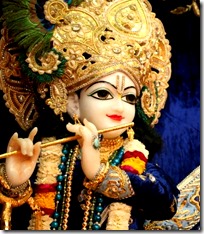 Since His strength and ability are beyond understanding, He can surely rescue everyone in the entire universe simultaneously. He can hear every prayer offered to Him in earnest, and He can arrive at any space, in the personal form, with an interest to intervene, through the sounds of His names:
 “We have no control over these threefold miseries. They are controlled by Krishna's maidservant, goddess Durga, who is material nature. She is not independent of Krishna. However, she is so powerful that she can create and maintain. Prakriti, nature, can be very unkind. Mother Durga is often portrayed as chastising demons by piercing them with a trident.” (Shrila Prabhupada, Teachings of Lord Kapila, Vs 8 Purport)
 Durga Devi is shakti, or the potency in the material world. That power is symbolically represented in her trident. Just one look at that trident is enough to inspire fear. Those who don’t know the purpose to the material creation and how it runs in cycles due to the desire of the living entity to continue to enjoy separate from God become afraid of Durga Devi and the power she wields. Better to just worship her and avoid her wrath.
 There is much more to be gained from this existence than temporary rewards. There is more progress to be made from the state of God-fearing. Instead of responding to the power of the gods, there is the bliss of surrender in knowing and feeling the unmatched love of the Supreme Lord. The representatives of Krishna reveal how to tap into that love and how to always keep it as time marches on.


 “All states of being - be they of goodness, passion or ignorance - are manifested by My energy. I am, in one sense, everything - but I am independent. I am not under the modes of this material nature.” (Lord Krishna, Bhagavad-gita, 7.12)
 The doctor lays you down on the examination table. He calls someone to check your blood pressure. He looks at your tongue; he takes your pulse. After a few minutes, he tells you that everything is fine. “Take this medicine on a timely basis. You got some virus in the stomach, but it should go away after a few days.” You’re obviously relieved. It appears that nothing major is wrong.
 Despite being the source of everything, He is not affected by that which He creates. If I have some intelligence in the area of computer programming, I can write an application that automatically trades stocks on the open market. I input a few parameters, and it knows when to buy and sell. If I make a small error in coding, however, that application can cause me great harm. Though it is outside of me, not part of my body, it still affects me.
 The virata-rupa consists of the material nature, which is made up of three modes: goodness, passion and ignorance. These modes govern body types, behavior, religious practice, determination, and even charity. They are all-encompassing. When we see someone do something really stupid, they are influenced by ignorance. When someone works really hard to enjoy their senses, they are in passion. When an individual takes a step back and acts with detachment, in the process increasing their knowledge of the difference between matter and spirit, they are in goodness.
 Still, He is friendly with those who render service to Him. Since He is unaffected by the modes of nature that He creates, He can grant the same ability to His servants. The most famous example is Shri